

More news on this day
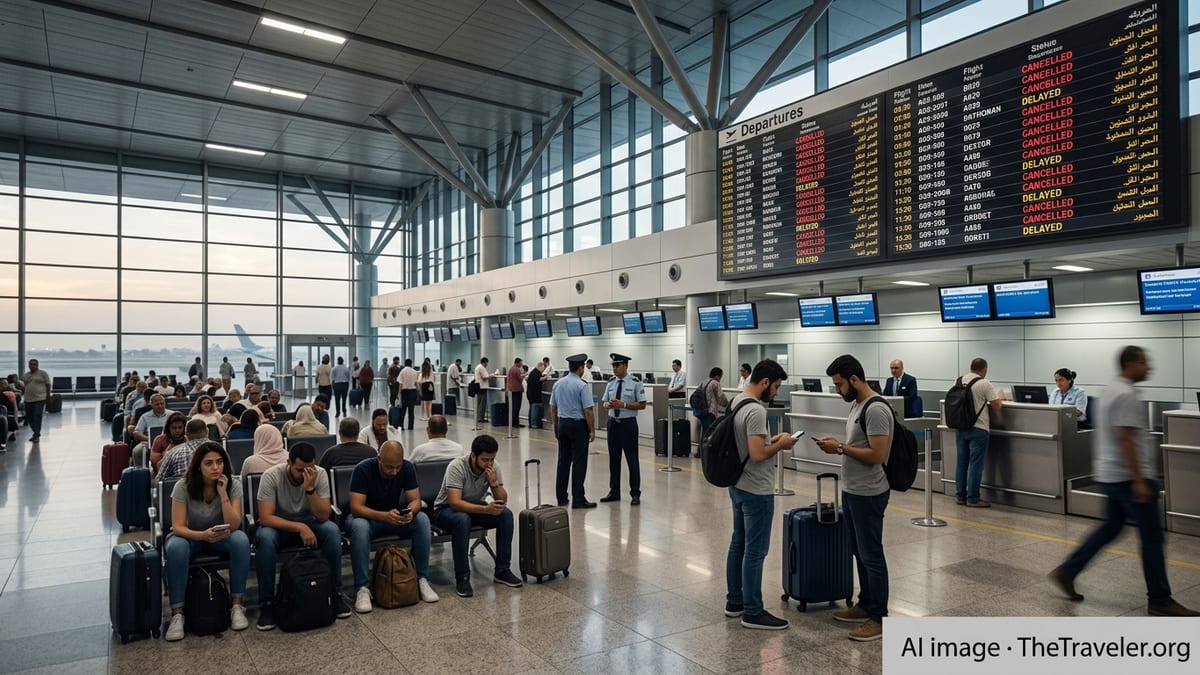
Travel plans for thousands of passengers passing through Cairo International Airport were disrupted today, as around 20 flights were reportedly cancelled and more than 100 delayed across services operated by EgyptAir, Qatar Airways, Gulf Air, Air Cairo and Emirates, affecting major routes to Doha, Kuwait City, Riyadh, Dubai and Abu Dhabi.
Get the latest news straight to your inbox!
Regional Airspace Turmoil Reaches Cairo
The disruption at Cairo International Airport comes against the backdrop of continued airspace restrictions and operational suspensions across several Gulf states, following recent escalation in the wider Middle East. Publicly available advisories and aviation tracking data show that closures and tight controls over airspace in Qatar, the United Arab Emirates, Kuwait and other countries have forced airlines to thin out schedules, reroute services and, in some cases, suspend operations on short notice.
Although Cairo’s own airspace remains open, its role as a key North African hub linking Europe, Africa and the Gulf means that any constraint on traffic into Doha, Dubai, Abu Dhabi, Riyadh and Kuwait City rapidly reverberates through its departure boards. Flight monitoring platforms indicate that a wave of cancellations and extended delays has clustered around services to and from these cities, particularly where aircraft or crews would otherwise transit closed or restricted air corridors.
The result has been a patchwork of partial operations, with some services running close to schedule while others are grounded entirely. Passengers connecting through Cairo to the Gulf have faced rolling disruptions as airline operation centers attempt to rebuild viable routings around constrained airspace and limited slots at reopened airports.
Key Carriers Scale Back Schedules
National carrier EgyptAir appears among the most heavily affected operators at Cairo International Airport, given its dense network into Gulf capitals. According to publicly available schedule data, a portion of its daily services to Doha, Kuwait City, Riyadh and Dubai were cancelled outright, while others experienced substantial departure delays as aircraft and crews were reassigned to routes still able to operate.
Qatar Airways, already contending with constrained operations at its Doha hub following Qatari airspace restrictions, has seen its Cairo services come under additional strain. Reports indicate that some Cairo–Doha rotations were withdrawn from sale or cancelled close to departure, reflecting the limited capacity permitted through emergency corridors and the prioritization of repatriation or essential travel on the flights that remain.
Gulf Air and Emirates, both reliant on now-fragile networks centered on Bahrain and Dubai, have also contributed to the disruption in Cairo. Published coverage of the ongoing situation describes how major Gulf airlines have reduced or temporarily suspended portions of their operations while airspace closures remain in force, and this has translated into last-minute changes on Cairo services, including several cancellations to Dubai and extended delays on flights connecting via Bahrain or the United Arab Emirates.
Regional carrier Air Cairo has not been immune, particularly on short- and medium-haul routes feeding Gulf hubs. Where partner or codeshare flights onward from Doha, Dubai or Abu Dhabi have been curtailed, Air Cairo has adjusted its own schedules accordingly, in some cases delaying departures from Cairo while alternative routings are explored, and in others cancelling flights where no viable onward connections remain.
Ripple Effects on Passengers and Connections
For travelers on the ground at Cairo International Airport, the operational picture has translated into long waits, missed connections and sudden itinerary changes. Airport information screens and online status tools have shown clusters of flights marked delayed or cancelled across multiple terminals, often with estimated departure times pushed back repeatedly as airlines reassess airspace availability and slot allocations.
Passengers booked on multi-leg journeys via Doha, Dubai, Abu Dhabi, Kuwait City or Riyadh have been among the hardest hit, particularly where onward flights rely on hubs that are operating limited schedules or remain subject to tight airspace controls. In many cases, even when the first leg from Cairo is able to depart, uncertainties around the second or third segment of an itinerary have prompted airlines to hold or cancel services altogether rather than strand travelers in transit.
Publicly available guidance from travel management companies and aviation bodies continues to urge passengers to verify their flight status as close to departure as possible and to allow additional time at the airport for rebooking. With operational decisions sometimes being taken only hours ahead of scheduled departure, same-day changes have become common, leaving affected travelers reliant on airline call centers, digital channels and airport service desks for up-to-the-minute information.
Operational Challenges for Airlines and Airport
Behind the scenes, the pattern of 20 cancellations and more than 100 delays in Cairo reflects the complexity of rebuilding flight schedules around a partially closed regional airspace. Airlines serving the Egyptian capital have had to evaluate each route against shifting factors, including which neighboring countries’ airspace is available, what overflight permits can be secured, and whether destination airports are accepting regular commercial traffic or only limited evacuation and cargo services.
According to industry analyses of the broader Middle East situation, carriers have reduced frequencies, consolidated passenger loads onto fewer flights and, where possible, rerouted aircraft via alternative corridors in Saudi or Omani airspace. For Cairo International Airport, this has translated into irregular peaks of arrivals and departures, as airlines bunch flights into windows when routings are available, followed by quieter periods when services are curtailed.
Ground operations at Cairo have also faced added pressure, as delayed inbound aircraft disrupt planned turnarounds and crew duty-time limits force further schedule adjustments. Handling teams, immigration services and ground transport providers have had to adapt quickly to changing arrival patterns, with some passengers arriving many hours later than expected or being accommodated overnight while they await new connections.
What Travelers Through Cairo Should Expect Next
Looking ahead, the outlook for travelers using Cairo International Airport to reach Doha, Kuwait City, Riyadh, Dubai, Abu Dhabi and other Gulf destinations remains uncertain and heavily dependent on the pace at which regional airspace restrictions are eased. Industry bulletins suggest that any normalization is likely to be gradual, with airlines restoring capacity in phases and prioritizing key trunk routes and repatriation needs before secondary frequencies are added back.
Passengers with upcoming journeys via Cairo are being encouraged in public advisories to remain flexible, monitor airline communications frequently and consider alternative routings where possible, such as itineraries that avoid the most affected airspace. For those already holding tickets on EgyptAir, Qatar Airways, Gulf Air, Air Cairo or Emirates services, airline policy updates indicate that options may include rebooking on later dates, rerouting via less affected hubs, or in some cases requesting refunds, depending on fare rules and the extent of disruption.
Until a clearer timeline emerges for the full reopening of key Gulf air corridors and the stabilization of hub operations, Cairo is expected to continue experiencing an elevated level of schedule volatility. For one of Africa’s busiest gateways, the current wave of cancellations and delays underscores how quickly events centered hundreds of kilometers away can reshape travel patterns for passengers across multiple continents.