

More news on this day
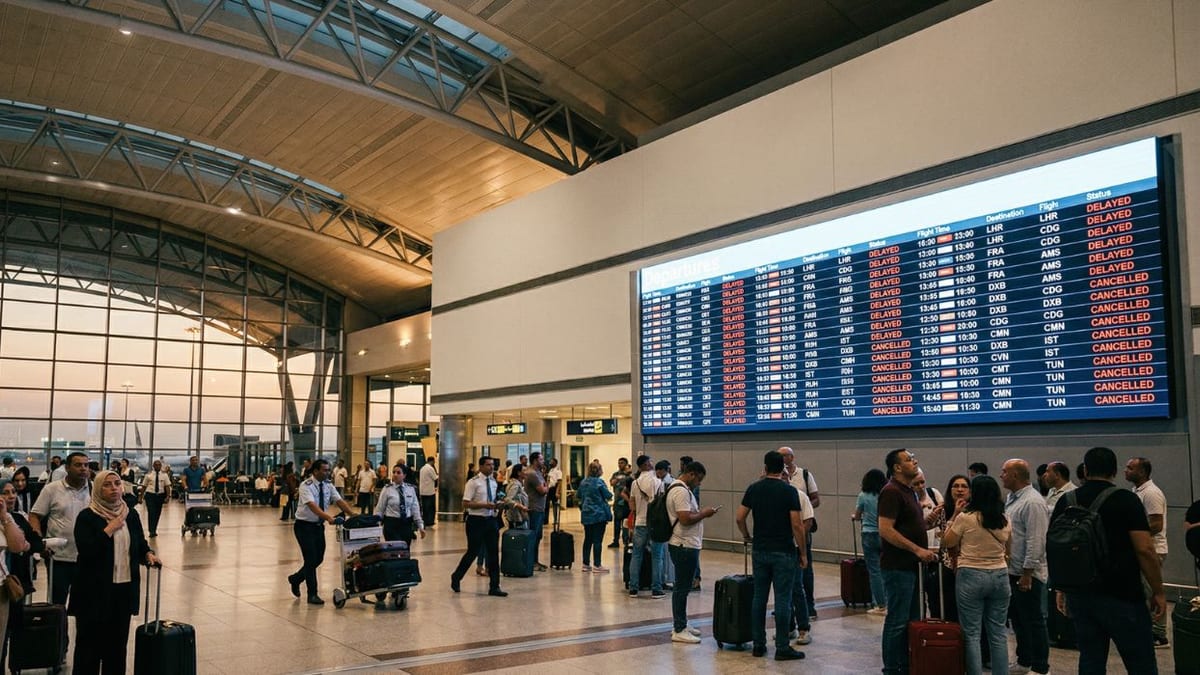
Widespread disruption hit Cairo International Airport on April 11, 2026, as more than 100 delayed departures and arrivals rippled across key routes linking Europe, the Middle East, and North Africa, stranding thousands of passengers and compounding an already fragile regional air travel picture.
Get the latest news straight to your inbox!
Operational Bottlenecks Converge on a High-Traffic Hub
Preliminary data from flight-tracking services and published aviation dashboards indicate that Cairo International Airport experienced an unusually high concentration of delayed services on April 11, with well over 100 flights departing or arriving behind schedule throughout the day. The disruption primarily affected medium and long-haul services connecting Cairo with major European cities, Gulf hubs, and North African capitals.
Analysts note that Cairo has assumed an outsized role in recent weeks as airlines adjust routings around restricted or volatile airspace elsewhere in the region. Publicly available scheduling information shows that additional frequencies into Cairo from Europe, as well as added connections to sub-Saharan Africa, have increased pressure on runway, gate, and ground-handling capacity. On April 11, that pressure appears to have reached a breaking point, with minor delays in the morning building into significant late departures and missed connections by evening.
The pattern of disruption suggests a cascading effect rather than a single, easily identifiable trigger. Airlines operating through Cairo had already been coping with longer flight times, revised routings, and constrained crew duty windows since broader Middle East airspace restrictions intensified in late February and early March. By April 11, this operational strain appears to have combined with local congestion and turnaround challenges to create a sustained backlog.
While Egypt’s airspace has generally remained open during the wider regional turbulence, aviation advisories over recent weeks have highlighted Cairo as a critical diversion and connection point. That role, which has helped keep many routes viable, has also magnified the impact when irregular operations occur inside the airport itself.
Europe, Gulf, and North Africa Routes Hit Hardest
Publicly available flight-status data from April 11 show that the worst-affected services were those bridging Cairo with Western and Central Europe, along with busy corridors linking the Egyptian capital to the Gulf and key North African markets. Delays on morning departures to cities such as London, Paris, Frankfurt, and Rome led to late evening arrivals, disrupting subsequent rotations and pushing crew closer to maximum duty limits.
Similar patterns were visible on Cairo’s links to Gulf hubs serving the wider Middle East and South Asia. Extended routings around restricted airspace have lengthened block times on services to destinations such as Dubai, Doha, Riyadh, and Jeddah. When compounded by late aircraft arrivals into Cairo, these longer sectors on April 11 led to knock-on delays, gate conflicts, and occasional aircraft swaps, which further slowed boarding and departure processes.
North African connectivity also suffered as Cairo-based carriers and regional airlines juggled delayed arrivals from Europe and the Gulf with scheduled departures to cities including Casablanca, Tunis, Algiers, and Khartoum. In several cases, aircraft that were planned to operate multi-leg rotations across the day arrived late into Cairo from Europe, forcing operators either to compress turnaround times or accept additional delays on subsequent legs.
Industry observers point out that this interconnected network design, which is central to Cairo’s role as a transfer hub between continents, can quickly amplify disruption. When one bank of inbound flights arrives significantly behind schedule, departure waves across multiple regions are affected, leaving passengers facing missed connections and extended layovers even if their own flight eventually operates.
Wider Regional Turbulence Sets the Stage
The April 11 chaos in Cairo did not occur in isolation. For several weeks, air travel across the broader Middle East and North Africa has been unsettled by intermittent airspace closures, missile and drone activity, and heightened security postures around key hubs. Travel advisories issued in March highlighted widespread route changes, extended flight times, and substantial cancellations at airports in the Gulf region, prompting airlines to reconfigure networks at short notice.
Publicly available risk assessments describe a patchwork of restricted corridors and sudden operational suspensions at major airports in the United Arab Emirates, Qatar, and neighboring states. As some carriers diverted traffic away from heavily impacted hubs, Egypt’s relatively stable airspace and Cairo’s established infrastructure made the airport an attractive alternative for rerouting and emergency diversions.
This shift has had significant knock-on effects. Airlines that once favored direct routings via Gulf hubs increasingly scheduled connections through Cairo, while others used the airport as a fallback when regional conditions deteriorated. Observers note that this influx of additional traffic added complexity to Cairo’s daily operations even before April 11, stretching resources from air traffic control and ramp operations to baggage handling and security screening.
On April 11, those accumulated pressures appear to have collided with already tight timetables and constrained staffing windows, resulting in delays that were more widespread and prolonged than on preceding days. As long as regional airspace volatility persists, specialists caution that Cairo and other relatively unaffected airports will remain vulnerable to similar episodes of acute congestion.
Passenger Experience: Missed Connections and Long Queues
Accounts shared on social platforms and travel forums on April 11 describe crowded departure halls, long queues at transfer desks, and confusion over revised departure times at Cairo International Airport. Many travelers transiting between Europe and destinations across the Middle East and North Africa reported missed onward flights, with some facing unplanned overnight stays or lengthy rebooking processes.
Information posted by passengers suggests that flight-status boards and airline apps were frequently updated throughout the day, reflecting rolling delays rather than outright cancellations in many cases. While this allowed some services to operate eventually, the uncertainty made it difficult for travelers to make informed decisions about connections, hotel arrangements, and ground transport at their final destinations.
Travel advisories circulated in recent weeks had already urged passengers flying through the region to build extra time into itineraries and to monitor flight status closely before heading to the airport. The April 11 disruption in Cairo underscored that guidance, particularly for those attempting tight connections between long-haul and regional services.
Consumer-rights advocates note that passengers traveling to or from the European Union on eligible carriers may have recourse to compensation or assistance under existing air passenger protection frameworks when delays reach certain thresholds. However, the complex mix of non-European airlines, codeshare arrangements, and extraordinary regional circumstances means that entitlements can vary widely from case to case and may require detailed documentation of the disruption.
Outlook for Travelers and the Summer Season
Looking ahead, aviation analysts warn that the April 11 episode at Cairo International Airport may foreshadow a challenging summer for travelers using routes that intersect with the Middle East and North Africa. Seasonal demand from tourists, expatriate workers, and religious pilgrims typically drives a sharp increase in traffic from late spring onward, leaving less slack in schedules to absorb irregular operations.
Airlines serving Cairo are expected to continue refining timetables and routings as they respond to evolving airspace conditions elsewhere in the region. Public schedules and booking engines already show a mix of modest frequency reductions on some routes and upgauged aircraft on others, as carriers attempt to consolidate capacity and reduce exposure to cascading delays.
Travel experts recommend that passengers planning trips via Cairo or neighboring hubs in the coming weeks build generous connection windows, especially when itineraries involve separate tickets or multiple airlines. Booking flexible fares, maintaining up-to-date contact information with airlines, and tracking flights in real time can help mitigate some of the uncertainty highlighted by the April 11 disruption.
For now, Cairo remains a vital connector between Europe, the Middle East, and Africa, even as it grapples with the strain of regional instability and surging demand. The events of April 11 have reinforced both its strategic importance and its vulnerability, providing a stark reminder of how quickly operational stress at a single hub can reverberate across three continents.