

More news on this day
Passengers transiting Cairo International Airport are facing mounting disruption as a fresh wave of delays and cancellations affects flights operated by EgyptAir, Emirates, Iraqi Airways, Gulf Air and other regional carriers, with 179 services reportedly delayed and 29 cancelled on key routes linking Egypt to the United Arab Emirates, Bahrain, Qatar, Kuwait and additional Gulf destinations.
Get the latest news straight to your inbox!
Regional Airspace Closures Ripple Into Cairo
Recent airspace restrictions and heightened security conditions across multiple Middle Eastern states have triggered broad schedule upheaval for carriers using Cairo as a key north Africa hub. Publicly available operational advisories describe continuing closures or severe limitations in the skies over the United Arab Emirates, Bahrain, Qatar, Kuwait, Iraq and neighboring states, forcing airlines to trim or reconfigure services.
The latest disruption in Cairo is being framed by industry observers as another escalation in a regional aviation crisis that began intensifying in late February 2026. Travel management advisories issued in early March pointed to widespread suspensions of flights to and from Dubai, Abu Dhabi and Doha, with knock-on effects for connecting points such as Cairo that feed traffic into Gulf super-hubs.
As those restrictions persist, Cairo has shifted from being an alternate gateway around Gulf closures to a pressure point of its own. With 179 delayed flights and 29 cancellations reported in the current wave of disruption, travelers connecting through the Egyptian capital on Gulf-bound itineraries are experiencing extended airport waits, missed onward connections and last-minute rebooking challenges.
EgyptAir, Emirates, Iraqi Airways and Gulf Air Under Strain
EgyptAir, the national carrier based in Cairo, is among the airlines most exposed to the turmoil. Publicly accessible scheduling data and passenger reports indicate that services linking Cairo to major Gulf hubs are being systematically delayed as the airline navigates rerouted flight paths, crew time limitations and rapidly changing slot allocations at regional airports.
Emirates, which ordinarily uses Cairo as a significant feeder market for its Dubai hub, is contending with the dual challenge of suspended or reduced operations at its home base and irregular traffic flows from North Africa. Reports from travelers and airline communications over recent weeks point to repeated timetable revisions, with Cairo Dubai services frequently pushed back, combined or, in some cases, cancelled outright when airspace bottlenecks tighten.
Iraqi Airways and Gulf Air, both already heavily constrained by airspace and hub closures closer to home, are also contributing to the disruption picture at Cairo. Schedules connecting Egypt to Baghdad, Basra and Bahrain have been especially volatile, with some rotations removed from timetables at short notice and others operating with extended block times as flights detour south around restricted zones.
Other regional and international carriers operating via Cairo are affected to varying degrees. While some airlines have opted to temporarily suspend select routes into Gulf states, others are attempting to maintain skeleton services, accepting widespread delays as the cost of keeping limited connectivity alive for stranded passengers.
Routes to UAE, Bahrain, Qatar and Kuwait Hardest Hit
Routes from Cairo into the United Arab Emirates, Bahrain, Qatar and Kuwait are bearing the brunt of the latest operational shock. Travel advisories and airport departure boards show particularly heavy disruption on flights to Dubai and Abu Dhabi, which normally function as primary long haul gateways for passengers from Egypt heading to Asia, Australia and parts of Europe.
With Dubai International Airport and other UAE facilities operating under constrained conditions, airlines are recalibrating how many Cairo originating flights can realistically be accommodated in any given window. This has led to rolling delays throughout the day, as aircraft depart only when suitable routings and arrival slots become available, leaving passengers facing uncertain departure times even after check in.
Services from Cairo to Doha and Bahrain are similarly unstable. Limited access to Qatari and Bahraini airspace, along with ongoing adjustments to regional traffic corridors, has translated into a pattern of tactical cancellations and consolidated services. Flights that do operate are often routed further south, adding flight time and compounding crew scheduling pressures that can cascade into subsequent departures from Cairo.
Kuwait bound routes, while sometimes benefiting from alternative corridors via Saudi or Egyptian airspace, are still experiencing elevated disruption levels. Longer routings, congestion on remaining open airways and operational caution have all contributed to delays, with some departures from Cairo pushed back repeatedly over a single operating day.
Stranded Passengers Navigate Long Queues and Limited Options
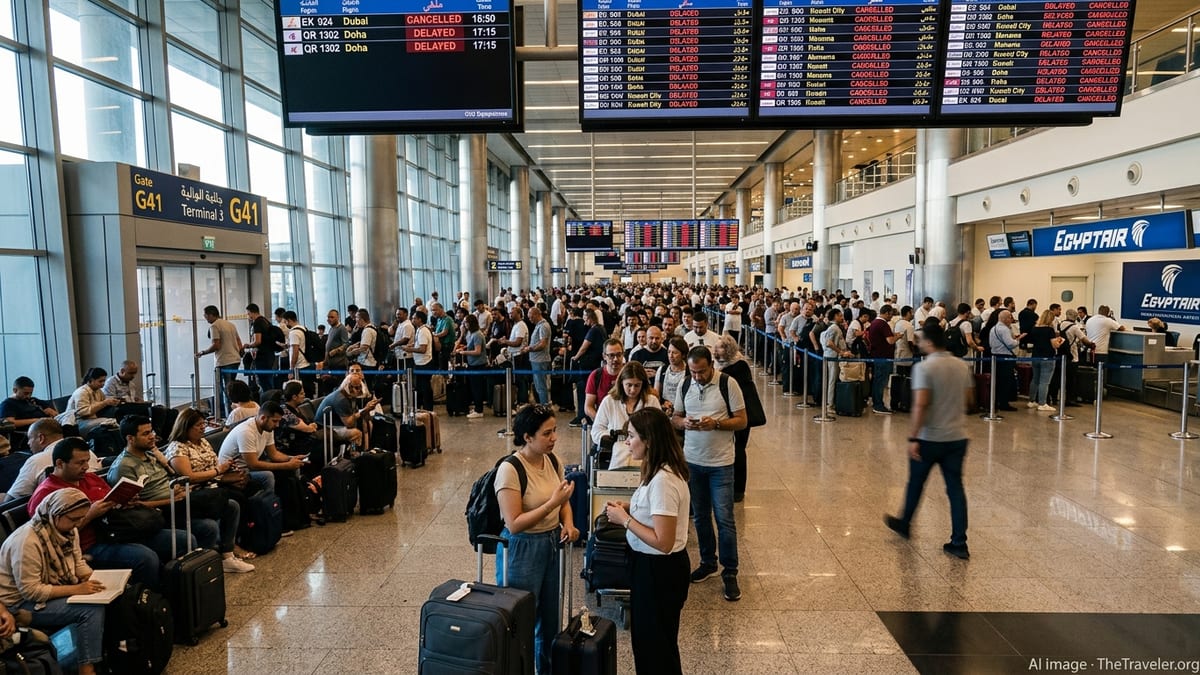
For passengers on the ground at Cairo International Airport, the statistics around 179 delays and 29 cancellations are translating into crowded terminals and extended waits at service counters. Images and accounts shared publicly from the airport in recent days describe long lines for check in, security and customer service, as travelers attempt to rebook disrupted itineraries or seek clarity on revised departure times.
The combination of constrained capacity across Gulf hubs and limited spare seats on alternative routings means that rebooking options are often scarce. Travelers whose plans depend on onward connections from Dubai, Doha, Manama or Kuwait City are especially vulnerable, as a missed Cairo leg can render a multi segment itinerary unworkable. Many are being re-accommodated on later dates or on complex routings that detour via European or African gateways when available.
Airport infrastructure in Cairo is also under strain. Holding large numbers of delayed passengers for extended periods requires additional seating, crowd management and coordination with ground handlers. In some terminals, information screens are being updated frequently as airlines adjust departure estimates, leaving passengers reliant on both digital status boards and periodic public announcements to track their flights.
Travel industry commentators note that the current situation is particularly challenging for families, elderly travelers and those with tight visa or work permit timelines in destination countries. Extended layovers and last minute overnight stays can trigger additional accommodation, transport and documentation costs that many passengers did not anticipate when they booked their trips.
What Travelers Using Cairo Should Expect in the Coming Days
Forward looking assessments from travel management companies and aviation analysts suggest that disruption across Middle Eastern air corridors is likely to persist in the near term, keeping pressure on Cairo as a regional connection point. As long as airspace over key Gulf states remains restricted or partially closed, airlines are expected to operate with conservative schedules that favor safety and regulatory compliance over punctuality.
Passengers planning to travel through Cairo on itineraries touching the UAE, Bahrain, Qatar, Kuwait or other Gulf states are being advised, in publicly available guidance, to monitor flight status closely, build in additional buffer time for connections and be prepared for abrupt changes. Same day rebooking at the airport is becoming increasingly difficult as load factors rise on the limited number of flights that do depart on schedule.
Industry observers also anticipate that airlines may continue to refine their approaches as the situation evolves. This could include the introduction of more dedicated repatriation style services, the consolidation of low demand frequencies into fewer, higher capacity flights and the ongoing use of alternative routings through Saudi and Egyptian airspace where possible.
For now, the combination of 179 delays and 29 cancellations emerging from Cairo serves as a snapshot of a wider regional aviation upheaval. Travelers with upcoming trips through the Egyptian capital are being cautioned by public advisories and travel providers to remain flexible, stay informed and factor significant uncertainty into any plans involving Gulf destinations.