

More news on this day
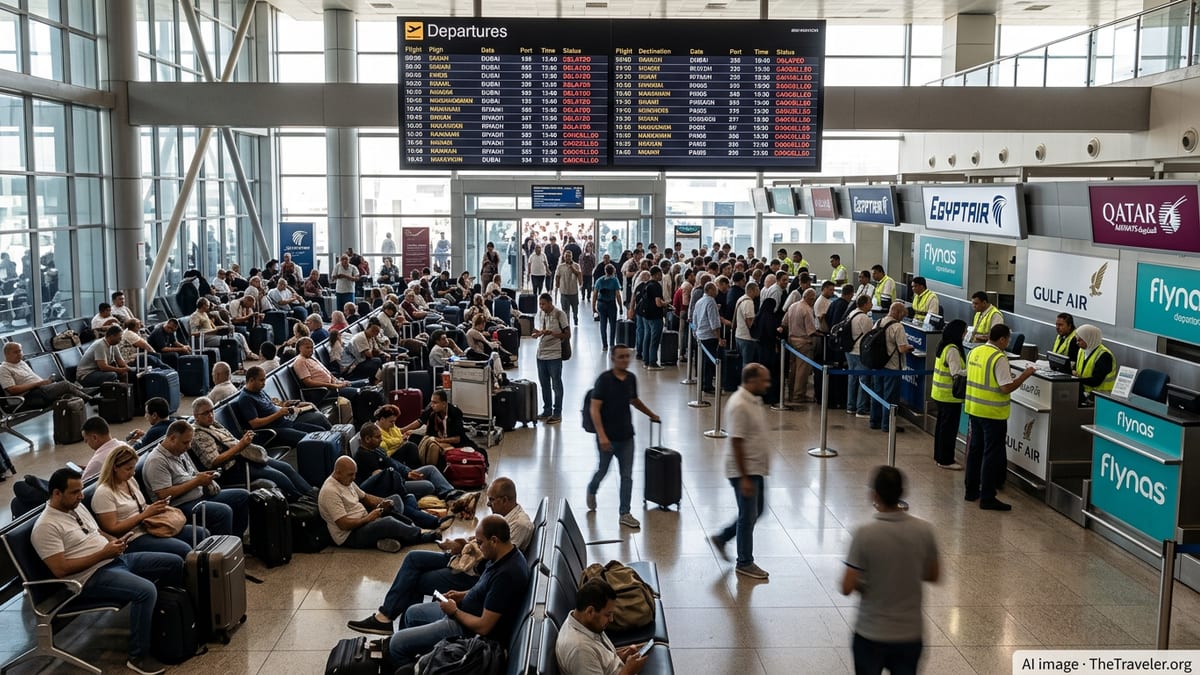
Passengers at Cairo International Airport faced mounting frustration today as EgyptAir, Qatar Airways, Gulf Air, and Flynas recorded 62 delayed departures and 49 flight cancellations, snarling regional and long-haul connections to Dubai, Riyadh, Paris, and other key cities.
Regional Tensions Ripple Through Cairo’s Skies
The fresh wave of disruptions in Cairo comes amid a broader aviation crisis across the Middle East, where shifting airspace closures and rerouting around conflict zones have upended airline schedules. Egyptian authorities have kept the country’s airspace open, but flights linking Cairo with Gulf and European hubs are being repeatedly adjusted, consolidated, or halted at short notice as carriers respond to fast-changing risk assessments.
Operational data reviewed by travel rights groups and airport monitoring platforms on 8 and 9 March indicate that Cairo International Airport has become a pressure point in this unfolding disruption. With multiple Gulf and Levant air corridors constrained, Cairo is acting both as a gateway and a bottleneck, particularly for passengers attempting to reach or transit through Dubai, Abu Dhabi, Doha, and Riyadh.
EgyptAir, the national carrier, has been operating in what its Integrated Operations Control Center describes as emergency mode in recent days, while Qatar Airways, Gulf Air, and Flynas have also been reshuffling their Cairo services. For passengers, the result is a patchwork of last-minute schedule changes and rolling delays that can stretch for several hours.
While airlines stress that safety remains the overriding priority, the scale and speed of the disruption have caught many travelers off guard, with limited advance warning before departure times and crowded customer-service desks struggling to keep up with rebooking requests.
Key Routes to Dubai, Riyadh, and Paris Among the Worst Hit
The bulk of the latest 62 delays and 49 cancellations has been concentrated on Cairo’s high-demand links to Gulf hubs, with multiple EgyptAir and Flynas departures to Dubai, Sharjah, Dammam, and Riyadh either grounded or pushed back. Qatar Airways services connecting Cairo with Doha for onward connections to Asia and Europe have also seen irregular operations, tightening the squeeze on travelers with tight transfer windows.
Gulf Air’s Cairo flights, which typically funnel passengers to Bahrain and onward to destinations in South and Southeast Asia, have similarly been affected. Some departures have been held at the gate awaiting revised routing clearances, while others were canceled outright, forcing passengers to seek alternative connections days later.
Long-haul links have not been spared. Selected EgyptAir services between Cairo and European capitals, including Paris and London, have suffered knock-on delays as aircraft and crews rotate late from disrupted Gulf and Levant rotations. In several cases, aircraft scheduled to operate to Paris were reassigned to relief flights on heavily backlogged Dubai and Riyadh routes, prompting timetable changes for European-bound passengers.
Industry analysts say this pattern is likely to continue in the short term, with carriers prioritizing routes where large numbers of stranded travelers can be repatriated or moved onward, even if it means reshuffling capacity away from normally stable European and African services.
Airlines Activate Emergency Schedules and Gradual Restarts
In response to the mounting disruption, airlines operating in and out of Cairo have rolled out a mix of emergency schedules and phased restarts. EgyptAir has announced a gradual resumption of certain United Arab Emirates routes, including Dubai and Sharjah, on a reduced-frequency basis, while keeping suspensions in place on other Gulf and Levant destinations until regional security assessments improve.
Qatar Airways has adjusted its Cairo timetable to reflect constrained capacity through Doha, focusing on flights with the highest load factors and transferring some passengers to alternative departure days. Gulf Air and Flynas are likewise thinning their flight programs, sometimes merging lightly booked services and placing affected travelers on consolidated departures later in the day.
Despite these measures, the disruption figures logged at Cairo indicate that the recovery is fragile. A single airspace update or operational hold at a major hub such as Dubai or Doha can trigger a cascade of missed connections and aircraft rotations that quickly propagate back to Cairo. Airline operations teams are therefore revising schedules almost hour by hour, leaving printed timetables and even same-day itineraries only loosely predictive.
Transport officials in Egypt have urged passengers not to head to the airport without checking their flight status directly with airlines or through official airport information channels. They note that some relief flights are operating with little advance public notice, targeted at clearing backlogs of travelers whose original services were canceled earlier in the week.
Passengers Face Long Queues, Patchy Information, and Limited Options
Inside Cairo International Airport’s terminals, the human impact of the disruption has been visible in long queues at airline counters, overcrowded seating areas, and clusters of travelers glued to departure boards. Families attempting to connect from Cairo to Gulf cities for onward journeys to South Asia have been especially hard hit, with some reporting overnight waits for rebooking and limited availability on the next several days of flights.
Passengers on delayed EgyptAir, Qatar Airways, Gulf Air, and Flynas services described a patchwork of communication standards. Some received early-morning text alerts or app notifications advising of schedule changes, while others only learned of cancellations upon arrival at the check-in area. Airport staff, facing a constant stream of queries, have struggled to provide firm alternative travel times as schedules remain in flux.
Accommodation and meal support have also varied by carrier and ticket type. While some travelers were provided hotel vouchers or meal coupons after lengthy delays, others said they were instructed to await further updates in the terminal without clear timelines. Consumer advocates have urged travelers to retain all receipts for food, transport, and any self-arranged lodging to support later compensation claims where applicable.
Travel law specialists note that passenger protection rules differ depending on the point of origin, airline, and jurisdiction. Flights departing the European Union or operated by EU carriers may be covered by more robust compensation frameworks than purely regional services, even when all legs touch Cairo. They advise travelers to document communications with airlines in writing whenever possible.
What Travelers Should Do Now if Flying via Cairo
With disruption levels remaining high, seasoned travel planners recommend that anyone scheduled to fly to or through Cairo in the coming days adopt a defensive strategy. That includes monitoring flight status multiple times before departure, ensuring contact details in airline bookings are up to date, and allowing extra time at the airport in case of security or check-in bottlenecks.
Passengers with critical time-sensitive trips to Dubai, Riyadh, or European hubs such as Paris are being advised to proactively contact their airline or travel agent to explore alternative routings. In some cases, rerouting via less congested regional hubs or adjusting travel dates by a day or two may significantly reduce the risk of becoming stranded mid-journey.
Travel insurers have reported a spike in inquiries from customers affected by the cancellations and delays. Policyholders are being reminded to check whether their coverage includes disruption caused by airspace closures or regional security incidents, as some basic policies exclude such events. Where covered, insurers may reimburse additional accommodation, meals, and rebooking costs, subject to documentation.
Although airlines and regulators expect a gradual normalization of schedules once airspace restrictions ease, the experience of the last several days suggests that Cairo’s role at the crossroads of Middle East and Europe traffic will continue to make it particularly vulnerable to regional shocks. For now, flexibility, vigilance, and a willingness to adjust plans remain essential for anyone traveling through the Egyptian capital.