

More news on this day
Cairo International Airport is grappling with a fresh wave of disruption after EgyptAir, Gulf Air and Qatar Airways canceled 37 flights and imposed rolling delays on Friday, snarling passenger traffic across major Middle Eastern hubs and leaving thousands of travelers facing missed connections and overnight stays.
Get the latest news straight to your inbox!
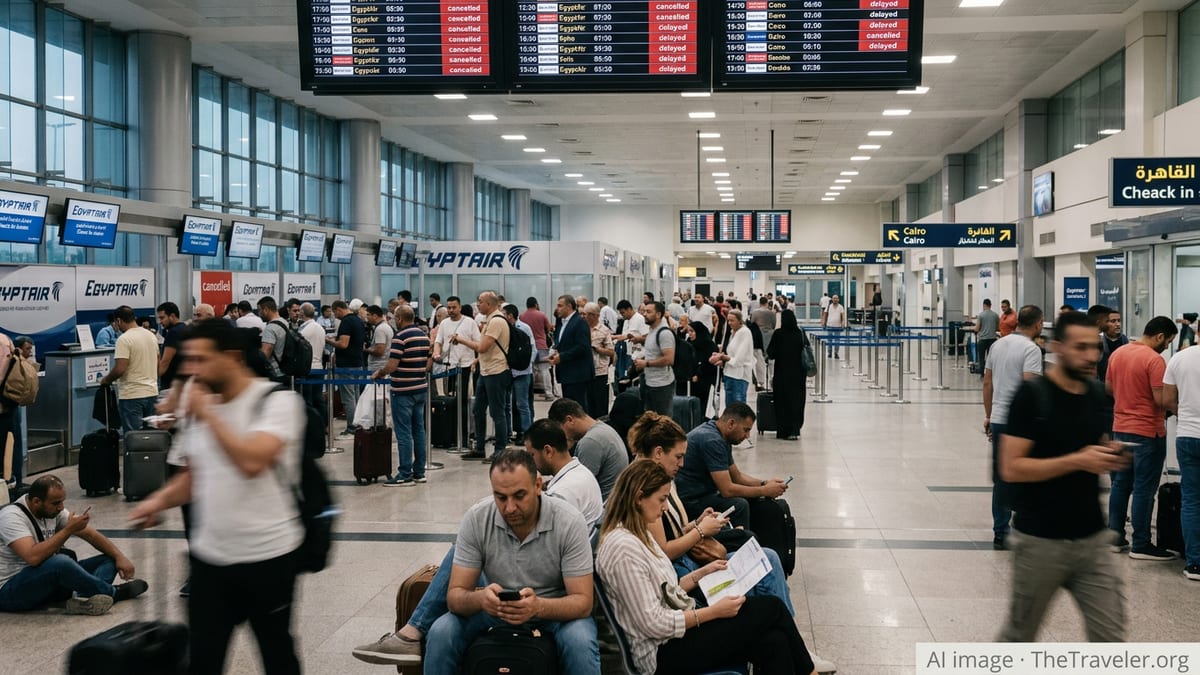
Wave of Cancellations Hits Cairo and Key Regional Hubs
Airport officials in Cairo said a total of 37 flights operated by EgyptAir, Gulf Air and Qatar Airways were withdrawn from Friday’s schedule, primarily affecting services linking the Egyptian capital with Doha, Beirut, Amman, Kuwait City and Bahrain, along with several onward connections to Europe and Asia. The cancellations, clustered around peak morning and late evening departure banks, quickly triggered congestion at check in counters and transit desks as passengers scrambled for alternatives.
The disruption comes amid broader operational instability across Middle East airspace, where periodic restrictions and rerouting requirements have tightened capacity at some of the region’s busiest hubs. Aviation sources said airlines were forced to consolidate lightly booked itineraries, build in longer block times and leave additional turnaround buffers, a combination that pushed some rotations beyond crew duty limits and made selective cancellations unavoidable.
At Cairo International Airport, ground staff reported heavier than usual crowds in departure halls as information screens cycled through updates and boarding times slipped. While Egyptian airspace remained open and most domestic services operated as scheduled, international travelers relying on one stop connections via Doha, Bahrain and Kuwait faced particular uncertainty as their onward flights were either delayed, retimed or removed from the board.
Impact on Doha, Beirut, Amman, Kuwait City and Bahrain
Hamad International Airport in Doha, typically one of the region’s most resilient transfer hubs, saw a new round of schedule adjustments as Qatar Airways trimmed frequencies and retimed select services to match available airspace corridors and crew resources. Passengers arriving from Cairo reported extended layovers and, in some cases, unplanned overnight stays while they waited for seats on relief flights with limited capacity.
In Beirut and Amman, where EgyptAir and Gulf Air both operate key regional links, airport authorities said arrivals and departures were broadly functioning but warned that irregular operations into Cairo and Gulf hubs were complicating connection banks. Travelers accustomed to tight transfer windows found themselves rebooked on later departures, with some itineraries pushed back by 12 to 24 hours as airlines prioritized passengers with imminent onward long haul journeys.
Kuwait City and Bahrain were among the hardest hit by cascading changes. Temporary airspace constraints and earlier suspensions in the Gulf have already reduced the number of daily frequencies, leaving little slack in schedules. As Gulf Air and other regional carriers pulled rotations involving Cairo, airports reported pockets of crowding around transfer desks and raised the prospect of additional short notice cancellations should crew or aircraft positioning fall further out of sync.
Airlines Juggle Safety, Capacity and Passenger Pressure
EgyptAir, Gulf Air and Qatar Airways all framed the Cairo related cancellations as part of a wider effort to maintain safety margins while operating in a constrained regional environment. Airline insiders said the carriers are facing a difficult balance, striving to preserve core trunk routes while managing crew duty limits, maintenance windows and the extra flying time required by detours around restricted airspace.
Qatar Airways has already been running a reduced network with limited relief and repatriation flights out of Doha, placing intense pressure on remaining services through the Gulf. With many aircraft committed to long haul missions that cannot easily be rescheduled, the airline has increasingly opted to cut shorter regional sectors such as Cairo, Beirut or Amman when last minute operational challenges arise, rather than risk knock on disruptions across its intercontinental network.
Gulf Air and EgyptAir face similar constraints, albeit on a smaller scale. Both have relied on consolidating passenger loads onto fewer departures and using codeshare partners where possible, but aviation analysts note that spare capacity across Middle Eastern carriers is now so tight that rerouting options are limited. This leaves airlines more frequently resorting to compensation, hotel accommodation and refund offers to manage customer expectations in the face of service cuts.
Travellers Endure Long Queues, Missed Connections and Uncertain Timelines
For passengers on the ground, the operational logic offers little comfort. At Cairo International Airport, travelers described lines snaking through check in halls and security lanes as early morning cancellations rippled through the day’s schedule. Airline staff fielded repeated questions about when normal service might resume, but with flight plans under constant review many could offer only provisional timings and standby lists.
Families returning to the Gulf after school holidays in Egypt reported being split across multiple flights departing hours apart, while business travelers bound for Europe and Asia via Doha or Bahrain rushed to secure seats on the few remaining connections. Travel agents in Cairo said they were scrambling to rebook clients on alternative routings through Istanbul, Riyadh and Jeddah, though higher fares and limited availability meant not everyone could be accommodated.
Similar scenes played out at hubs across the region, where airport authorities moved to prevent overcrowding by limiting terminal access to ticketed passengers and those with confirmed, operating flights. Information desks urged travelers to rely on airline apps and direct notifications rather than outdated printouts or third party booking confirmations, which in some cases still listed flights that had already been pulled from schedules.
What Passengers Should Expect in the Coming Days
Aviation analysts expect Cairo and surrounding Gulf and Levant hubs to remain in a period of heightened volatility in the short term, with schedules likely to change at shorter notice than travelers are used to. While Egyptian airspace remains open and some Gulf restrictions have been partially eased, airlines are continuing to build conservative timetables and keep additional aircraft and crew in reserve to absorb further shocks.
Passengers booked to travel through Cairo, Doha, Beirut, Amman, Kuwait City or Bahrain over the next week are being advised to monitor their reservations closely, confirm flight status several hours before departure and arrive at the airport earlier than usual to allow for longer queues at check in, security and transfer desks. Those with time sensitive itineraries, such as cruise departures or major events, are being encouraged by agents to consider flexible tickets or routings that offer backup options if their primary connection fails.
Industry observers note that the current disruption underscores how concentrated global air travel has become around a handful of Middle Eastern super hubs. With airlines, airports and regulators now working to stabilize operations, travelers may see a gradual return of frequencies and the restoration of familiar schedules. Until then, however, Cairo’s latest setback and its ripple effects across Doha, Beirut, Amman, Kuwait City and Bahrain are likely to remain a defining feature of flying through the region.