

More news on this day
Hundreds of passengers were stranded at Cairo International Airport today after a fresh wave of disruptions forced airlines including EgyptAir, Qatar Airways, Gulf Air, Jazeera Airways, Emirates, Saudia, Air Arabia and Flynas to cancel 53 flights and delay a further 76, snarling connections across the Middle East’s busiest routes.
Ripple Effects Across Doha, Dubai and Regional Hubs
The disruption at Cairo quickly rippled across the region, with delayed and cancelled departures affecting onward connections to Doha, Dubai, Beirut, Kuwait City, Riyadh and other major hubs. Many of the affected flights were part of complex multi-leg itineraries linking Europe, Africa and Asia via Gulf gateways, compounding the difficulty of rebooking stranded travelers.
Qatar Airways and Emirates, which both rely heavily on Cairo for feeder traffic into their long-haul networks, reported mounting operational pressures as missed connections forced them to juggle limited spare seats on already constrained schedules. Regional carriers such as Gulf Air, Jazeera Airways, Saudia, Air Arabia and Flynas also faced cascading knock-on delays as aircraft and crews were left out of position.
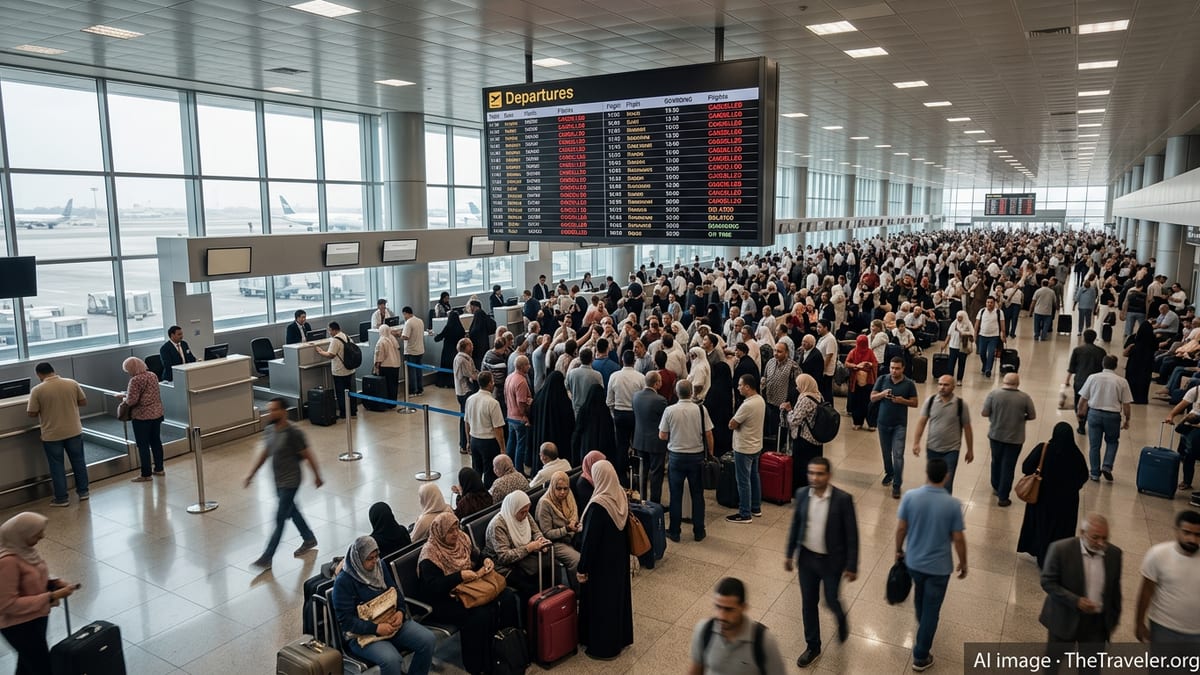
Airport staff said departure boards at Cairo showed clusters of flights to Doha, Dubai and other Gulf cities either cancelled or repeatedly retimed, leaving passengers queuing at service desks for hours in search of alternatives. With many nearby hubs themselves operating reduced timetables, viable replacement options were often scarce.
Airspace Restrictions Keep Timetables Fragile
The latest wave of cancellations comes as Middle East aviation continues to struggle with ongoing airspace closures and restrictions linked to recent regional tensions. Reroutings around no-fly zones have added time and complexity to many services, leaving schedules far less resilient when weather, technical issues or congestion strike.
Airline analysts note that carriers such as EgyptAir, Emirates and Qatar Airways are still operating with thinner buffers in their networks, meaning a disruption at one key hub can quickly spread across multiple airports. Cairo’s role as a bridge between North Africa, the Gulf and Europe makes it particularly vulnerable to these regional shocks.
In recent days, several Gulf and Levant destinations have already seen services adjusted or suspended from Cairo as airlines juggle aircraft availability and changing safety assessments. The result is a patchwork of timetables that can change at short notice, catching travelers off guard even when flights appear confirmed at the time of booking.
Stranded Passengers Face Long Queues and Uncertain Plans
Inside Cairo’s terminals, scenes of frustration played out as families, business travelers and transit passengers joined long lines at airline counters to seek clarity on their journeys. Many reported receiving late notifications of cancellations, arriving to find their flights scrubbed and hotel and meeting plans in Doha, Dubai or Riyadh thrown into disarray.
Some passengers were offered same-day rebooking via alternative hubs, but with dozens of flights already full, others were told they might have to wait one or two days for confirmed seats. Those on separate connecting tickets were particularly exposed, risking the loss of onward segments they could no longer reach on time.
With accommodation in Cairo near the airport filling quickly, airlines worked with handling agents to arrange meal vouchers and overnight stays for eligible travelers. However, several stranded passengers described confusion over who qualified for assistance and how long support would last if the disruption continued into the week.
Airlines Under Pressure to Restore Confidence
The latest disruption adds to the strain on airline call centers and digital channels, which have been inundated for days by passengers seeking updates and alternative routing. EgyptAir, Qatar Airways, Emirates, Saudia and other carriers urged customers to monitor their bookings through official apps and to avoid travelling to the airport unless their flights were shown as operating.
Industry observers say the episode underscores how fragile regional connectivity remains while airspace conditions are unstable. Even as some carriers gradually rebuild schedules, operational reliability has yet to return to pre-crisis levels, with last-minute changes still common on routes touching the Gulf and Levant.
Travel agents in Cairo reported a rise in demand for more flexible tickets and routes that avoid key bottlenecks, even when that means paying higher fares or accepting longer journeys. Corporate travel managers are also revisiting risk policies, instructing staff to build additional buffer time into trips involving transit through Doha, Dubai or Cairo.
What Travellers Passing Through Cairo Should Expect Now
For passengers due to travel through Cairo over the coming days, airlines and airport officials are advising a cautious approach. Those with imminent departures are being urged to confirm flight status repeatedly on the day of travel and to arrive early, as security screening and check-in lines may lengthen when multiple flights are retimed into tight windows.
Travel experts say travelers should be prepared for schedule changes even after check-in, and to carry essential items and medications in cabin baggage in case unplanned overnight stays become necessary. Where possible, booking all segments on a single ticket with one carrier or alliance can make it easier to secure rebooking and assistance if connections are missed.
While airlines insist that safety considerations will continue to override commercial pressures, today’s disruption at Cairo illustrates how quickly operational challenges can strand hundreds of people in a matter of hours. Until regional airspace stabilizes and full timetables are restored, passengers on routes linking Cairo with Doha, Dubai, Beirut, Kuwait City and Riyadh are likely to face a higher-than-usual risk of cancellations and delays.