

More news on this day
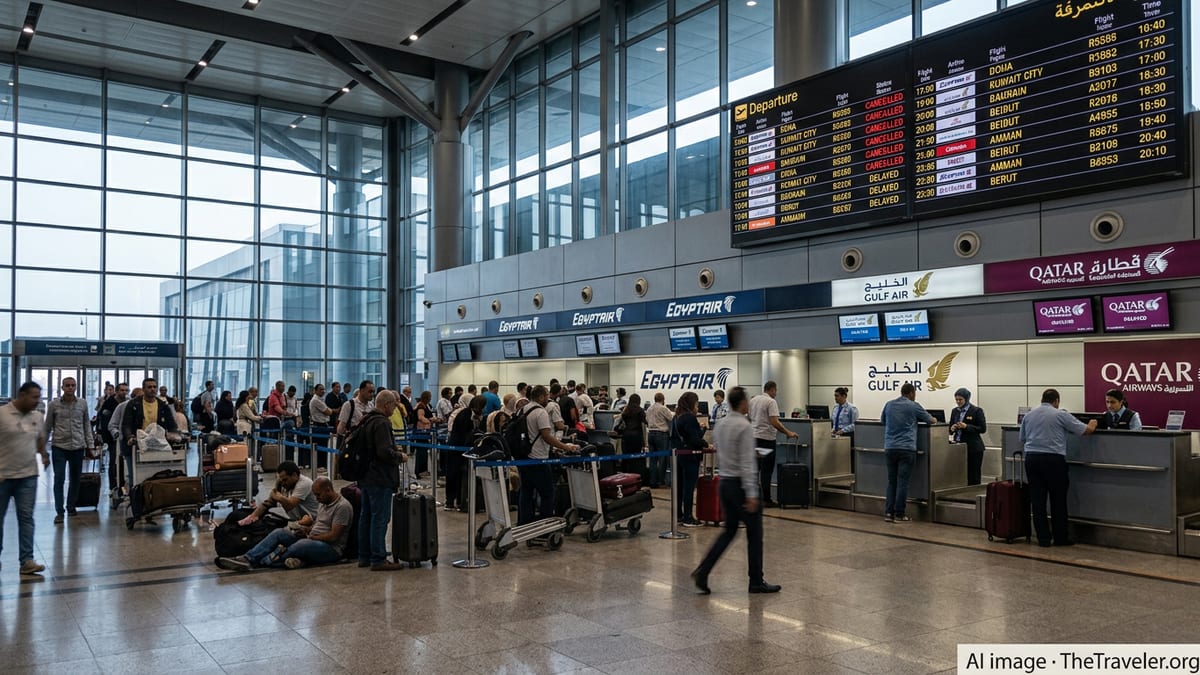
Cairo International Airport is grappling with a fresh wave of disruption after at least 37 flights operated by EgyptAir, Gulf Air and Qatar Airways were cancelled or heavily delayed, creating a cascade of schedule chaos across major hubs in Doha, Beirut, Amman, Kuwait City and Bahrain at a time of already fragile Middle East air connectivity.
Get the latest news straight to your inbox!
Regional Tensions and Airspace Restrictions Deepen Disruptions
The latest cancellations at Cairo come against the backdrop of heightened regional tensions and rolling airspace restrictions that have strained airline operations across the Gulf and Levant since late February. Carriers have been forced to replan flight paths, adopt lengthy detours or suspend services altogether as authorities in several states periodically close or restrict their skies for security reasons.
Egyptian airspace remains technically open, but national carrier EgyptAir has repeatedly adjusted its schedules in response to the wider Middle East environment and the operational challenges at key partner hubs. Gulf Air and Qatar Airways, which rely on dense connecting banks at Bahrain International Airport and Hamad International Airport in Doha, have similarly trimmed frequencies and consolidated flights as they wrestle with unpredictable access to regional corridors.
Analysts say the confluence of partial airspace closures, shifting no-fly zones and capacity caps at major airports has created a fragile network in which even modest schedule changes in one city can trigger knock-on delays across multiple time zones. For Cairo, a primary gateway between Africa, the Middle East and Europe, the result has been mounting pressure on ground operations and growing frustration among transit passengers.
Cairo Passengers Face Long Queues, Missed Connections
At Cairo International Airport, passengers arriving for overnight and early-morning departures reported long check-in queues, crowded transfer zones and limited information as airlines scrambled to rebook travellers from cancelled departures onto remaining services. Staff at several carriers were seen manually reissuing boarding passes where automated systems struggled to keep pace with rolling schedule changes.
Travellers connecting through Cairo to Gulf destinations have been particularly exposed. With reduced capacity into Doha, Kuwait City and Bahrain, some EgyptAir and Gulf Air customers were told they would need to wait 24 hours or more for the next available seat, while others were rerouted via secondary hubs such as Istanbul or Jeddah. Airport hotels around Cairo saw a spike in last-minute bookings as airlines handed out accommodation vouchers to stranded passengers.
The disruption has also affected origin-and-destination traffic. Business travellers bound for regional meetings and family visitors heading to the Gulf for school holidays described repeated last-minute schedule notifications, with departure times moving by several hours or services disappearing from airline apps entirely before being reinstated on different days. Travel agents in Cairo say they are fielding a surge of calls from customers seeking alternative routings that avoid the most volatile hubs.
Doha, Kuwait City and Bahrain Struggle to Stabilize Operations
Beyond Egypt, the operational strain has been felt acutely in Doha, Kuwait City and Bahrain, three hubs that sit at the heart of Middle East long-haul connectivity. Repeated airspace restrictions around the Gulf have forced Qatar Airways and Gulf Air to cancel or delay waves of flights, compressing schedules into narrow operating windows and limiting the number of arrivals and departures that can be safely handled each hour.
At Hamad International Airport in Doha, passengers in recent days have described departure boards dominated by the words “cancelled” and “delayed,” alongside a small but growing list of relief and repatriation services intended to clear backlogs. While authorities have allowed limited navigation along contingency routes, capacity remains significantly below normal levels, forcing Qatar Airways to prioritize key trunk routes and essential travel.
Bahrain International Airport and Kuwait International Airport have faced similar challenges. Periodic closures and restrictions on their surrounding airspace have led to extended ground stops, with aircraft and crews out of position and tightly choreographed connection banks broken apart. Gulf Air has trimmed frequencies on several regional routes as it attempts to rebuild a more predictable timetable, while Kuwait-based operators have diverted some services to alternative airports until conditions stabilize.
Knock-On Effects in Beirut, Amman and Beyond
The disruption radiating from Cairo and the Gulf hubs has spilled into Beirut, Amman and other key cities that depend on Middle East carriers for both point-to-point and connecting traffic. Flights between Cairo and the Lebanese and Jordanian capitals have been subject to rolling delays as airlines juggle aircraft rotations and crew duty limits that have been stretched by longer detours and congested air corridors.
In Beirut, ground handlers report irregular arrival waves, with clusters of delayed flights touching down in tight succession, taxing baggage handling and immigration desks. Some passengers arriving late from Cairo or the Gulf have missed onward connections to Europe and North America, forcing airlines to shoulder the cost of rebooking on partner carriers or providing overnight accommodation.
Queen Alia International Airport in Amman has seen comparatively more stability thanks to Jordan’s efforts to reopen and manage its airspace with additional safeguards, yet its role as an alternative waypoint for rerouted flights means schedules remain fluid. Airline planners are using Amman, Riyadh and other regional airports as pressure valves, diverting certain services there when congestion or closures flare up in Doha, Kuwait City or Bahrain, further complicating the travel picture for passengers.
Travelers Urged to Monitor Flights and Expect Ongoing Volatility
With no clear end date for regional airspace restrictions, airlines and aviation authorities are urging passengers to treat schedules as provisional and to monitor their flights closely in the 24 to 48 hours before departure. Carriers including EgyptAir, Gulf Air and Qatar Airways have expanded waivers that allow affected customers to change their travel dates or reroute via alternative destinations without additional fees, provided they rebook within specified windows.
Travel advisers recommend that passengers build extra time into itineraries that require connections through Cairo, Doha, Kuwait City or Bahrain, and consider avoiding tight layovers that leave little margin for delays. Those with flexible plans are being encouraged to route via more stable hubs where possible, even if this adds extra flying time, in order to reduce the risk of extended airport stays or missed events.
For now, the cancellations at Cairo International Airport and the wider disruptions at major Middle East hubs underscore the fragility of global air connectivity when geopolitical tensions intersect with tightly networked hub-and-spoke systems. As airlines work day by day to rebuild reliable operations, travellers across the region are likely to face continued uncertainty each time they head to the airport.