

More news on this day
Escalating conflict involving the United States, Israel, and Iran has triggered sweeping new U.S. security messages across the Middle East, casting renewed attention on Cairo’s safety profile even as Egypt’s formal travel advisory level remains unchanged.
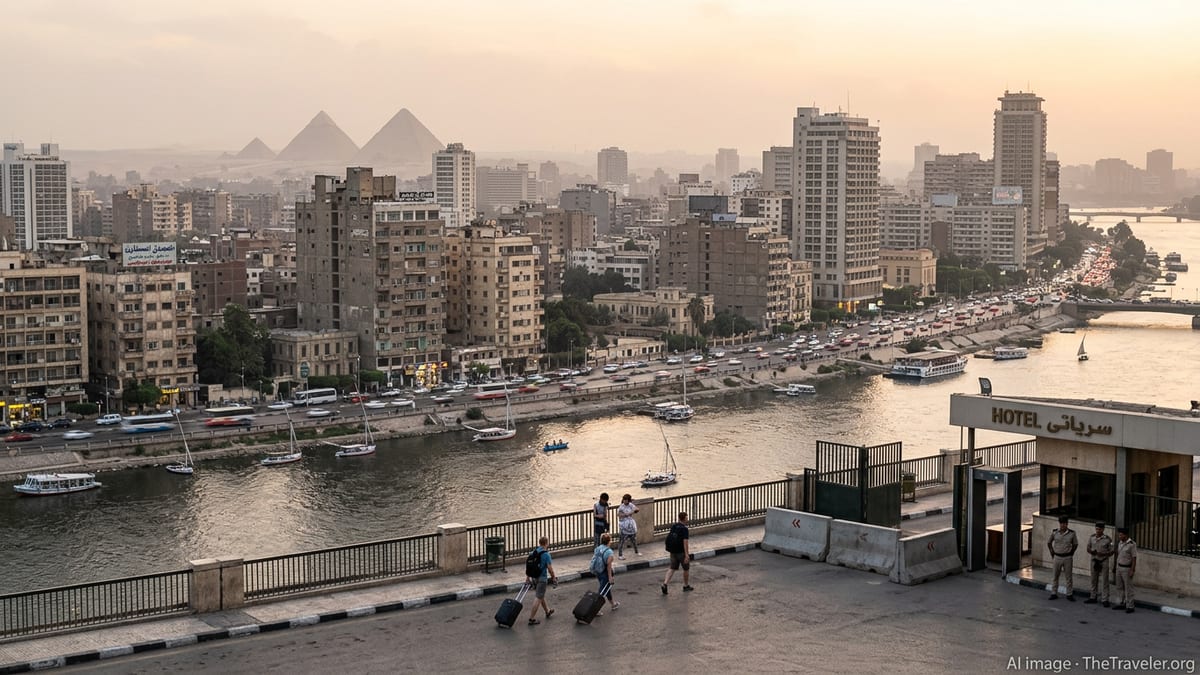
US Issues Region-Wide Alert While Keeping Egypt at Level 2
The U.S. government this week broadened its security messaging for the Middle East, urging Americans to depart a swath of countries amid intensifying military operations and disrupted airspace. The move follows days of strikes and counterstrikes involving U.S. and Israeli forces and Iranian targets, described by diplomats as the most serious regional flare-up in years.
Despite the sweeping nature of the warnings, U.S. officials have confirmed that Egypt’s country-level advisory remains at Level 2, the same designation it held prior to the latest escalation. Level 2 signals that travelers should exercise increased caution, but it falls below the more severe “Reconsider travel” and “Do not travel” categories now applied elsewhere in the region.
In a statement circulated on social media, the U.S. Embassy in Cairo underscored that there had been no change to the overall assessment of Egypt’s internal security. At the same time, the embassy reiterated that a region-wide alert was issued on March 2 to Americans across the Middle East, warning that conditions could shift quickly and advising travelers to remain prepared for rapid departures if needed.
The dual messaging has created a nuanced picture for visitors and residents in Cairo: a country that is not considered a front-line conflict zone, but one that sits next to a rapidly evolving theater of operations.
Cairo on Alert as Regional Conflict Ripples Across Borders
On the streets of Cairo, there have been no reports of direct attacks linked to the current fighting, and daily life in core tourist districts such as downtown, Zamalek, and the Giza plateau continues largely uninterrupted. Security forces, however, remain visibly present around government buildings, major hotels, and transport hubs as authorities watch for any spillover effects from the broader conflict.
Egypt’s long-standing role as a regional mediator, particularly on Gaza and broader Arab-Israeli issues, has kept it deeply entangled in the diplomatic fallout from the latest hostilities. Analysts note that this position, while bolstering Cairo’s international profile, also increases the risk of political demonstrations and public tensions, especially if casualties mount elsewhere in the region.
Travel security specialists say the primary concerns for foreign visitors in Cairo stem from the potential for targeted protests near foreign missions, sporadic unrest around sensitive anniversaries or political flashpoints, and the enduring risk of terrorism that underpins the State Department’s Level 2 designation. Travelers are advised to avoid demonstrations entirely, monitor local news, and maintain flexible itineraries in case of temporary disruptions.
For now, there have been no official curfews or domestic movement restrictions announced in Cairo as a direct result of the latest conflict. However, security briefings emphasize that conditions could change on short notice if regional dynamics shift or if Egypt’s leadership recalibrates its internal security posture.
Air Travel to and from Cairo Faces Growing Uncertainty
While Egypt’s advisory level has held steady, the conflict’s impact on regional aviation is increasingly evident. Several Middle Eastern countries have imposed full or partial airspace closures as military activity intensifies, prompting airlines to cancel or reroute flights and adding hours to long-haul journeys.
So far, Egypt’s airspace remains open and Cairo International Airport continues to operate, but carriers are adjusting schedules and routings in response to closures elsewhere. Industry trackers report that some airlines serving Cairo have reduced frequencies to neighboring hubs and built in additional flight time to avoid higher-risk air corridors.
Egyptian officials have simultaneously highlighted the country’s role as a logistical lifeline for the wider region. Cairo has positioned itself as a key transit point and potential evacuation hub for foreign nationals seeking to leave conflict-affected states, a status that could lead to surges in airport traffic and short-notice charter operations.
Travel planners warn that even travelers whose trips begin and end in Egypt may encounter cascading disruptions. Connecting flights via Gulf or Levantine hubs are particularly vulnerable, and passengers are being urged to check bookings repeatedly, allow extra layover time, and be prepared for last-minute changes to routing or departure times.
Western Governments Balance Caution With Confidence in Egypt’s Stability
Egyptian authorities have moved quickly to reassure foreign partners that the country remains stable and open for tourism, despite the turbulence beyond its borders. The Ministry of Foreign Affairs has engaged in intensive outreach to Western capitals, arguing that there is no security rationale for tightening travel guidance for Egypt at this stage.
That effort appears to have yielded results. Officials in Cairo say the United States, Canada, Ireland, and several European partners have all opted to keep their existing advisories in place, signaling confidence in Egypt’s internal security controls even as they take a much harder line on travel to neighboring states.
Local tourism operators in Cairo report that, so far, bookings have not collapsed, though there are escalating inquiries from travelers seeking clarity on the new U.S. messages. Many tour companies have introduced more flexible cancellation and rebooking policies, hoping to reassure visitors who are uneasy about the headlines but still interested in traveling if conditions allow.
Economists caution that a prolonged conflict could still exert significant pressure on Egypt’s tourism-dependent economy if perceptions of regional instability persist. For now, the government is betting that clear communication with foreign partners, coupled with a visible security presence in major urban and resort areas, will help insulate Cairo’s travel sector from the worst shocks.
What the New Guidance Means for Travelers Heading to Cairo
For American travelers, the current landscape amounts to a layered warning rather than a blanket prohibition. Egypt’s Level 2 advisory remains in force, indicating that trips to Cairo are not discouraged outright but should be approached with heightened situational awareness, particularly around political sites, religious holidays, and crowded public spaces.
The U.S. region-wide alert adds another layer, encouraging Americans anywhere in the Middle East to have contingency plans in place. That includes registering itineraries with consular services, ensuring access to emergency funds, and keeping travel documents and communication devices ready in case a rapid departure becomes necessary.
Security consultants recommend that visitors to Cairo carefully audit their own risk tolerance. Travelers who are uncomfortable with the idea of fast-changing flight schedules, potential demonstrations, and a heavier security footprint in public areas may choose to defer non-essential trips until the regional picture stabilizes.
Those who decide to proceed are being encouraged to work with reputable local operators, stay in established hotel districts with robust security, and build flexibility into their itineraries. As regional tensions continue to evolve, Cairo remains open, but the calculus of traveling there now demands closer attention to both official advisories and the fast-shifting realities on the ground.