

More news on this day
Cambodia’s emerging Cambodia–China International Street Arts Festival is rapidly taking shape as a flagship event within the Cambodia–China Tourism Year 2025, using open-air performances and collaborative artworks to spotlight Khmer heritage, deepen people-to-people exchange and drive a fresh wave of cultural tourism between the two countries.
Get the latest news straight to your inbox!
Street Arts at the Heart of Cambodia–China Tourism Year
Publicly available information shows that the street arts festival is part of a wider calendar of joint events scheduled under the Cambodia–China Tourism Year 2025, which was officially launched in Phnom Penh with a large-scale cultural performance program. Plans outlined by tourism authorities include music festivals, street art performances, martial arts shows, gastronomy promotions and film-related activities designed to attract more Chinese visitors while showcasing Cambodia’s creative energy.
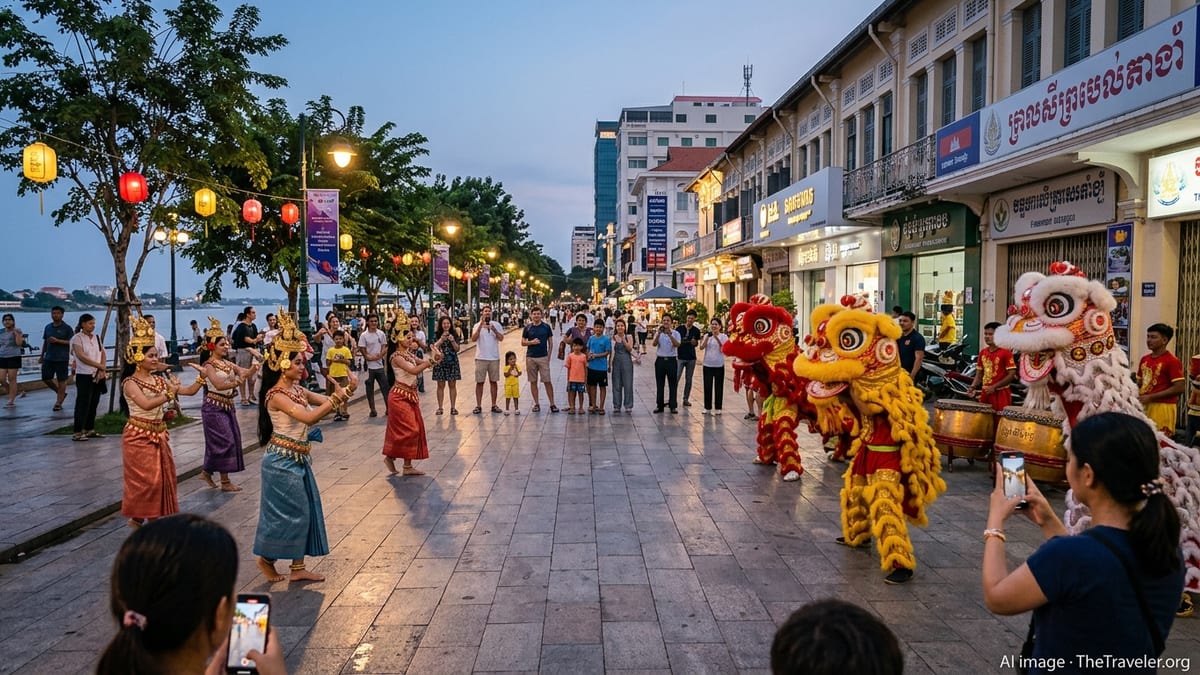
Early programming has focused on turning urban streets and public spaces into open-air stages. Reports on recent Cambodia–China cultural performances at Phnom Penh’s riverside Walking Street describe a blend of traditional music, dance, acrobatics and martial arts presented for residents, domestic travelers and international tourists strolling along Sisowath Quay. The street-based format is being promoted as a way to bring the festival directly to the public without the barriers of ticketed venues.
Tourism planners are positioning the international street arts festival as a recurring highlight within this broader framework, building on momentum from these pilot performances. The goal is to establish a recognizable cultural brand that can be expanded to other Cambodian cities and coordinated with Chinese partners, creating a signature experience that visitors can plan trips around in coming seasons.
Showcasing Living Traditions in Open-Air Performances
The festival concept emphasizes living, participatory culture rather than static displays. Reports on recent joint programs highlight performances of Kun Lbokator, a traditional Khmer martial art, alongside Chinese Shaolin Kung Fu demonstrations. Set on pedestrianized streets, these shows invite spectators to move freely, pause for photos and interact informally with performers, creating an accessible introduction to both Cambodian and Chinese heritage.
Alongside martial arts, the Cambodia–China International Street Arts Festival is expected to feature classical and folk dance, contemporary circus, traditional music ensembles and community-based troupes. Cambodia’s growing ecosystem of urban art events, including initiatives in cities such as Battambang and Siem Reap that turn walls, plazas and waterfronts into creative canvases, provides a ready pool of artists and producers experienced in working outdoors and engaging mixed audiences.
By clustering these performances in concentrated areas and over several days, organizers aim to generate a festival atmosphere that encourages visitors to spend more time in destination neighborhoods. Street food vendors, night markets and small businesses are expected to benefit from increased foot traffic, with cultural programming serving as the main draw but local commerce capturing much of the spillover activity.
Deepening Cambodia–China Cultural and Tourism Ties
The festival is unfolding against a backdrop of rapidly intensifying tourism cooperation between Cambodia and China. According to recent tourism statistics, Chinese travelers have returned as one of Cambodia’s largest international source markets, with year-on-year arrivals from China rising sharply as regional travel recovers. Joint branding of 2025 as the Cambodia–China Tourism Year is intended to accelerate that rebound.
Publicly available information from government and industry briefings indicates that both sides see cultural programming, including the street arts festival, as a strategic tool to strengthen people-to-people links and diversify tourism away from a narrow focus on landmark sites. By pairing Cambodian and Chinese performers, curating shared stages and encouraging artist exchanges, the festival aims to highlight cultural affinities while also celebrating distinct traditions.
These initiatives are also designed to support longer-term tourism cooperation. Business-matching forums, tourism conferences and promotional campaigns timed around major cultural events are being used to foster new tour products, air links and investment opportunities. The street arts festival, visible and media-friendly, offers a compelling anchor for such efforts and a strong visual identity for promotional materials in both markets.
Driving Growth in Cultural Tourism and Local Economies
Recent tourism data for Cambodia point to a steady recovery in overall arrivals and a particularly strong performance in cultural and heritage segments. Angkor Archaeological Park, Phnom Penh’s historic districts and riverfronts, and emerging arts hubs such as Battambang are drawing travelers who are increasingly seeking immersive experiences rather than brief sightseeing stops. The Cambodia–China International Street Arts Festival aligns closely with this shift in visitor preferences.
By staging performances in central urban locations, the festival encourages tourists to explore surrounding neighborhoods, cafes and galleries, extending their stays and daily spending. Reports on similar urban art initiatives in Cambodia suggest that such events can stimulate demand for local accommodation, dining and transportation, while also creating seasonal employment for technicians, guides and creative workers.
Local cultural organizations are expected to play a key role, collaborating on programming, workshops and community outreach. This approach can help ensure that benefits are more evenly distributed and that the festival supports capacity-building within Cambodia’s arts sector. For visitors, the result is a more authentic and varied experience that goes beyond standard tour itineraries.
Positioning Cambodia as a Regional Street Arts Destination
As planning continues for the Cambodia–China International Street Arts Festival, cultural observers note that Cambodia is drawing on lessons from successful street arts and urban culture festivals elsewhere in Asia and beyond, while adapting the model to local conditions. The country’s mix of historic architecture, compact city centers and youthful population provides a strong foundation for a distinctive street arts identity.
In Siem Reap, Battambang and Phnom Penh, recent and upcoming arts events are already reshaping public perception of Cambodia as a creative destination, not only a place of ancient temples and tragic history. Integrating the Cambodia–China festival into this evolving landscape could help consolidate that image, especially if the event returns annually and rotates across multiple cities.
For Chinese travelers, the festival offers an additional layer to Cambodia’s appeal, combining familiar elements of Chinese performance culture with the discovery of Khmer traditions in a relaxed, street-level environment. For Cambodian communities, it presents a platform to share local heritage with a growing international audience, reinforcing pride in living traditions while also contributing measurably to tourism growth.