

More news on this day
Drivers, rail passengers and cyclists across Cambridge and Cambridgeshire are being warned to expect significant disruption in the coming days and weeks as a cluster of urgent roadworks, resurfacing schemes and rail level-crossing shutdowns converges on key routes into and around the city.
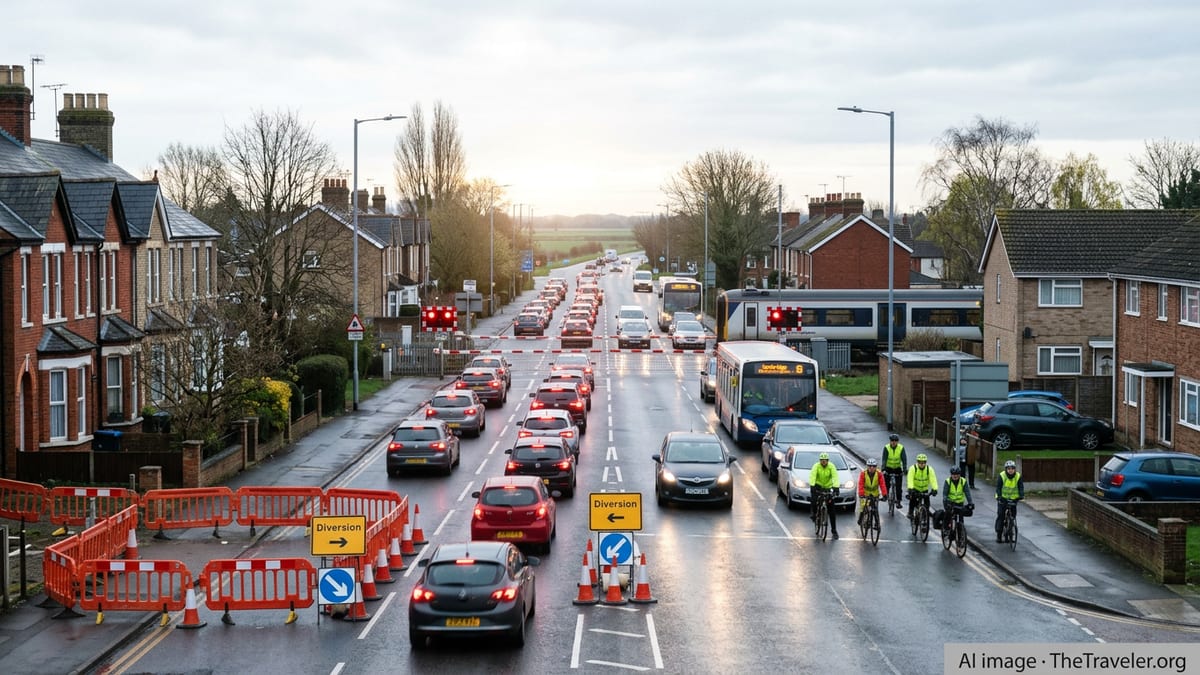
Resurfacing Works Pinch Access to Central Cambridge
In Cambridge itself, late-notice resurfacing has already begun to squeeze some of the city’s busiest approaches. Trumpington Road, a primary southern gateway connecting villages such as Trumpington and Hauxton with the historic core, has seen a series of overnight and daytime closures this week for emergency patching ahead of the Cambridge Half Marathon weekend. Local residents have reported queues stretching along Long Road and Hills Road as traffic is funnelled onto alternative routes.
The timing is particularly sensitive. The half marathon, which draws thousands of runners and spectators into the city centre, requires temporary lane restrictions and rolling closures around Trumpington, the city centre and riverside streets. Combined with resurfacing, it is leaving little slack in the network. Bus services have been reshuffled, with operators warning of extended journey times on routes serving Addenbrooke’s, the Biomedical Campus and the railway station.
Cambridgeshire County Council has acknowledged that some of the works have been brought forward at short notice, citing the deteriorating condition of key stretches of carriageway after a wet winter. Officials argue that carrying out high‑impact repairs now, rather than deferring them, will prevent more extensive closures later in the year. However, motoring groups say signage and advance warning have been patchy, catching commuters off guard at peak times.
Neighbouring streets, including parts of Hills Road and Long Road, are also affected by smaller scale utility excavations and lane closures for telecoms and broadband upgrades. While not full closures, these works are narrowing already busy corridors used heavily by cyclists and buses, adding to journey-time uncertainty on school and commuter runs.
A14 Overnight Closures Threaten Regional Arteries
Beyond the city boundary, one of the most disruptive pinch points will be the A14, the strategic dual carriageway that carries long-distance traffic between the Midlands, the A1, Cambridge and the ports in Suffolk. A series of overnight closures is scheduled on the eastbound carriageway near key junctions, with National Highways confirming that sections around junction 20 will be fully shut between 21:00 and 05:00 on selected nights from 9 March.
The closures, to allow resurfacing, drainage work and inspections, will divert traffic onto a lengthy signed route using parallel A and B roads. Hauliers and coach operators are being urged to plan for additional mileage and time, with some diversions expected to add up to 50 miles to overnight journeys. Local villages along the diversion corridors are bracing for a temporary surge in heavy goods vehicles using narrow high streets and rural bends.
These works are part of a broader highways maintenance and improvement programme recently signed off by Cambridgeshire County Council, which will see more than 200 kilometres of roads treated between now and spring 2027. While most schemes are scheduled for later phases, transport chiefs concede that the concentration of early works on the A14 and around Cambridge is likely to be acutely felt by both local and through traffic this month.
Travel information providers are advising motorists heading to Stansted Airport, the A11 corridor or the East Coast ports to check closure timings carefully and, where possible, adjust departure times to avoid the most disruptive overnight windows spilling into the morning peak.
Level-Crossing Incidents Trigger Rail Disruption
On the railway, a recent series of level‑crossing incidents has highlighted the fragility of the network around Cambridge and Ely. Services between Cambridge, Cambridge North and Ely were suspended earlier this week after a serious collision between a train and a car at a level crossing near Stretham, north of the city. Trains were halted for much of the day while emergency services, crash investigators and engineers worked at the scene, forcing passengers onto hastily arranged rail‑replacement buses and alternative routes via Peterborough and Norwich.
National Rail and train operators have warned that, although the line has since reopened, further short‑notice closures of crossings for inspection and repairs cannot be ruled out. The flat, fenland landscape around Ely is intersected by multiple level crossings on both major and secondary roads, making it particularly vulnerable to disruption when incidents occur.
At the same time, ongoing signalling renewal and safety upgrades around the wider Cambridge rail hub continue to prompt planned weekend and overnight possessions. Recent works have included converting older automatic half‑barrier crossings to full, manually controlled barriers with CCTV monitoring, requiring temporary shutdowns of both rail lines and the minor roads that cross them. While such schemes are designed to reduce the risk of collisions in the long term, they add to the immediate patchwork of closures facing travellers.
Commuters travelling on Great Northern, Greater Anglia and CrossCountry services through Cambridge are being urged to check live departure boards before leaving home and to be prepared for last‑minute changes to stopping patterns or the substitution of buses on shorter rural branches.
Villages Face Detours as Rural Roads Close
The impact of the current wave of works is being felt most sharply in Cambridgeshire’s villages, where a single closure can sever the most direct link to market towns or employment centres. Parish councils across South and East Cambridgeshire have circulated notices of temporary traffic orders covering stretches of the A10, A142 and a web of B‑roads near Ely, Soham and Haddenham, many of which coincide with rail crossings or ageing bridges.
In some locations, highways teams have imposed complete closures on narrow lanes that run across or alongside railway lines while drainage and embankment works are carried out. Residents in hamlets northeast of Ely report detours of up to 15 kilometres to reach supermarkets, GP surgeries or schools that are ordinarily a short drive away. For households without cars, the combination of rural bus cuts and diverted traffic has further complicated access to essential services.
Farmers and local businesses have expressed concern that the maze of temporary diversions is confusing delivery drivers and visitors unfamiliar with the area. Seasonal agricultural movements, including early spring planting and livestock transport, are also being forced onto longer and sometimes unsuitable routes. County officials say they are working with operators to sign diversions more clearly and to time the most disruptive closures outside of key agricultural windows where possible.
Cyclists, who make up a significant share of journeys in and out of Cambridge, are also affected as popular quiet lanes and shared-use paths near the railways are intermittently closed or narrowed. Campaigners have called for clearer, dedicated diversion maps for cycle traffic, arguing that mixing diverted motor traffic with bicycles on unlit fen roads is a safety risk.
Authorities Urge Early Planning and Flexible Travel
Transport authorities are stressing that, while the clustering of closures is uncomfortable, many of the schemes are essential to address long‑standing maintenance backlogs and safety concerns. The county’s highways committee has pointed to an inherited maintenance deficit running into hundreds of millions of pounds and argues that postponing works will only increase long‑term costs and risk.
In the short term, however, residents are being urged to adopt more flexible travel habits. Motorists are advised to leave extra time for critical journeys, especially those to hospitals, examinations or flights, and to consider alternative modes such as park‑and‑ride services where they remain unaffected. Employers in Cambridge’s science parks and university departments are being encouraged to allow staff to adjust working hours or work remotely on the days of the heaviest disruption.
Rail passengers are similarly being told to check for late-evening and early-morning alterations linked to engineering works, particularly on routes north to Ely and south toward London via the mainline and the emerging Cambridge South corridor. Where buses replace trains, operators recommend allowing additional time for connections in Cambridge and Ely, as road congestion from the wider works programme may slow replacement services.
Local councils have promised more joined‑up communication, with an updated push to consolidate road and rail disruption information into single online dashboards and social media feeds. For now, though, drivers, riders and rail users across Cambridge and Cambridgeshire face a challenging few weeks navigating an unusually dense patchwork of closures and detours just as the region heads into the busy spring travel season.