

More news on this day
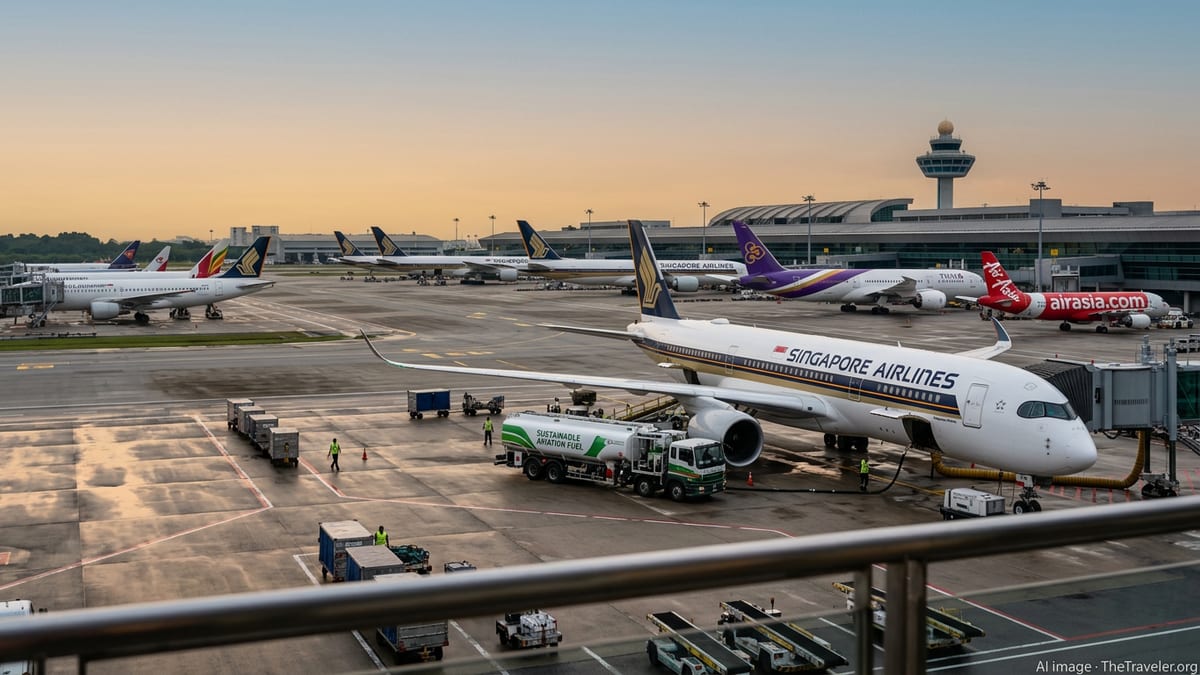
Major Asian carriers including Singapore Airlines, Thai Airways and AirAsia are accelerating investments in sustainable aviation fuel as governments roll out new mandates, raising hopes that cleaner jet fuel can blunt rising emissions without derailing a tourism economy worth hundreds of billions of dollars a year.
Get the latest news straight to your inbox!
Airlines Move From Pilot Flights To Multi-Year SAF Deals
Singapore Airlines has emerged as one of the region’s most active adopters of sustainable aviation fuel, or SAF. Publicly available company information shows the group has set a target to cover 5 percent of its total fuel needs with SAF by 2030, after earlier trials that saw blended fuel delivered through Changi Airport’s existing hydrant system. More recently, Singapore Airlines and low-cost sister airline Scoot signed fresh supply and certificate agreements with Neste and World Energy in early 2025, expanding access to SAF produced at Neste’s Singapore refinery and injected into local jet fuel infrastructure.
In Thailand, Thai Airways has been experimenting with SAF on domestic routes since late 2023 in partnership with Thai energy major PTT Oil and Retail Business. Corporate disclosures describe a demonstration flight between Phuket and Bangkok using SAF, part of a broader plan to reduce emissions and align with the country’s net-zero ambition by 2050. Thai Airways is now among eight Thai carriers that agreed in late 2025 to a coordinated rollout of SAF from 2026, under an initiative backed by the Civil Aviation Authority of Thailand.
Low-cost giant AirAsia is positioning itself within this emerging ecosystem rather than building out its own large-scale fuel supply. The group has conducted SAF demonstration flights in cooperation with refiners and airport operators in Malaysia and Thailand and has signed framework agreements that allow for SAF use where it is available at competitive prices. Industry reports indicate AirAsia’s strategy focuses on tapping regional hubs such as Kuala Lumpur, Bangkok and Singapore as SAF production ramps up, while continuing to prioritize high aircraft utilization and modern, fuel-efficient narrowbody fleets.
Together, these moves signal a shift from symbolic pilot flights toward multi-year supply arrangements and regulatory-backed adoption. While current SAF volumes remain small relative to overall jet fuel demand, Asia’s flagship carriers are increasingly treating clean fuel as a core component of their decarbonisation plans rather than a branding exercise.
Singapore’s Mandatory SAF Levy Raises Regional Bar
Singapore is setting one of the clearest policy signals in the region. The government has confirmed that from 2026 all flights departing Changi and Seletar airports will be required to use SAF, starting with a 1 percent blend of total jet fuel. To help airlines manage higher costs, authorities have designed a passenger levy that will channel a surcharge of roughly 75 cents to 32 dollars per ticket into a central fund for bulk SAF purchases. A dedicated Singapore Sustainable Aviation Fuel Company has been established to coordinate procurement and supply.
This levy-backed model is intended to give carriers such as Singapore Airlines cost predictability while guaranteeing demand for producers like Neste, which has significantly expanded SAF capacity in the city-state. The arrangement also supports cargo operators, with logistics players including DHL entering some of Asia’s largest SAF deals to fuel freighters at Changi. Analysts see the policy as positioning Singapore not only as a passenger hub but as an anchor market for regional SAF production and trading.
The move carries important competitive implications. Changi is the primary gateway for millions of long-haul passengers heading to Southeast Asia’s beach resorts and city destinations. By locking in a baseline of SAF use on all outbound flights, Singapore effectively bakes a climate cost into the price of access to much of the region, potentially nudging neighboring hubs to adopt similar measures to avoid being viewed as laggards on sustainability.
For airlines, the new levy is a double-edged sword. It offers clarity and shared cost recovery mechanisms but also reduces flexibility on when and how quickly they invest in cleaner fuel. Carriers based outside Singapore that rely heavily on Changi for connecting traffic will be drawn into the regime regardless of their home country’s policies, reinforcing SAF as a new operating reality for Asia’s tourism lifelines.
Thailand’s 2026 SAF Push And Budget Carrier Strategies
Thailand, one of the world’s most tourism-dependent economies, is moving on a parallel track. The Civil Aviation Authority of Thailand signed a memorandum of understanding in November 2025 with eight local airlines, including Thai Airways and both Thai AirAsia units, to start using SAF from 2026. Public reports outline a gradual approach, with an initial 1 percent blend and plans to scale up in line with emerging national SAF standards and refinery capacity.
Energy company PTT Oil and Retail and other local partners are building a supply chain based largely on used cooking oil and agricultural residues, reflecting Thailand’s sizable food-processing sector. Bangkok Airways and other carriers have already operated SAF flights on routes such as Bangkok–Samui, providing early operational data on blending, engine performance and ground handling. These experiences are expected to inform how Thai Airways and AirAsia structure longer-term offtake contracts once commercial-scale production is in place.
For budget airlines like AirAsia, which compete aggressively on price, even a modest SAF blend can squeeze thin margins. Industry commentary suggests these carriers will lean on high-density seating, fleet renewal and dynamic pricing to absorb part of the SAF premium, while passing some costs onto passengers through fuel surcharges. Thailand’s tourism authorities, keen to maintain the country’s appeal to price-sensitive travelers, are watching closely to ensure green policies do not choke off demand just as visitor numbers surpass pre-pandemic levels.
The Thai policy trajectory mirrors broader global trends, including the European Union’s phased SAF blending mandate for flights departing European airports. As Thai Airways expands its long-haul network back into Europe, alignment with such rules will become increasingly important in marketing the flag carrier and Thailand more broadly as responsible choices for climate-conscious travelers.
Can SAF Keep Pace With Asia’s Tourism Surge?
The stakes are high. Before the pandemic, international tourism in the Asia-Pacific region was valued at well over 300 billion dollars annually, with Southeast Asia accounting for a large share of arrivals. Recovery has been rapid, helped in part by travelers rerouting through Asian hubs to avoid geopolitical disruptions in other corridors. Load factors are climbing, and airlines from Singapore to Bangkok report strong demand on both leisure and business routes.
Yet the same rebound is pushing aviation emissions steadily higher. SAF is widely seen by industry bodies as the single most important lever for deep decarbonisation this decade, because it can be used in existing aircraft and fueling infrastructure with minimal modifications. However, global SAF output remains a small fraction of total jet fuel consumption, and cost differentials of two to five times conventional kerosene are common. That gap presents a structural challenge for Asian carriers operating in intensely competitive markets.
Scalability depends on rapid investment in regional production. Southeast Asia has clear advantages, including abundant feedstocks from palm and coconut supply chains, extensive refining capacity and large, centralized hubs such as Singapore, Bangkok and Kuala Lumpur. Governments are beginning to align incentives, with measures like Singapore’s levy, Thailand’s emerging SAF standard and collaborative frameworks backed by regional forums and climate initiatives. The question is whether these steps can translate into the tens of billions of dollars in capital expenditure needed to achieve a meaningful share of SAF by 2030.
For now, Singapore Airlines, Thai Airways and AirAsia are pursuing a pragmatic path that blends incremental SAF use with fleet renewal, operational efficiencies and carbon offset programs. If regional policy momentum holds and producers deliver on current expansion plans, their early commitments could help anchor a larger SAF market that cushions Asia’s tourism-led economies from climate-related scrutiny and potential carbon border costs. If supply growth stalls, however, airlines may find themselves paying more for limited volumes of green fuel while facing growing pressure from travelers and investors to do much more.
What It Means For Travelers And Destinations
For passengers flying into and around Asia, the immediate impact of SAF adoption will mostly be visible in airfares. Singapore’s levy effectively itemizes a climate cost on outbound tickets, while Thai carriers have already flagged the possibility of higher fuel surcharges as global oil prices and SAF-related expenses rise. The increases are modest on a per-ticket basis but could add up for families and frequent travelers, particularly on long-haul itineraries that rely on Asian hubs.
Destinations stand to gain reputationally if they can show that booming visitor numbers are not coming at the expense of climate goals. Singapore is marketing its green aviation agenda as part of a broader sustainable tourism narrative around attractions such as its nature reserves and climate-resilient urban design. Thailand is weaving SAF and airline fleet renewal into efforts to position the country as a higher-value, lower-impact destination, with policies that prioritize longer stays and more dispersed travel beyond crowded hotspots.
At the same time, there is a risk of uneven progress. Smaller island and secondary-city airports that rely heavily on low-cost carriers may struggle to secure regular SAF supplies, leaving them behind better-connected hubs. Without coordinated regional standards and financing mechanisms, the clean-fuel premium could deepen divides between flagship airlines able to sign long-term SAF deals and smaller operators focused purely on survival.
How effectively Singapore Airlines, Thai Airways and AirAsia navigate this transition will influence not only their own competitiveness, but also the trajectory of Asia’s tourism engines as climate constraints tighten. Their early embrace of SAF shows that cleaner fuel is moving from the realm of pilot projects to a central pillar of aviation strategy. Whether that proves enough to future-proof a 300-billion-dollar tourism economy against rising emissions remains one of the defining questions for the region’s skies.