

More news on this day
Long overshadowed by established beach destinations like Vung Tau and Phan Thiet, Can Gio on the fringe of Ho Chi Minh City is rapidly moving into focus as southern Vietnam’s next major coastal tourism hub, propelled by large-scale infrastructure projects and a US$9 billion marine tourism–urban development now taking shape along its shoreline.
Get the latest news straight to your inbox!
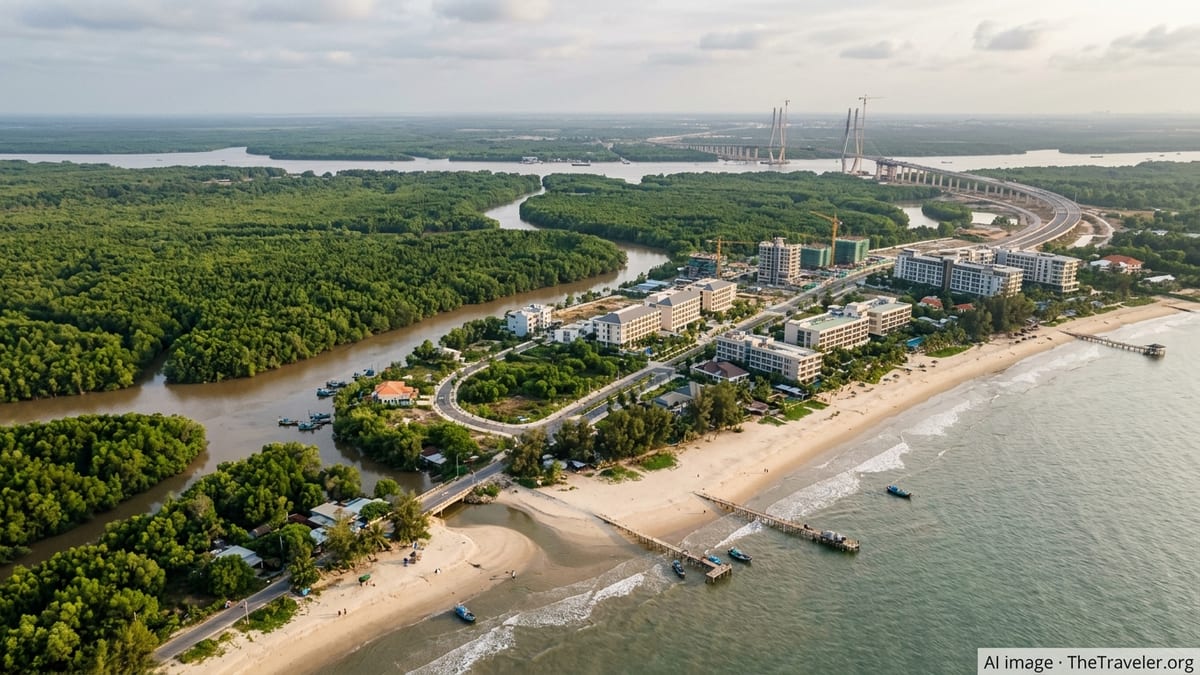
Strategic Planning Positions Can Gio at the Heart of a New Coastal Economy
Can Gio is Ho Chi Minh City’s only coastal district, located around 50 kilometers southeast of the city center and framed by a 13-kilometer stretch of coastline and extensive mangrove forests. Recent planning documents identify the district as a future marine ecological urban area, with tourism and services expected to play a leading role in local economic transformation.
Publicly available planning information for the period to 2030, with a vision toward 2045 and beyond, shows that city authorities view Can Gio as a key pillar in a broader “riverside and coastal tourism economy” stretching from downtown Saigon’s riverfront to the East Sea. The district is earmarked for high-quality ecological tourism, resort development, coastal urban areas and supporting marine services.
Reports indicate that this long-term repositioning is also tied to a wider strategy to “activate maritime space,” connecting Ho Chi Minh City more closely with neighboring coastal localities and offshore destinations. Within this framework, Can Gio is seen as both a recreational playground for the metropolitan population and a potential gateway for coastal trade, cruise activity and nature-based tourism.
At the same time, the district’s future is being shaped by its environmental sensitivities. Large portions of Can Gio are covered by a UNESCO-recognized mangrove biosphere reserve, and planning documents emphasize that tourism expansion must be aligned with conservation targets, low-carbon design and controlled visitor flows.
US$9 Billion Marine Tourism–Urban Area Set to Reshape the Coastline
The most visible symbol of Can Gio’s tourism ambitions is the 2,870-hectare Can Gio coastal marine tourism–urban project, a sea-reclamation development that has been moving through detailed planning and environmental review since its approval at national and city levels. According to published coverage, total investment for the complex is estimated at nearly US$9 billion, making it one of Vietnam’s largest single coastal urban schemes.
Recent local media reports describe a mixed-use coastal city-in-the-making, with plans for resort hotels, second homes, entertainment facilities, marinas, commercial and financial centers, schools and hospitals. The project is designed to accommodate a large resident and visitor population, effectively creating a new seafront skyline off the existing Can Gio shoreline.
Developers and planners are presenting the project as an integrated destination rather than a standalone resort strip, with internal canals, waterfront promenades and themed neighborhoods intended to support year-round tourism demand. The scale of the planned facilities suggests capacity for both domestic weekenders from Ho Chi Minh City and international travelers connecting via the city’s airports and ports.
At the same time, the project remains under close environmental scrutiny. The Ministry of Agriculture and Environment has opened public consultations on its environmental impact assessment, reflecting public interest in how large-scale reclamation will interact with the surrounding mangrove systems and coastal hydrology. The outcome of this process is expected to shape design adjustments, mitigation measures and long-term monitoring of the new urban coast.
Game-Changing Transport Links: Bridges, Expressways and a New Metro
Behind the vision of Can Gio as a premier coastal tourism hub is a pipeline of transport infrastructure that aims to make the district far more accessible from the wider southern region. Currently reached mainly by road and ferry, the area has long been seen as relatively remote compared with other beach destinations despite its proximity to Ho Chi Minh City.
One of the most closely watched projects is the planned Can Gio Bridge across the Soai Rap River, which would replace the Binh Khanh ferry and directly connect Can Gio with Nha Be district and the urban core. Market and infrastructure reports describe the bridge as a key missing link in the city’s coastal traffic network, with expectations that it will significantly cut travel times and unlock new tourism and real-estate investment once completed.
The district is also positioned to benefit from the Ben Luc – Long Thanh Expressway, a major east–west corridor in southern Vietnam that is expected to enhance regional connectivity between Long An, Ho Chi Minh City and Dong Nai. While the expressway does not run directly through Can Gio, urban-planning analyses point to its role in redistributing traffic flows and strengthening access from the Mekong Delta and eastern economic zones to the city’s coastal areas.
Looking further ahead, publicly released information shows that Ho Chi Minh City has approved the Ben Thanh – Can Gio rapid transit line, a high-speed rail or metro-style link connecting the downtown Ben Thanh area with the coastal district. The line, which has been assigned preliminary investment figures in official documents, would effectively turn Can Gio into a beachfront extension of urban Ho Chi Minh City, compressing the journey to under an hour for future visitors once operational.
Eco-Tourism, Biosphere Protection and the Future Visitor Experience
Any tourism boom in Can Gio is inseparable from the district’s defining natural asset: the Can Gio Mangrove Biosphere Reserve. Covering tens of thousands of hectares of rehabilitated mangrove forests, the reserve has been recognized by UNESCO for its biodiversity and role in coastal protection, and already serves as a popular day-trip destination for birdwatching, boat tours and environmental education.
Tourism authorities and planning documents consistently highlight eco-tourism and community-based tourism as the backbone of the district’s visitor strategy. Current tours typically combine mangrove canals, monkey-watching sites, elevated walkways and visits to local fishing communities, with operators positioning the area as a quieter, more nature-focused alternative to more built-up Vietnamese beach towns.
As large-scale coastal urban projects advance, public debate and expert commentary emphasize that any move to become a premier tourism hub will depend on strict management of carrying capacity in the biosphere reserve. This includes zoning sensitive areas away from mass tourism, ensuring that new marinas and waterfront facilities do not disrupt tidal flows and maintaining robust environmental impact monitoring as visitor numbers grow.
For travelers, this evolving balance suggests a future Can Gio in which high-end resorts and urban amenities sit within reach of carefully protected wetlands and low-key fishing villages. The success of this model is likely to be measured not only in arrivals and revenue, but also in the health of mangrove forests and the resilience of local communities that rely on both tourism and traditional livelihoods.
What Travelers Can Expect in the Coming Years
In the short term, visitors can already experience a mix of rustic seaside atmosphere and emerging tourism services. The 30 April beach area, simple seafood eateries, homestays and small resorts form the core of current offerings, alongside organized day tours from Ho Chi Minh City. Road improvements over the past decade have made weekend trips more practical for residents of the metropolitan area.
Over the medium to long term, the completion of key transport links and progressive rollout of the marine tourism–urban complex are expected to change both the skyline and the visitor profile. Analysts anticipate a wave of branded hotels, vacation residences, entertainment complexes and conference facilities, with Can Gio competing more directly with regional coastal destinations for both leisure and meetings business.
At the same time, the district’s positioning as a green, ecological coastal city means that regulatory conditions may remain tighter than in some other resort zones, particularly regarding building density and shoreline modification. For travelers, this could translate into a destination that feels less crowded and more integrated with its natural surroundings, even as new infrastructure shortens the distance from central Ho Chi Minh City.
For now, Can Gio remains at a pivotal moment: on the cusp of major transformation, yet still defined by mangroves, river estuaries and a slow-paced coastal lifestyle. As infrastructure investment accelerates and master plans move from paper to reality, the district is widely expected to stand out as one of southern Vietnam’s most closely watched experiments in combining large-scale coastal tourism with environmental stewardship.