

More news on this day
For more than a century, the week-long rail journey between Moscow and Vladivostok has captured the imagination of travelers, symbolizing both the vastness of Russia and the romance of slow, overland exploration. Today, the world’s longest continuous rail trip finds itself at a crossroads, operating in a tourism landscape reshaped by war, sanctions and shifting travel patterns.
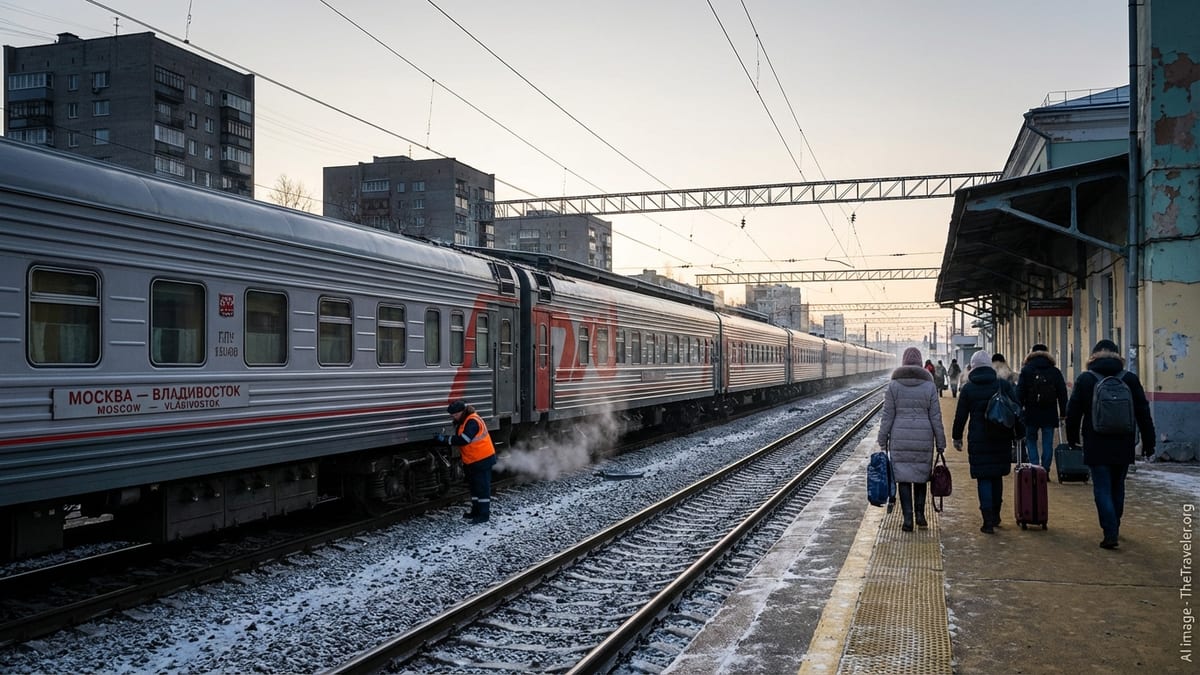
A Legendary Route in a Changed Geopolitical Landscape
The Moscow–Vladivostok route, commonly folded into the broader Trans-Siberian brand, still covers over 9,200 kilometers across eight time zones, passing birch forests, industrial hubs and remote Siberian towns. On paper, it remains one of global tourism’s most iconic overland adventures, a once-in-a-lifetime journey that featured heavily in pre-2020 bucket lists and tour brochures. In practice, its place in international tourism has been fundamentally altered by geopolitics.
Following the invasion of Ukraine in 2022, Western governments advised against travel to Russia, major airlines pulled out routes and several global booking and payment systems became difficult or impossible to use. That effectively cut off most of the traditional long-haul markets for the Trans-Siberian, from Western Europe to North America and Australia. Operators that once sold multi-country itineraries tying Moscow–Vladivostok to Beijing or Ulaanbaatar saw demand collapse almost overnight.
And yet the train itself never stopped. Russian Railways continued to run services along the route, with domestic travelers filling seats that foreign tourists once reserved months in advance. The legendary rail epic is no longer the same international magnet it was a decade ago, but it has not become obsolete. Instead, it is being repurposed, both by rail operators and by a new set of travelers less constrained by the Western political climate.
Tourism Numbers: Domestic Growth, Foreign Caution
Russia’s overall tourism picture helps explain the new reality for Moscow–Vladivostok. International arrivals have rebounded from the pandemic low, but they remain far below pre-2019 levels and skew heavily toward neighboring countries and Asian markets rather than Europe or North America. Official statistics and industry analyses show that domestic travelers now account for the bulk of overnight stays and organized trips inside the country, with international tourists representing a modest minority.
Inbound tourism in 2023 and 2024 recovered sharply from the pandemic years, driven in part by simplified visa procedures for citizens of China, Gulf states and several Asian and Middle Eastern countries. At the same time, Russia’s inbound tourism in 2025 saw signs of strain again, with a reported drop in foreign leisure visitors over the peak summer season. Analysts attribute this to a combination of intermittent airspace disruptions, a stronger ruble and the continued hesitancy of many long-haul markets.
Outbound travel by Russian citizens, by contrast, has risen steadily, with millions of trips annually to Turkey, the United Arab Emirates, Egypt and other destinations. The picture is of a tourism market in which Russians are increasingly traveling abroad again, while foreign visitors to Russia are returning more slowly and unevenly. For long-distance rail, this tilt toward domestic demand matters: it turns the Moscow–Vladivostok train into an instrument of internal mobility and domestic tourism rather than an international showpiece.
For now, that means the route’s potential to revive inbound tourism is limited by structural realities. The rail line can help keep domestic tourism buoyant and offer a marquee experience for those foreign travelers who do come, but it cannot in itself reverse broader geopolitical and logistical headwinds.
Railway Operators Pivot to Domestic and Regional Markets
Within this constrained landscape, Russian rail companies have not stood still. Passenger subsidiaries of Russian Railways have reported record or near-record overall ridership in 2024, boosted by strong domestic demand and the rediscovery of rail as a cost-effective and reliable way to cross a vast country. Tourist-specific trains and themed journeys, though still a relatively small segment, have grown from their pandemic lows.
Rail operators have expanded seasonal and regional services to popular domestic destinations such as the Black Sea coast, the North Caucasus and Arctic and Far East regions. While these are not direct Moscow–Vladivostok runs, they rely on the same long-distance rolling stock and booking systems, and they feed a narrative that rail is central to exploring Russia’s diverse landscapes. Tourist train traffic, including heritage-style trains and curated tours, has increased, indicating that there is a paying audience for rail-based experiences even in uncertain times.
The Trans-Siberian corridor benefits indirectly from this reorientation. Multi-day rail packages marketed to Chinese, Gulf and other Asian visitors now highlight sections of the line as part of broader itineraries that combine Moscow, St. Petersburg, Baikal and the Far East. Domestic tour operators have begun to position the full Moscow–Vladivostok route as the ultimate expression of internal travel, promoting it to Russian travelers who may previously have favored foreign beach holidays.
Still, these efforts operate within a constrained international market. Western specialist agencies that once carried much of the marketing weight for the Trans-Siberian have scaled back or suspended Russia programs. In their place, Russian and Asian operators are building new distribution channels, often relying on social media influencers, regional travel fairs and direct partnerships with foreign agencies in countries that have kept political and economic ties with Moscow.
Infrastructure Upgrades and the Freight–Passenger Balancing Act
Another determinant of the route’s tourism potential is the state of the infrastructure itself. Much of the Moscow–Vladivostok journey follows the Trans-Siberian Railway, a vital freight artery linking European Russia with industrial centers, ports and mines in Siberia and the Far East. In parallel, the government has poured resources into the Baikal-Amur Mainline and associated tunnels and bypasses to boost freight capacity to Asia-Pacific markets.
Key projects, such as the construction of a second major tunnel on the Baikal-Amur corridor, aim to dramatically increase freight throughput across the region. While that work does not primarily target passenger comfort, it matters for the tourist experience: more capacity can, in theory, reduce bottlenecks and delays for long-distance trains, even as freight volumes grow. On the other hand, a busier freight network can also mean more congestion and schedule pressure if passenger services do not receive priority.
Russian Railways has continued a rolling program of modernizing rolling stock on long-distance routes, introducing more modern sleeping cars and updating onboard services. These upgrades are uneven along the Moscow–Vladivostok corridor, with some trains and sections seeing newer coaches and improved dining options while others retain older stock and basic facilities. For tourists drawn by the idea of a romantic rail epic, the balance between authenticity and comfort is delicate: some seek vintage carriages and samovars, others expect Wi-Fi and modern cabins.
Crucially, large-scale infrastructure spending aims first at economic and strategic goals: moving coal, metals and containers more efficiently between Russia and Asian markets. Tourism is a secondary beneficiary rather than the primary driver. That limits how far improvements to tracks, tunnels and signaling will, on their own, transform the Moscow–Vladivostok line into a tourism engine, even if they make the ride marginally smoother and more reliable.
Shifting Source Markets: China, the Gulf and Beyond
With traditional European and North American visitor flows heavily reduced, the recovery of inbound tourism to Russia has been led by travelers from China, Central Asia and the Gulf. Visa facilitation measures, including electronic visas and simplified group procedures, have made it easier for citizens of dozens of countries to enter for short stays, and Russian authorities have actively courted these markets through trade fairs and social media campaigns.
From a Trans-Siberian perspective, this shift brings opportunities and constraints. Chinese visitors in particular have long been a key market for routes that combine Moscow with Siberia and the Russian Far East, sometimes onward to or from China by rail or air. As group travel from China resumed after the pandemic, rail-based itineraries began to reappear in tour catalogs, though often as shorter segments rather than the full Moscow–Vladivostok journey.
Gulf travelers represent a newer, fast-growing demographic. Attracted by visa easing, cool-climate summer escapes and relative affordability, visitors from countries such as Saudi Arabia and the United Arab Emirates are exploring destinations beyond Moscow and St. Petersburg. For these tourists, carefully curated rail experiences across photogenic stretches of Siberia or to Lake Baikal can be packaged as premium adventures. However, few currently commit to a seven-day point-to-point rail trip across the entire country, particularly when language barriers, payment limitations and long travel times remain deterrents.
Other regional markets, including travelers from Turkey, India and parts of Central Asia, are slowly discovering Russia’s long-distance rail as a novel way to travel internally. Whether this mix of source markets can ever match the volume and high per-capita spending of pre-2022 Western clientele remains an open question. So far, the numbers suggest a partial realignment rather than a full replacement.
Practical Barriers for International Rail Tourists
For would-be visitors considering the Moscow–Vladivostok journey, practical hurdles remain significant. Air connectivity to and from Russia has improved compared with 2022, but routes from many Western hubs are still limited, indirect or more expensive than before. That makes reaching Moscow or Vladivostok the first challenge, especially for travelers seeking value-focused adventures.
Once in Russia, payment systems can be another stumbling block. The withdrawal or suspension of many international card networks has forced visitors to rely on cash, local banking workarounds or specific foreign cards that still function. Some tour operators and hotels have adapted by arranging prepaid packages, but independent travelers considering a week on a train are often wary of navigating financial logistics on their own.
Digital services, including navigation apps and mapping tools, have also become less reliable in parts of the country due to sanctions and technical restrictions. While long-distance trains themselves are a contained environment, where tickets, berths and meals can be booked in advance, travelers frequently combine the journey with stopovers along the way. Uncertainty about local transportation, connectivity and language support in smaller Siberian cities can deter those accustomed to seamless digital travel.
Layered on top of these practical concerns is reputational risk. Many Western governments continue to maintain restrictive travel advisories for Russia, and some travelers are reluctant to visit for ethical or security reasons. For the Moscow–Vladivostok route to regain its status as a flagship global journey, such perceptions would need to shift significantly, something that lies far beyond the control of railway operators.
Storytelling, Nostalgia and the New Appeal of Slow Travel
Despite these headwinds, the Moscow–Vladivostok train still benefits from a powerful narrative advantage: it is a journey rich in story. Travel media, books and films from earlier decades fixed the Trans-Siberian in the global imagination as the ultimate slow travel experience, where days unfold to the rhythm of the rails and encounters in the restaurant car become the highlight of the trip.
Globally, there has been a renewed interest in rail travel as a lower-carbon alternative to flying and as a way to experience landscapes at a human pace. European night trains have returned to routes once abandoned, and scenic railways from Japan to Switzerland report stronger demand from travelers seeking meaningful, introspective journeys rather than quick checklists. In theory, the Moscow–Vladivostok route is perfectly aligned with this trend.
In practice, however, translating global slow travel enthusiasm into bookings on Russian long-distance trains is not straightforward. Environmental concerns, for example, weigh differently when the journey itself requires long-haul flights to reach Moscow. For the many travelers who still rely on Western media and government guidance, rail’s green credentials do not outweigh political and security apprehensions.
Where the narrative still holds sway is in niche segments: rail enthusiasts, adventure travelers from countries less bound by Western advisories, and domestic tourists who grew up hearing about the Trans-Siberian as a national rite of passage. For these groups, nostalgia and a desire to experience a storied route can overcome some of the practical and political obstacles.
Can the World’s Longest Rail Journey Revive Tourism?
The question facing industry insiders is not whether the Moscow–Vladivostok train can survive, but whether it can once again drive a broader tourism boom. On the survival front, the answer appears clear: as long as Russia remains geographically vast and rail remains central to internal mobility, the route will continue to operate, sustained by domestic travelers, regional visitors and its strategic value.
Its capacity to revive inbound tourism, however, is constrained by factors largely outside the railway’s control. Political isolation from much of the West, fragmented air connectivity, payment and digital obstacles, and uneven perceptions of safety all limit how many international travelers are willing or able to commit to a seven-day journey across Russia. Even strong growth from China, the Gulf and other emerging markets may not fully compensate for the loss of traditional high-spending audiences.
What the Moscow–Vladivostok line can realistically do is act as a flagship for the segments of tourism that remain open to Russia: a powerful symbol in marketing campaigns aimed at Asian and Middle Eastern visitors, a magnet for domestic adventurers, and a unique selling point for tour operators who specialize in complex, off-the-beaten-path itineraries. Its success will be measured less in mass-market numbers than in its ability to anchor a reoriented, more regionally focused tourism strategy.
In that sense, the world’s longest rail journey is unlikely to single-handedly restore Russia’s place on global tourism maps. But as part of a broader, eastward-looking realignment in how the country presents itself to travelers, the Moscow–Vladivostok train remains a powerful, if constrained, asset: a rolling showcase of a vast territory that is once again in flux.