

More news on this day
Canada is aligning with Japan Airlines on a complimentary domestic flight initiative designed to nudge more international visitors beyond Japan’s biggest cities, tying free in-country flights to transpacific tickets as part of a broader push to stimulate regional tourism and local economies.
Get the latest news straight to your inbox!
New Free-Flight Offer Targets International Travelers From Canada
Japan Airlines has introduced a complimentary domestic flight offer for overseas visitors booking international tickets, with Canada positioned as one of the key long-haul markets expected to benefit. Publicly available fare information shows that travelers flying to Japan on JAL from Canada can add a domestic sector within the country for no additional base fare when the flights are booked together on the same itinerary.
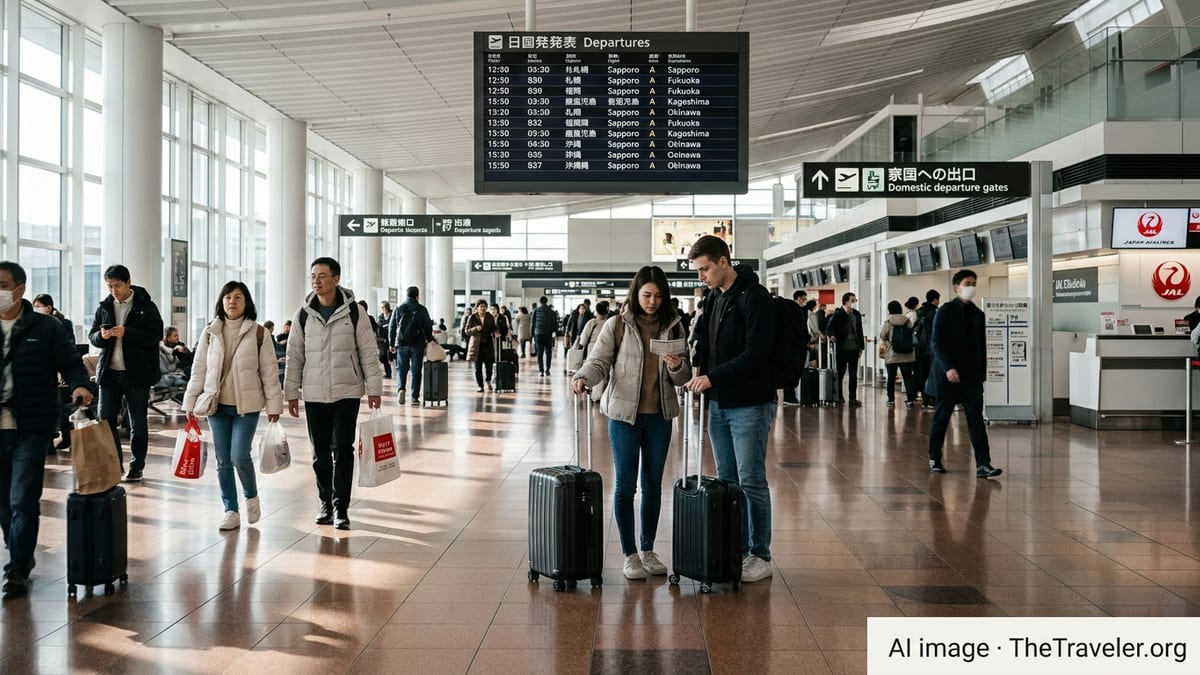
The structure of the promotion is straightforward. Passengers originating in Canada purchase a round-trip international ticket to a Japanese gateway such as Tokyo and then select an onward domestic flight, for example to Sapporo, Fukuoka, or Okinawa, as part of the same reservation. The Japanese domestic segment is priced at zero in the fare calculation, although standard taxes, fees, and any applicable stopover charges still apply under JAL’s conditions.
Reports indicate that a stopover fee may be triggered when travelers remain longer than 24 hours at their first point of entry in Japan, with a specific surcharge framework published for markets including Canada. Even with these conditions, the net cost for reaching secondary cities across the archipelago typically falls below the price of booking a separate domestic ticket, creating a meaningful incentive for Canadian visitors to explore beyond their arrival hub.
The initiative follows a broader pattern in Japan’s aviation sector, where airlines are using bundled domestic access as a tool to shape visitor flows. By embedding regional connections inside long-haul bookings, carriers aim to make multi-city itineraries the default choice for travelers who might otherwise remain in Tokyo, Osaka, or Kyoto for the duration of their stay.
Alignment With Japan’s Regional Revitalization and Overtourism Strategy
The free-flight program dovetails with national efforts to address overtourism in Japan’s most popular destinations while channeling spending into communities that have not yet seen comparable gains. Government statistics in recent years have highlighted record inbound arrival numbers and strong concentration in a handful of urban and heritage hotspots, including central Tokyo and Kyoto’s historic districts.
Policy documents and tourism planning materials emphasize a dual objective: preserving quality of life for residents in heavily visited areas and unlocking the economic potential of lesser-known regions. In this context, aviation is viewed as a lever to redistribute visitor traffic, with free or discounted domestic legs acting as a nudge toward emerging destinations in Kyushu, Shikoku, the Tohoku region, and remote islands.
Travel-industry analysis notes that similar free-flight or low-cost domestic add-on schemes have been used by other Japanese carriers and tourism agencies to steer overseas guests toward secondary airports. The Japan Airlines offer sits within this family of measures, but its explicit integration with long-haul markets such as Canada gives it a particular resonance for North American travelers planning once-in-a-decade trips.
Regional governments and tourism bureaus across Japan have been building product around this policy direction, developing themed itineraries, experiential stays, and rural cultural programs that pair neatly with domestic air access. By lowering the transportation barrier, the JAL program effectively elevates these smaller destinations into the consideration set for Canadian visitors mapping out their first or second trip to Japan.
Strategic Role of the Canadian Market in Japan’s Tourism Mix
Canada is emerging as an important component of Japan’s long-haul tourism strategy, with air service between the two countries recovering and expanding in the wake of the pandemic. Routes linking major Canadian gateways such as Vancouver, Toronto, and, in some seasons, Calgary or Montreal to Tokyo provide a backbone for leisure and business travel, while onward connections through Japanese hubs open access to the rest of Asia.
Travel trade publications point out that Canadian travelers typically stay longer in Asian destinations compared with some other markets, often combining urban sightseeing with nature, food, and cultural experiences. This pattern aligns closely with the aims of Japan’s regional revitalization agenda, which depends on extended itineraries that justify overnight stays in provincial cities and rural areas.
Tourism boards and airlines have also noted the strong role of loyalty programs and credit card points in the Canadian market, where travelers frequently accumulate miles over several years before redeeming for premium-cabin or long-haul tickets. The ability to bolt on a free domestic flight to a hard-earned award or paid fare makes multi-stop journeys to Japan more attractive and can tilt trip planning toward a broader exploration of the country.
From Japan’s perspective, cultivating a higher-spend, longer-stay visitor segment from Canada supports goals to increase per-capita tourism revenue rather than simply chasing headline arrival totals. The JAL free-flight initiative, framed in this light, is less a short-term promotion and more an instrument to deepen the relationship between Canadian travelers and Japan’s regional destinations.
Potential Economic Impact on Regional Hubs Across Japan
Economic studies of tourism in Japan consistently underline the importance of visitor spending beyond the major conurbations. Smaller cities and rural prefectures often rely disproportionately on hospitality, food, and local transport revenue, meaning incremental arrivals can have a visible impact on employment and small business turnover.
By linking free domestic flights to international arrivals, the Japan Airlines program seeks to convert interest in Japan’s headline attractions into actual footsteps in regional streets, markets, and accommodations. A traveler flying from Vancouver to Tokyo who then adds a no-fare segment to Kagoshima, for example, is more likely to stay in locally operated inns, dine in independent restaurants, and purchase regional crafts, keeping a larger share of travel spending within the community.
Analysts suggest that if even a modest fraction of Canadian visitors take up the free-flight option and include an additional city or island on their itinerary, the cumulative effect on regional economies could be significant over a full travel season. The impact may be especially pronounced in areas that have invested in new tourism infrastructure in anticipation of rising inbound demand but are still building brand recognition abroad.
The program also interfaces with sustainability considerations. While additional flights entail environmental costs, Japanese tourism planners are increasingly emphasizing managed dispersal over unchecked concentration, arguing that spreading visitors more evenly can reduce pressure on fragile sites and urban services. Some regional initiatives are pairing increased access with low-impact tourism products and carbon-offset schemes in an attempt to balance growth with environmental responsibility.
What the Free-Flight Initiative Means for Canadian Travelers
For travelers in Canada, the most tangible outcome of the program is a shift in how a trip to Japan can be structured. Instead of choosing between Tokyo or Osaka as a single base, visitors are being encouraged to treat the country as a multi-stop destination, stitching together urban centers, historic towns, and remote nature areas within a single ticket.
Consumer-focused travel coverage highlights practical steps for leveraging the offer, from searching multi-city itineraries that combine Canadian departure points with lesser-known Japanese airports, to checking fare rules for stopover durations and surcharges. The key message is that added complexity at the booking stage may yield a far richer on-the-ground experience at a similar overall cost.
The timing of the initiative coincides with a broader resurgence of interest in Japan among Canadian travelers, fueled by a strong yen-value perception, pop-culture visibility, and the lead-up to major events such as Expo 2025 Osaka, Kansai. As capacity gradually returns on transpacific routes, carriers and tourism organizations are seizing the opportunity to redefine what a “standard” Japan itinerary from Canada looks like.
Whether the free-flight program becomes a long-term feature of Japan’s tourism landscape or remains a time-limited promotion, early indications suggest that it is reshaping conversation about regional travel. For many Canadian visitors, the prospect of stepping onto a second plane within Japan at no extra fare may be the nudge that turns a familiar city break into a deeper journey across the country’s diverse regions.