

More news on this day
Canada has sharply escalated its travel advice for Ecuador, warning that extreme weather damage, deadly landslides and a deteriorating security landscape are combining to create unusually high risks for foreign visitors across key parts of the Andean nation.
Get the latest news straight to your inbox!
Canada Raises Alarm as Risks Mount Across Ecuador
Publicly available information from Canada’s official travel advisory service shows that Canadians are now urged to avoid non-essential travel to several regions of Ecuador, particularly coastal and border provinces already identified as high risk due to violent crime and organized gangs. The updated guidance emphasizes that serious safety concerns are no longer confined to isolated urban neighborhoods but increasingly affect highways, smaller towns and some rural areas popular with travelers.
The advisory reflects the convergence of two crises. On one side, Ecuador is enduring an intense rainy season linked to a coastal El Niño pattern, which has produced destructive floods, landslides and infrastructure failures across multiple provinces since the start of 2025 and continuing into 2026. On the other, the country remains under extraordinary internal security measures in response to rising criminal violence, including states of emergency, curfews and large-scale deployments of military and police personnel in the worst affected provinces.
For prospective visitors, the combined impact is a far more unpredictable environment than Ecuador’s traditional image as a relatively straightforward Andean and Galapagos destination. Travel plans that were once simple, such as overland journeys between the highlands and the Pacific coast or onward trips to the Colombian border, now require careful risk assessment and a willingness to adjust or cancel at short notice.
Devastating Floods and Landslides Disrupt Travel Corridors
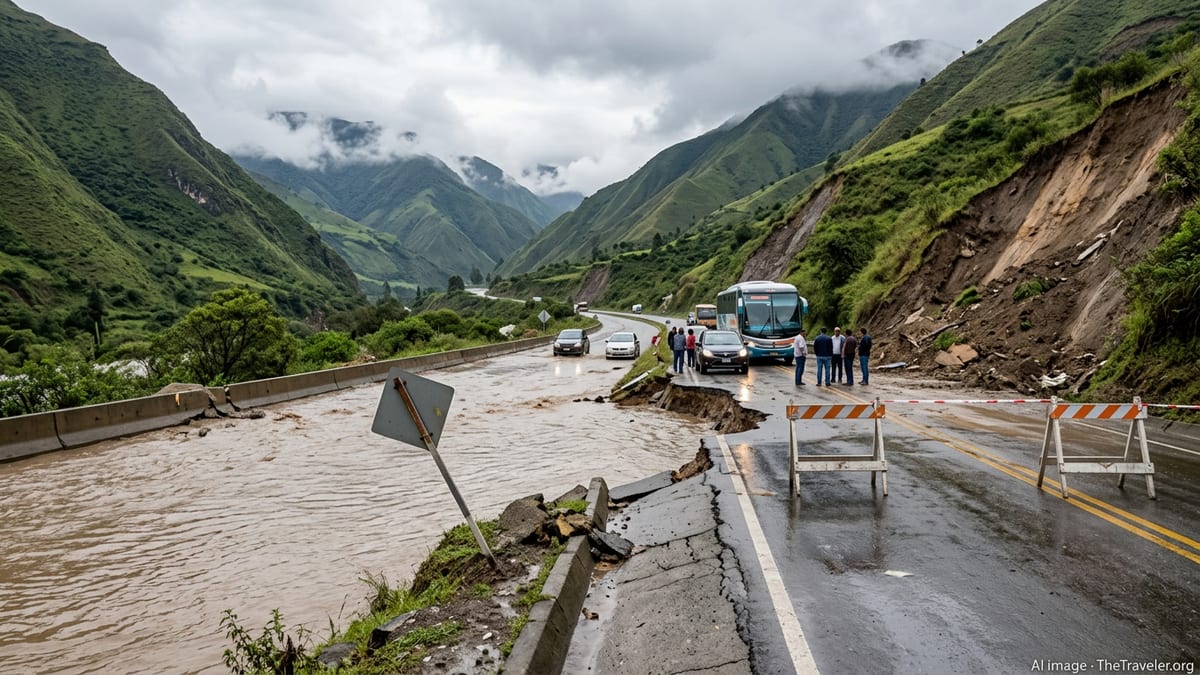
Recent months have brought an escalation of weather-related hazards across Ecuador. Reports from regional disaster monitoring agencies and humanitarian briefings indicate that, since early 2025, all 24 provinces have experienced unusually heavy rainfall, with thousands of rain-related incidents recorded nationwide. Landslides and floods have been the most frequent and damaging events, repeatedly cutting roads, damaging bridges and isolating communities.
Analyses of the 2025 rainy season compiled by international risk and humanitarian organizations describe more than a hundred thousand people affected, widespread housing damage and notable impacts on health infrastructure and water systems. In several western and northern provinces, floods and landslides have coincided with an oil pipeline rupture and localized contamination, complicating both emergency response and overland travel. These patterns have continued into early 2026 as the coastal El Niño episode extends intense rainfall over Ecuador and neighboring countries.
Travelers face particular exposure on popular intercity routes that cross steep Andean terrain. Past deadly landslides near tourist hubs such as Baños and along mountain highways underscore how quickly conditions can deteriorate when slopes saturated by days of rain give way. Even when incidents occur far from major cities, knock-on effects may include multi-hour detours, closures of bus routes, and flight disruptions if access roads to regional airports are compromised.
Authorities and aid agencies have noted that many incidents occur at night or in the early morning when visibility is poor and drivers are less able to detect washed-out sections, fallen rocks or overflowing rivers. Visitors planning road trips, long-distance buses or private transfers are therefore being urged by multiple risk bulletins to allow additional time, avoid nighttime travel where possible and monitor local weather updates closely.
Escalating Security Threats and Emergency Measures
Parallel to the climate-related emergencies, Ecuador continues to grapple with a serious security crisis. Over the past two years, published coverage by regional outlets and risk consultancies has documented sharp increases in homicides, kidnappings, extortion and gang-related clashes, particularly in Guayas, Esmeraldas and other coastal provinces. In response, the national government has repeatedly declared states of emergency and expanded the role of the armed forces in domestic security.
Recent reports from international news agencies describe tens of thousands of soldiers and police deployed to high-crime provinces under temporary curfews that restrict nighttime movement in cities such as Guayaquil and surrounding areas. While these measures are aimed at containing gang violence, they also create a more militarized environment that can be unsettling and potentially confusing for visitors who are unfamiliar with local rules or who arrive during a period of tighter controls.
Canada’s advisory notes align with those of other Western governments that warn travelers about armed robberies, carjackings and assaults that have occurred on highways, in urban neighborhoods and occasionally in areas frequented by foreigners. While the Galapagos Islands and parts of the Andean highlands continue to be assessed as relatively safer than some coastal regions, advisories stress that crime can occur anywhere and that overall risk levels in Ecuador are higher than in many other South American destinations.
For Canadians, the practical implications include potential delays in consular response in certain high-risk areas, stricter recommendations regarding after-dark movement, and caution against using informal transportation options that may lack proper registration or safety standards. Travel insurers may also treat Ecuador as a higher risk market, which can affect coverage conditions, premiums and exclusions, especially for travel to regions under formal state-of-emergency measures.
What Travelers Must Know Before Entering Ecuador
Given the overlap of environmental and security threats, the Canadian advisory framework now places particular emphasis on preparation and real-time monitoring. Travelers are urged to consult the most recent country-specific advice immediately before departure and to check whether planned routes cross provinces with heightened risk levels or active emergency measures. Published risk assessments recommend that visitors build extra flexibility into itineraries, including the ability to adjust domestic flights or postpone overland segments if conditions worsen.
Publicly available guidance underscores the importance of staying informed once in-country. This includes following local news outlets, monitoring official social media channels for updates on floods, landslides or curfews, and paying attention to announcements in bus terminals and airports where last-minute changes are often first posted. In areas prone to landslides, travelers are encouraged to ask accommodation providers and reputable local operators about current conditions on nearby roads and trails before setting out.
Canadians are also reminded that travel to regions with explicit “avoid non-essential travel” warnings may carry insurance implications. Some policies restrict coverage in areas under formal travel advisories, particularly where states of emergency or active conflict with criminal organizations are present. Prospective visitors are therefore advised, in publicly available insurance guidance, to confirm that their policy covers not only medical emergencies but also evacuation, trip interruption and natural disaster scenarios relevant to Ecuador’s current context.
For those who do proceed, security-focused recommendations include using licensed taxis or reputable ride services arranged by hotels, limiting display of valuables in public, and exercising extra vigilance in bus terminals, markets and other crowded settings. Travelers are also encouraged to register their presence abroad with Canadian consular services so that they can receive notifications and be more easily contacted in the event of severe weather, infrastructure failure or sudden changes in the security situation.
Key Regions of Concern and Safer Itinerary Choices
Canada’s most recent advisory map for Ecuador highlights particular concern along the northern border with Colombia, parts of the Pacific coast and the port city of Guayaquil, where organized crime groups have been especially active. These areas are often flagged as locations where kidnappings, bombings, prison violence and targeted assassinations have taken place, and where foreign travelers may face elevated collateral risk. Overland travel near the Colombian border is widely discouraged in multiple international advisories.
By contrast, Quito’s historic center, some parts of the Avenue of the Volcanoes, and the Galapagos Islands are generally presented as more viable for tourism, provided visitors maintain standard urban precautions and remain aware of evolving conditions. Even in these areas, however, recent rainy seasons have demonstrated that extreme weather can disrupt transportation links, fuel shortages and temporary isolation, especially for island and remote highland communities.
For travelers intent on visiting Ecuador in the coming months, itinerary choices that minimize time in high-crime coastal cities, reduce reliance on long nighttime bus journeys and prioritize regions with stronger emergency management capacity are likely to lower overall exposure. Many risk briefings now suggest combining a conservative routing strategy with continuous monitoring of both weather patterns and policy changes, such as new curfews or expanded emergency zones.
Ultimately, Canada’s heightened warning for Ecuador reflects a convergence of forces that cannot be managed through routine travel precautions alone. The scale of the rainy-season damage, together with entrenched criminal violence and shifting security measures, means conditions remain fluid. Travelers who continue to consider Ecuador are being urged by multiple public sources to approach plans with caution, detailed preparation and a readiness to change course if the situation on the ground deteriorates.