

More news on this day
Canada has escalated its travel advisory for Ecuador, citing an overlapping emergency of torrential rains, destructive floods, massive landslides and a deepening security crisis that is driving violent crime and prompting new curfews across key provinces popular with international visitors.
Get the latest news straight to your inbox!
Canada Raises Alarm as Dual Crises Grip Ecuador
Publicly available information from Canada’s official travel advisory system shows that guidance for Ecuador was updated in early January 2026 to reflect a significantly deteriorated security and public-safety environment. The advisory now highlights a nationwide risk profile shaped by gang-related violence, targeted killings, kidnappings and armed robberies, alongside growing disruption from extreme weather.
The Canadian government continues to flag specific regions for the highest levels of caution, including areas where travel is discouraged due to violent crime and states of emergency linked to gang activity. Recent analytical coverage notes that cities such as Babahoyo in Los Ríos province rank among the most dangerous urban centers in the region, with the area listed under “avoid non‑essential travel” guidance because of sustained violence.
At the same time, Ecuador’s own risk management authorities have activated extensive emergency measures in response to heavy seasonal rains. Since the start of 2026, national data cited in local media point to more than a thousand rain-related incidents, including floods, landslides, sinkholes and erosion affecting all 24 provinces, underscoring the wide geographic scope of the crisis.
The combined effect is an unusually complex risk environment for foreign travelers. Those considering trips to Ecuador in the coming weeks face a mix of weather-related hazards that can cut off transport and essential services, and a volatile security situation that can shift with little warning.
Devastating Floods and Landslides Disrupt Key Travel Corridors
Recent reporting from Ecuadorian and regional outlets describes a winter rainy season that has pushed large areas of the country into emergency mode. The National Secretariat of Risk Management has confirmed that eight provinces are currently under a 90‑day state of emergency due to damage from heavy rains. More than 19,000 people have been directly affected since January through flooded homes, damaged infrastructure and forced evacuations.
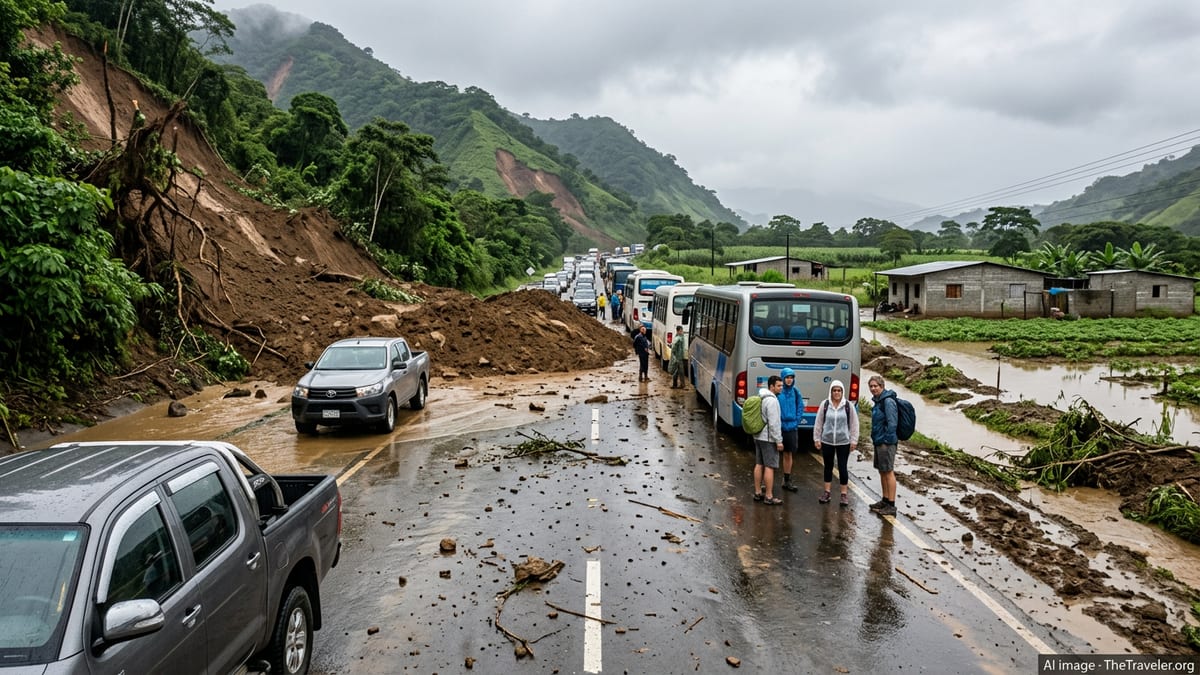
Floods and landslides have been recorded on major interprovincial routes, particularly along mountain and river valleys that connect the highland cities with the coastal lowlands. Authorities and local media note repeated road closures in provinces such as Bolívar, Cotopaxi, Azuay and Carchi, where saturated hillsides have triggered slope failures and debris flows that can bury vehicles with little warning.
In coastal and low‑lying areas including Guayas, Los Ríos, El Oro and Manabí, intense downpours have caused rivers to overflow their banks and inundate urban neighborhoods. Reports from national weather and emergency agencies describe red and orange alerts for river flooding, flash floods and urban drainage failures, particularly during periods of sustained rainfall associated with regional climate patterns.
For travelers, this means itineraries that rely on overland transport are especially vulnerable. Bus routes can be suspended without notice, bridges damaged or closed, and secondary roads rendered impassable by mud, rockfall or collapsed pavement. Canadian travelers are being urged, via open-source guidance, to monitor local advisories closely, avoid driving at night in affected regions, and be prepared for rapid changes to routes and travel times.
Escalating Gang Violence and New Curfews Heighten Security Risks
Alongside the weather emergency, Ecuador continues to experience a severe security crisis linked to organized crime and drug-trafficking networks. International coverage over the past year has documented sharp increases in homicides, attacks and high-profile criminal incidents, particularly in coastal provinces and major ports used as exit points for cocaine shipments.
According to recent analyses drawing on official statistics, Ecuador’s homicide rate has risen dramatically since 2020, reaching record levels in 2025. Events ranging from mass killings in rural communities to gruesome displays of violence on beaches have reinforced the perception of a rapidly deteriorating security environment in several provinces.
In March 2026, Associated Press reporting indicated that Ecuador deployed approximately 75,000 soldiers and police across four crime‑affected provinces, including Guayas and Los Ríos, and imposed nightly curfews from 11 p.m. to 5 a.m. for at least two weeks. Separate coverage days earlier described preparations for a major offensive against criminal organizations with logistical support from the United States, underscoring the scale of the challenge facing local authorities.
Canada’s advisory reflects these developments, highlighting a widespread risk of violent crime, express kidnappings, carjackings and armed robberies, and noting that security measures, including curfews and military deployments, may be introduced or tightened at short notice. Travelers are cautioned that such measures can restrict movement, close businesses and public spaces, and limit access to transport options, particularly at night.
High-Risk Regions and What Travelers Need to Consider
Canadian guidance distinguishes between different levels of risk inside Ecuador, and recent third‑party analyses offer additional context that travelers may find useful. Border regions near Colombia, certain coastal areas and specific provinces affected by criminal gang activity are described as posing elevated dangers ranging from kidnappings to crossfire during security operations. In some border areas within 20 kilometers of Colombia, various governments explicitly advise against all travel.
Major cities and tourism hubs face their own challenges. Guayaquil, Ecuador’s largest city and a key gateway for many international flights, has been a focal point for gang disputes and assassinations in recent years. Media coverage has also highlighted recurring violence linked to prison systems, with deadly riots and escapes that can spill over into surrounding neighborhoods.
Even areas known for nature and adventure tourism are not fully insulated. Historical incidents, such as deadly landslides near the resort town of Baños in 2024, illustrate how heavy rains can quickly transform mountain highways and hiking areas into high‑risk zones. With the current rainy season already generating hundreds of landslide reports, travelers planning road trips, trekking or visits to waterfalls and canyons are urged in public advisories to check conditions daily and use local, reputable operators.
Travelers are also reminded that the situation can evolve quickly. States of emergency, curfews and localized restrictions may be extended or expanded if violence or severe weather worsens. Airline schedules, ferry crossings and intercity bus services can be disrupted at short notice, and infrastructure damage may take weeks to repair in some remote areas.
Practical Safety Measures for Canadians in or Heading to Ecuador
For Canadians already in Ecuador, official open-source guidance emphasizes the importance of registering travel plans with consular services, keeping family or contacts informed of movements, and maintaining flexible itineraries that can be adjusted if roads close or security incidents occur. Travelers are advised to follow local news in Spanish or English, pay attention to civil defense alerts, and heed instructions from hotels and transportation providers about affected neighborhoods or routes.
In urban settings, safety advice commonly includes using only registered taxis or reputable ride‑hailing services arranged through hotels, avoiding the display of valuables, and limiting travel after dark, especially in areas reported to have high crime levels. Visitors are encouraged to stay in well‑reviewed accommodations that provide secure access and 24‑hour reception, and to keep copies of passports and key documents in separate locations.
Given the flood and landslide risk, travelers are also urged to avoid riverbanks, steep slopes and informal hillside settlements during and after heavy rain. Publicly available emergency guidance from Ecuadorian authorities stresses that even short, intense storms can trigger rapid water level rises and slope failures. Travelers driving in rural or mountainous regions are encouraged to carry extra water, food and fuel, and to avoid attempting to cross flooded roads.
Finally, analysts recommend that visitors review their travel insurance coverage carefully to ensure it includes medical evacuation and disruption related to natural disasters and civil unrest. With Canada’s advisory clearly underscoring both environmental and security threats, well‑prepared travelers will need to weigh the current risks against the possibility of postponing non‑essential trips until conditions stabilize.