

More news on this day
Canada is urgently warning its citizens to avoid non-essential travel across swathes of the Middle East as airspace closures, missile strikes and rapidly shifting military activity unleash severe disruption across some of the world’s busiest flight corridors.
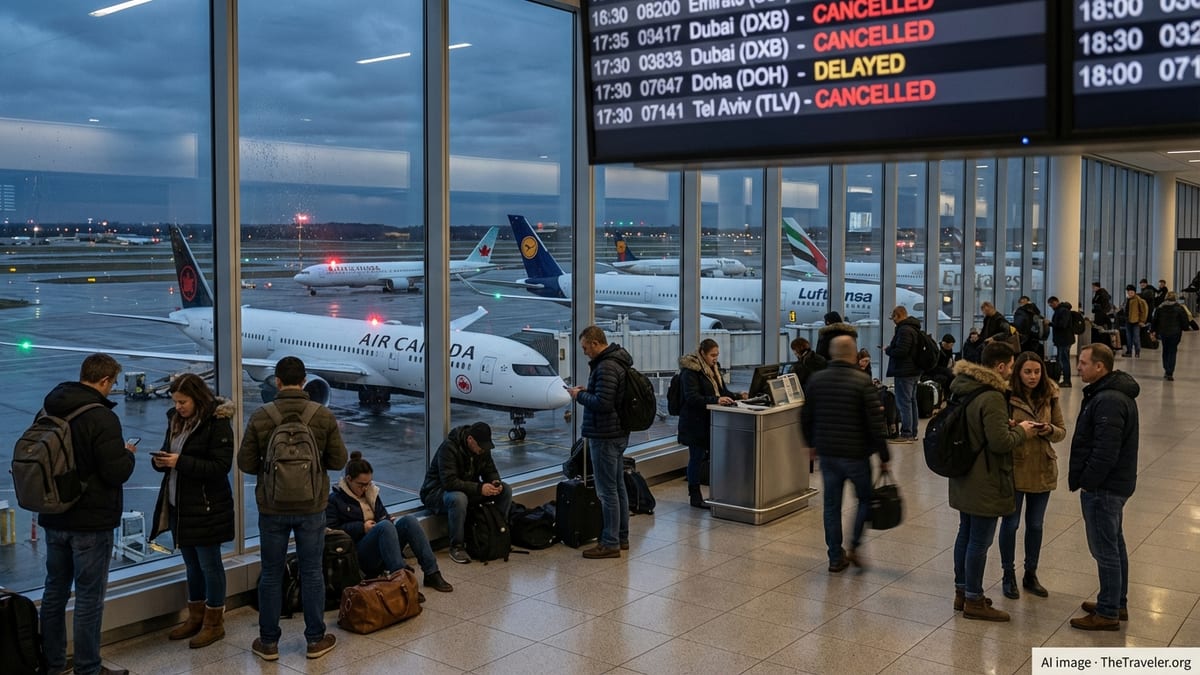
Ottawa Escalates Advisories as Regional Conflict Spreads to the Skies
The federal government has updated its travel advisories for multiple countries in the Middle East following a wave of United States and Israeli strikes on Iran and subsequent retaliatory attacks, which have turned regional skies into an active conflict zone. Officials in Ottawa say the risk to civilian aviation has risen sharply, with some national airspaces partially or fully closed and others subject to short-notice military restrictions.
Canadians are being urged to avoid all travel to Iran, Israel and the Palestinian territories and to reconsider non-essential trips to nearby states where spillover risks and sudden airspace changes are now a daily reality. The advisories highlight the potential for miscalculation or misidentification of civilian aircraft, particularly where military assets are operating at high tempo and at multiple altitudes.
Diplomatic sources say Canada is closely coordinating with partners including the United States, European Union members and Gulf states to track airspace notifications, missile activity and drone launches. Ottawa has also warned that consular assistance could be limited or delayed in areas where airports are closed, commercial flights are grounded or overland routes are affected by protests, fuel shortages or border restrictions.
Air Canada Halts Key Routes as Middle East Hubs Seize Up
Air Canada has moved quickly to suspend and reshape its operations in the region, acknowledging that the current military situation makes normal scheduling impossible. The carrier has suspended flights to Tel Aviv and Dubai and is cautioning passengers not to travel to affected airports while it reassesses safety conditions and navigational alternatives.
In a series of customer updates, the airline said all services to and from Dubai and Tel Aviv remain suspended, with an expanded flexible-change policy covering tickets purchased before the latest escalation. Travelers booked to or through Dubai, Abu Dhabi, Tel Aviv, Beirut, Amman, Erbil and Dammam for travel in early to mid March are being offered free date changes within a defined window or full refunds if they choose to cancel.
The shutdown of major hubs and air corridors has triggered widespread knock-on effects for Canadian travelers far beyond the Middle East itself. Flights between Canada and South Asia, East Africa and parts of the Indian Ocean region are facing longer routings and potential delays as airlines reroute around closed or high-risk airspace. Industry analysts say carriers will be forced to balance safety, fuel costs and crew duty limits while trying to maintain at least skeletal global connectivity.
Airspace Closures, Rerouting and a Maze of Notices to Air Missions
The most immediate impact of the crisis has been the rapid closure or restriction of airspace across a broad arc of the Middle East. Authorities in Iran, Israel and several neighbouring states have issued sweeping notices to air missions, limiting civilian access to key flight levels and temporarily shutting entire sectors to commercial traffic during peak military operations.
Iran has already been operating under tight aviation restrictions, including a nationwide suspension of many low-altitude visual flight operations until late April, and the latest strikes have only intensified scrutiny of the airspace above and around the country. Security experts say these layered bans and corridors create a patchwork of safe and unsafe routes that can change multiple times a day, complicating flight planning for Canadian and other international airlines.
For travelers, the result is a confusing mix of cancellations, rolling delays and unexpected diversions as aircraft are rerouted around danger zones or forced to land at alternate airports. Airline websites and apps often lag behind real-time operational decisions, leaving passengers to navigate a haze of partial information, changing departure times and long waits for rebooking or refunds at overwhelmed call centres and check-in desks.
Canadian Travellers Stranded and Itineraries Upended Worldwide
As airspace closures ripple outward, thousands of Canadian travelers have found themselves stranded at airports from Dubai to European and Asian transit hubs. Travel agents report a surge in emergency calls from clients seeking last-minute alternatives to reach home or continue their journeys without overflying the Middle East, often at significantly higher cost.
Tour operators specializing in pilgrimages, cruise extensions and winter sun packages in the Gulf say itineraries that once relied on smooth connections through Dubai, Abu Dhabi or Doha are now under urgent review. Some are scrambling to rebook clients via southern routes through Africa, while others are suspending departures entirely until there is greater clarity on the safety and reliability of regional airspace.
Travel insurers are fielding questions about coverage for trip cancellations, missed connections and extended hotel stays caused by the conflict. Policy terms vary widely, but many plans treat war and acts of state conflict differently from standard weather or mechanical delays, leaving some travelers uncertain about what support they can expect if their route crosses newly volatile skies.
What Canadians Need to Know Before Booking or Boarding
Officials and aviation experts stress that Canadians should not assume their journey is unaffected simply because their final destination is outside the Middle East. Any long-haul flight to Africa, South Asia, the Indian Ocean or parts of Southeast Asia may be impacted if its usual routing passes near restricted airspace, even if the flight still appears on schedule at the time of booking.
Travelers are being advised to monitor official travel advisories for their destination and any planned transit points, check airline communications frequently and keep contact details up to date in their bookings. Those already abroad are urged to maintain flexible plans, carry extra medication and essentials in their hand luggage in case of unexpected stopovers, and be prepared for sudden schedule changes.
For now, Canadian authorities are not ruling out further tightening of travel guidance or targeted evacuation assistance if the security situation deteriorates around key hubs. With the regional military picture still fluid and the pattern of airspace openings and closures shifting by the hour, officials say the safest assumption for anyone planning to cross or approach Middle Eastern skies is that disruption is likely and rapid changes are possible right up to departure.