

More news on this day
A wave of free and heavily discounted domestic flights linking Canada and Japan is poised to reshape how visitors move around the country in 2026, steering budget-conscious travelers away from familiar hubs and into rural communities that have long struggled to attract international tourism spending.
Get the latest news straight to your inbox!
From Experimental Campaigns to a Cross-Pacific Opportunity
Japan has spent the past several years testing how free domestic flights can nudge foreign visitors beyond Tokyo and Kyoto. A series of limited-time campaigns by major carriers such as All Nippon Airways and Japan Airlines has offered overseas travelers complimentary or deeply discounted seats on internal routes, typically when bundled with an international ticket. Publicly available information shows that these initiatives have been framed as a tool to relieve pressure on overcrowded hotspots and redirect demand toward lesser-known regions.
Coverage in European and Asian outlets indicates that these schemes have focused first on key source markets such as the United Kingdom and continental Europe, often during winter travel windows between late 2025 and early 2026. In parallel, Japan’s national tourism authorities have promoted regional recovery campaigns in areas hit by natural disasters, pairing free or discounted flights with messaging around supporting local businesses and communities.
Within this broader context, travel analysts in Canada are now watching closely as discussions around a Canada–Japan free flight concept gather momentum for the 2026 travel year. While program details remain fluid, the working idea mirrors earlier models: Canadians booking eligible trans-Pacific tickets would be able to add one or more domestic legs within Japan at no additional base fare, opening up access to secondary cities and rural gateways that are typically expensive to reach.
Industry commentary suggests that airlines and tourism boards see Canada as a logical next step. Canada is a high-spend, long-haul market with strong repeat visitation to Japan, yet itineraries often concentrate on the same urban corridor. A dedicated free-flight channel for Canadian travelers would test whether incentives proven in Europe can be scaled successfully across the Pacific.
How the Free Flight Structure Could Work for Canadian Travelers
Although timelines and partners for a Canada–Japan free flight program in 2026 have not been formally finalized, publicly discussed models and existing international schemes offer a clear picture of how it would likely be structured. Under comparable campaigns, travelers receive a code or booking option when purchasing an international flight on a participating carrier. That code unlocks up to two domestic segments within Japan at a promotional fare that removes the standard base ticket cost, leaving only taxes and airport fees.
For a Canadian traveler, that could mean flying from Vancouver or Toronto into a major gateway such as Tokyo Haneda or Narita, then adding a free onward flight to regional destinations like Aomori in Tohoku, Tokushima on Shikoku, or Kagoshima in southern Kyushu. Instead of purchasing a separate domestic ticket that might otherwise push a trip over budget, the traveler folds regional exploration into the original long-haul booking.
Reports on similar European-focused schemes indicate that eligible routes are typically limited to economy class, with fixed booking windows and blackout dates. Seats are capacity controlled, which means the most popular periods and routes may sell out quickly. For the Canada–Japan concept, industry observers expect a similar pattern: advance planners and shoulder-season travelers would be best placed to take advantage of the offer, while last-minute visitors might find more limited options.
Travel planners also note that such a program can be particularly powerful for Canadians building multi-stop itineraries on a tight budget. Internal journeys that once required juggling low-cost carriers, complex rail passes, or overnight buses could instead be handled on a single reservation, reducing both costs and logistical friction.
Rural Japan Stands to Gain From Budget Travelers
Japan’s tourism statistics show that visitor numbers have rebounded strongly since borders fully reopened, yet overnight stays remain concentrated in a handful of prefectures anchored by Tokyo, Osaka, and Kyoto. At the same time, surveys cited in regional tourism plans indicate that a large majority of international visitors express interest in rural landscapes, smaller cities, and off-the-beaten-path cultural experiences, even if they rarely build them into a first or second trip.
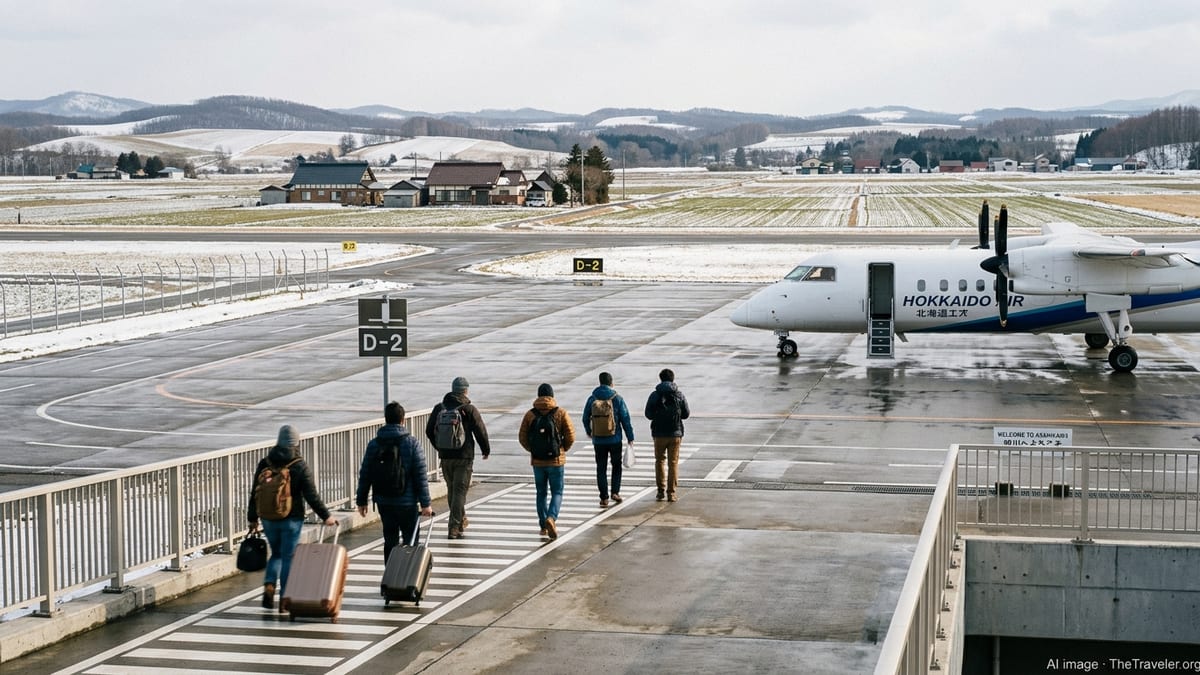
A Canada–Japan free flight program would directly target that gap between aspiration and action. By removing one of the biggest cost barriers to exploring the countryside, it encourages travelers to look beyond familiar itineraries and consider destinations such as coastal Tohoku, mountain villages in Shikoku, hot spring towns in Kyushu, or agricultural heartlands in Hokkaido. In many of these places, a small uptick in foreign guests can have an outsized effect on local businesses.
Regional development plans in Japan often highlight tourism as a tool to counter population decline and economic stagnation in rural areas. When a visitor from Canada spends money at a family-run ryokan, a neighborhood izakaya, or a community-operated activity like rice planting or craft workshops, that spending circulates locally rather than disappearing into large-city chains. Free flight access does not guarantee balanced growth, but it does change the geography of where visitors can realistically afford to go.
Budget-conscious Canadian travelers may also be better aligned with the type of tourism many rural communities say they want. Public commentary from local tourism organizations frequently emphasizes slower travel, longer stays, and deeper engagement over quick-hit day trips. Free domestic flights make it more feasible to structure a trip around one or two lesser-known regions instead of a checklist of top-ten attractions.
Economic Ripple Effects for Local Communities
Evidence from earlier free-flight and discount campaigns suggests that the financial impact does not stop at the airport. When airlines waive base fares on domestic routes, they effectively treat the ticket as a form of targeted subsidy for regional economies, betting that each free seat will translate into multiple nights of accommodation, restaurant meals, retail purchases, and local transport spending.
Economic modeling used in Japanese tourism policy discussions often estimates that a single long-haul visitor can generate several times the value of their airfare in local consumption. If even a modest share of Canadian travelers use free domestic legs to reach rural prefectures, that could create a measurable uptick in revenue for small and medium-sized enterprises, from guesthouses and onsen resorts to taxi cooperatives and family-owned tour operators.
The benefits extend to seasonal balance as well. Observers of recent campaigns note that many have been timed for winter and shoulder seasons, when hotel occupancy drops and local businesses struggle with cash flow. A Canada–Japan program calibrated for 2026 could follow a similar pattern, strategically filling quieter periods in ski regions, coastal areas, and hot spring towns that are well suited to Canadian tastes but often overlooked outside peak cherry blossom and autumn foliage windows.
There are, however, notes of caution from communities that have already weathered waves of sudden tourism growth. Some local commentators point to risks of crowding in fragile environments, cultural misalignment, and uneven benefits within regions. For the Canada–Japan free flight initiative to be seen as an economic positive, coordination between airlines, local governments, and community groups will be critical, particularly in ensuring that marketing campaigns highlight areas with the infrastructure and interest to host more international guests.
What Canadian Travelers Should Watch Ahead of 2026
Travel industry reports indicate that 2026 is shaping up as a pivotal year in Japan’s international tourism strategy, with free and subsidized transport at the center of efforts to disperse visitors and strengthen regional economies. Canadians considering a trip should monitor airline announcements, tourism board updates, and travel trade coverage for confirmation of eligibility rules, dates, and participating airports tied specifically to the Canada–Japan free flight framework.
Based on existing programs in other markets, travelers can expect strict booking windows, limited seat allocations, and specific fare classes that qualify for the promotion. Those willing to plan several months in advance will likely capture the best value. Travel advisors also suggest building itineraries around a small number of regions reachable via the free-flight network rather than trying to string together too many domestic hops that might fall outside the promotional structure.
Even with these constraints, the potential upside is significant. For many Canadians, domestic flights inside Japan have been the hidden cost that pushes an otherwise affordable trip out of reach, particularly for students, young professionals, and families planning multi-city routes. If the Canada–Japan free flight program crystallizes along the lines currently being discussed, it could open rural Japan to a new cohort of budget-conscious visitors while giving local economies a timely boost.
For Japan, the initiative would signal a shift from simply counting arrivals to actively shaping where those visitors go and how they spend. For Canadian travelers, it represents a rare alignment of value and adventure in one of the world’s most sought-after destinations.