

More news on this day
Canada is moving ahead with a carefully scoped expansion of Toronto’s Billy Bishop Toronto City Airport, with new safety infrastructure and governance changes positioning the downtown hub for increased travel and broader economic activity in the years ahead.
Get the latest news straight to your inbox!
Runway Safety Project Clears Key Environmental Milestones
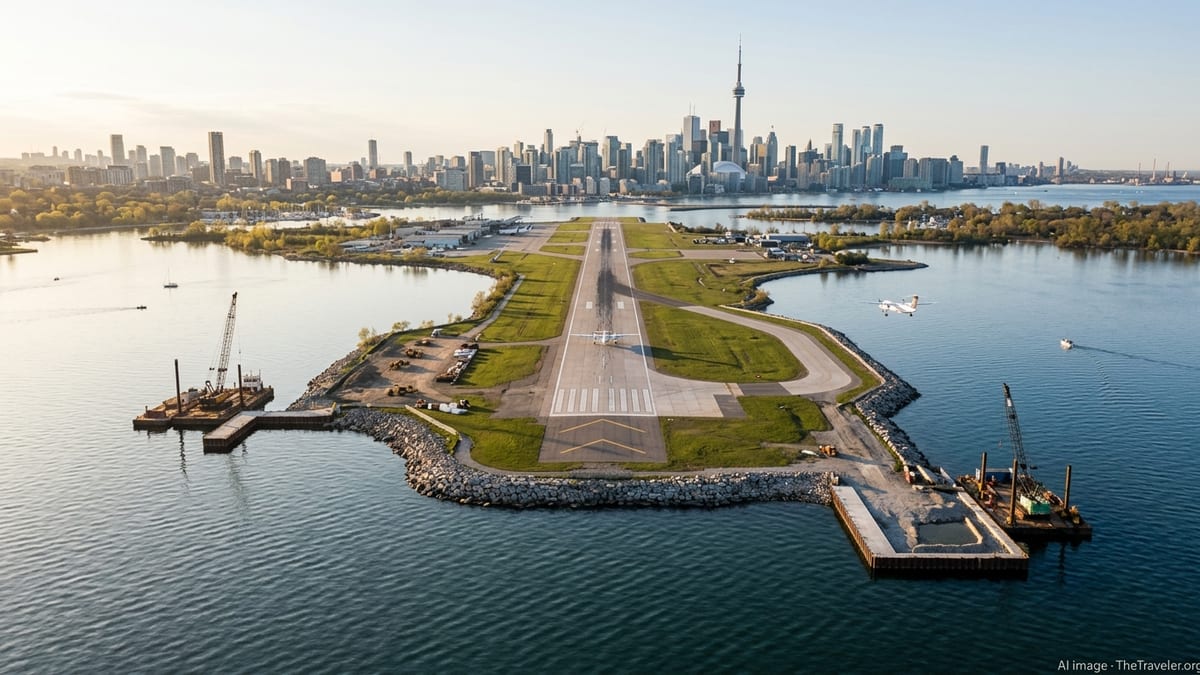
Plans to expand the airfield at Billy Bishop are centered on meeting Transport Canada’s runway end safety area requirements, which call for additional protected space at each end of the main runway. Publicly available information indicates that PortsToronto, the airport’s owner and operator, has completed a non-statutory environmental assessment for the project and selected a minimal landmass extension design intended to limit impacts on Toronto’s inner harbour.
The preferred concept adds modest new land at both the east and west ends of the existing runway to accommodate engineered safety zones without lengthening the strip itself. Federal documents on the project emphasize that there will be no change to the types of aircraft currently permitted to use the airport, distinguishing the safety-driven expansion from earlier, more controversial proposals tied to jet operations and longer runways.
Reports on the airport’s consultation process show that the environmental review examined construction effects, marine navigation, fish habitat and shoreline dynamics, reflecting the airport’s location on the Toronto Islands. The study process also set out mitigation measures, including controls on in-water work and commitments to restore marine habitat once the new structures are in place.
With the environmental assessment finalized and a design-build contract awarded, the project is now moving into detailed design and permitting. The current schedule aims to achieve compliance with federal runway safety rules ahead of a 2027 deadline, aligning Billy Bishop with updated standards at other Canadian airports.
Tripartite Agreement Changes Enable Long-Term Investment
The advance of the safety expansion has been closely tied to the legal framework that governs Billy Bishop. The airport operates under a tripartite agreement between PortsToronto, the City of Toronto and the federal government, which sets out conditions for infrastructure changes, noise limits and the types of aircraft that may use the facility.
According to council records and agency statements, Toronto City Council voted in 2024 to endorse the minimal expansion option for the runway safety areas and to extend the airport lease by roughly a dozen years, to the mid-2040s. That decision gave PortsToronto the operational certainty it sought to finance and deliver the multi-year construction program.
Subsequent documentation from the port authority shows that the three partners concluded a formal amendment to the tripartite agreement in early 2025, specifically to enable the runway safety project. The amended terms recognize the need to complete the work by the federal compliance date and open the door to further discussions on a longer-term framework for airport operations once the safety upgrades are in place.
Those governance changes are seen by analysts as a signal that senior governments view Billy Bishop as a long-term part of the regional aviation network. While the current expansion is constrained to safety works, the updated agreement underpins other investments at the airport, from terminal improvements to new border facilities.
Downtown Airport Positioned as a Growth Engine for Travel
Billy Bishop has grown into a key short-haul hub for Toronto, serving regional business and leisure routes within Canada and to the northeastern United States. Passenger volumes rebounded strongly after the pandemic, and published annual reports from PortsToronto describe the airport as an important contributor to jobs, visitor spending and tax revenues for the city’s core and waterfront.
Economic impact studies prepared for earlier planning exercises have highlighted the airport’s role in supporting corporate travel, tourism and convention business by offering quick access to downtown financial and entertainment districts. The compact terminal, frequent shuttle connections to the central business district and proximity to major hotels have proven attractive to time-sensitive travelers.
The safety-driven airfield expansion is expected to reinforce that role by ensuring regulatory compliance and operational resilience, which in turn support airline scheduling and investment decisions. Industry observers note that upgrading critical infrastructure typically reduces the risk of future service disruptions tied to regulatory deadlines, making the airport a more reliable gateway for carriers and passengers.
In parallel, other enhancements at Billy Bishop are reshaping the travel experience. Public coverage has pointed to the arrival of a permanent United States preclearance facility in 2026, which allows travelers to clear U.S. border formalities before departure and arrive stateside as domestic passengers. That change is anticipated to make downtown-to-downtown itineraries even more competitive relative to larger suburban airports.
Balancing Waterfront Concerns With Regional Connectivity
The decision to move forward with an expansion on Toronto’s inner harbour has renewed attention on how the airport coexists with a rapidly developing waterfront. Consultation materials issued by the city and PortsToronto in 2024 and 2025 underline efforts to balance regional connectivity with local quality-of-life priorities such as noise, air quality and access to recreational spaces.
The selected safety-area design was framed as a compromise solution that satisfies federal requirements while limiting the footprint of new fill in the lake. Background reports describe it as the smallest of several options reviewed, chosen specifically to reduce marine impacts and minimize encroachment into shipping channels and boating areas around the Western Gap.
Noise and emissions remain central to the debate over the airport’s future scale. The current expansion does not alter the existing ban on jets or the runway length, and federal project summaries explicitly state that aircraft types will remain unchanged. For some waterfront residents and environmental advocates, however, any physical growth at the airfield raises questions about incremental traffic and the long-term vision for the islands.
City briefing documents indicate that municipal staff will continue to monitor operations as the construction program advances, including tracking community feedback on construction noise, haul routes and work hours. PortsToronto has committed to a construction management and traffic plan designed to limit disruption, including an emphasis on overnight runway work to maintain daytime flight schedules.
Longer-Term Prospects and Policy Choices Ahead
While the current expansion is defined as a safety and compliance project, recent political developments suggest that the future of Billy Bishop will remain a live policy issue. Provincial leaders have signaled interest in a broader economic role for the airport, and public debate continues over whether jets or a longer runway should one day be reconsidered to support new routes.
For now, federal and project documentation draw a clear line between the safety-area construction and any renewal of past jet proposals. The present plan holds to the existing turboprop-focused operating model, even as new infrastructure and governance arrangements potentially create a platform for future discussions among governments, regulators, airlines and residents.
Transportation planners note that downtown Toronto’s wider transit network, including light rail projects on the waterfront and Eglinton corridor, will influence how the airport fits into the region’s long-term mobility picture. Better surface connections could either amplify the appeal of a constrained but convenient island airport or shift more growth toward larger facilities with room for additional runways and terminals.
As construction preparation advances through 2026, Billy Bishop’s expansion is emerging as both a technical engineering project and a test case for how Canadian cities integrate aviation infrastructure into dense, waterfront settings. The outcome will help define the balance between urban growth, environmental protection and the demand for fast, downtown-oriented air travel.