

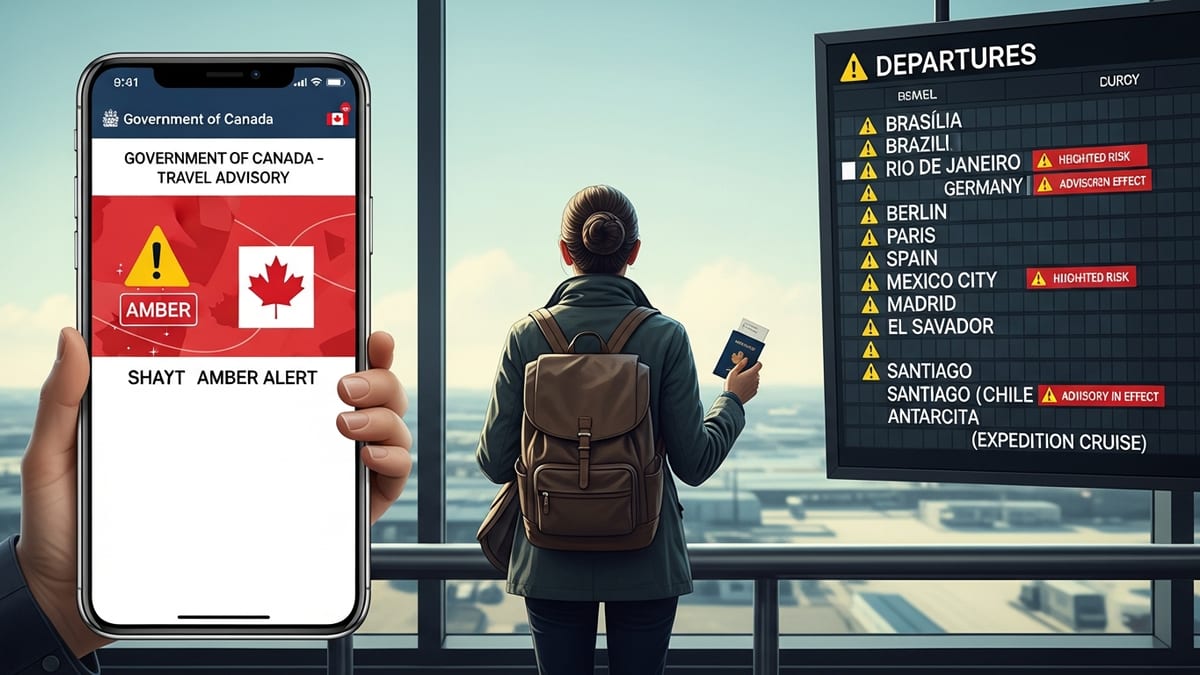
Canada has added Brazil to a fast-expanding roster of destinations flagged for heightened security risks and political volatility, grouping the South American giant with countries such as Germany, El Salvador, Mexico, Spain, France and Chile, as well as Antarctica.
The move underscores a broader recalibration of Canadian travel advice as governments confront overlapping crises, from urban crime and migration pressures to institutional instability and extreme-weather vulnerability.
More News
- Baja California Sur Raises Tourist Embrace It Tax for 2026 Visitors
- Free 2026 Airport Coaches Turn Hong Kong into No-Cost Gateway to Macao
- Flood Risk and Travel Disruption as Heavy Rain Batters South and Mid Wales
Brazil’s Risk Level Raised Amid Crime, Unrest And Institutional Strain
In its latest advisory update for Brazil, the Government of Canada is urging travellers to exercise a high degree of caution, highlighting persistent violent crime, entrenched inequality and periodic eruptions of political tension. The notice follows a series of high-profile incidents in major urban centres, concerns over organised gangs in some states and lingering unease after the January 8, 2023 storming of government buildings in Brasília. While the advisory stops short of recommending that Canadians avoid non-essential travel, it marks a firmer tone on security and situational awareness across the country.
Authorities warn that violent crime, including armed robbery, carjacking and assaults, can occur in broad daylight in cities such as Rio de Janeiro, São Paulo, Salvador and Recife. Travellers are advised to avoid displaying jewellery or electronics, to use registered taxis or ride-hailing services arranged through hotels, and to stay clear of informal housing areas where security conditions can deteriorate rapidly. Canadian officials also refer to targeted police operations in favelas and on highways, which may trigger sudden road closures and the risk of being caught in crossfire.
Beyond day-to-day crime, Canadian risk assessors are monitoring the broader political climate. Deep polarisation, contentious reforms and disputes over indigenous land demarcation have all fuelled protests in recent months. While most demonstrations are peaceful, the advisory stresses that they can escalate quickly, with security forces deploying tear gas and non-lethal munitions. Travellers are urged to follow local media, heed instructions from authorities and avoid large gatherings even when they appear festive or well organised.
Canadian consular officials emphasise that millions of tourists visit Brazil each year without incident, drawn by its beaches, Amazonian biodiversity and cultural festivals. Nonetheless, the latest advisory reflects Ottawa’s view that the balance of risks has shifted, with organised crime, social tension and institutional fragility now combining to create a more unpredictable environment, particularly for visitors unfamiliar with local conditions.
Germany, France And Spain Face Heightened Threat Environment Inside Europe
The inclusion of European heavyweights like Germany, France and Spain in Canada’s roster of concern illustrates how security anxieties are no longer confined to traditionally fragile states. Ottawa’s advice for these destinations generally urges travellers to exercise a high degree of caution, citing the risk of terrorism, politically charged demonstrations and sporadic episodes of violent unrest in major cities and transport hubs.
For Germany, Canadian officials point to an elevated terror threat, as well as the possibility of attacks motivated by extremist ideologies from across the political spectrum. Large public events, Christmas markets, train stations and airports have been singled out as locations requiring particular vigilance. Canada notes that German security agencies remain on alert following disrupted plots and isolated violent incidents that have kept the national alert level at a sustained high.
In France and Spain, similar concerns about terrorism and public order have been compounded by recurring protests linked to economic reforms, labour disputes and regional independence movements. France has witnessed waves of demonstrations over pension changes and policing, some of which devolved into clashes, property damage and transit shutdowns in Paris, Marseille and other cities. Spain has faced periodic unrest in Catalonia, as well as strikes that disrupt rail and air travel. Canadian travellers are advised to monitor local media, anticipate delays and remain flexible with sightseeing or intercity itineraries.
Despite the strength of public institutions and well-resourced security forces in these European states, the Canadian government frames its advisories as a reminder that densely populated urban areas can become flashpoints with little warning. The guidance encourages visitors to be especially cautious around government buildings, embassies, religious sites and locations where large crowds gather, from sporting arenas to major tourist attractions.
El Salvador, Mexico And Chile Under Scrutiny For Crime, Protests And Political Volatility
Latin America features prominently in Canada’s updated travel guidance, with El Salvador, Mexico and Chile each flagged for distinct but overlapping concerns. El Salvador has drawn international attention for its aggressive security crackdown targeting gangs, a policy that has drastically reduced officially recorded homicide rates but raised questions over human rights and due process. Canada’s advisory recognises the improved statistics but notes that security operations can be unpredictable, with heavily armed forces deployed in urban neighbourhoods and rural communities on short notice.
Mexico remains one of the most complex destinations in Canada’s advisory portfolio, reflecting stark regional disparities in safety conditions. While popular resort zones and urban cultural centres continue to welcome large numbers of Canadian visitors, Ottawa points to persistent cartel-related violence, kidnappings and highway robberies, particularly in border states and certain interior regions. Travellers are often cautioned to stay within tourist corridors, avoid night driving and rely on reputable transport and tour operators vetted in advance.
In Chile, traditionally regarded as one of South America’s more stable democracies, Canadian officials have become more guarded since the mass protest movement that erupted in October 2019 over inequality and living costs. Although day-to-day life has largely normalised, the country’s drawn-out constitutional overhaul, periodic demonstrations and occasional confrontations between protesters and police have kept risk analysts on edge. Canada has previously advised travellers to steer clear of protest areas in Santiago, Valparaíso and Concepción, warning that even peaceful marches can lead to the use of tear gas and crowd-control measures.
Across these three countries, the Canadian government stresses the importance of tailoring risk assessments to specific destinations within national borders. While coastal resort zones and well-policed business districts may see only minor disruptions, interior routes, border regions and urban peripheries can present markedly different realities, with organised crime, social unrest and weak local governance amplifying the potential for harm.
Antarctica’s Unique Hazards Keep Risk Level Elevated
The presence of Antarctica alongside large nation-states in Canadian advisories and travel-industry headlines may appear incongruous at first glance, but Ottawa’s stance reflects the continent’s unique blend of environmental and logistical hazards. Canada continues to classify Antarctica as a destination where travellers should exercise a high degree of caution, emphasising severe weather, isolation and the near-total absence of medical and emergency infrastructure.
Canadian guidance stresses that Antarctica is subject to rapidly changing conditions, with high winds, sub-zero temperatures and intense ultraviolet radiation combining to create a hostile environment for unprepared visitors. Even cruise passengers who step ashore only briefly can face risks of slip-and-fall incidents on ice, exposure-related injuries and accidents involving small landing craft used to shuttle between ships and coastal sites.
Ottawa underlines that there are no Canadian diplomatic offices or permanent emergency services on the continent, and that search and rescue resources are extremely limited and often distant. As a result, travellers are urged to take out comprehensive insurance, including coverage for medical evacuation that may require multiple air and sea legs at significant cost. Independent expeditions are advised to notify Canadian authorities of their plans prior to departure and to ensure they can remain self-sufficient for the duration of their journey.
The advisory also draws attention to strict environmental rules under the Antarctic Treaty System and related protocols, which impose limits on tourist numbers at landing sites, ban interference with wildlife and regulate waste disposal. Canadian citizens and operators are reminded that they are subject not only to international norms but also to domestic legislation governing their conduct in polar regions, reinforcing the message that Antarctica is not a casual adventure destination.
How Canada Calibrates Its Global Travel Warnings
The expanding list of countries and territories singled out in Canadian travel advisories reflects a systematic approach to risk evaluation that has grown more sophisticated in recent years. Officials at Global Affairs Canada weigh a range of indicators, including crime statistics, political developments, conflict dynamics, natural-disaster exposure and public-health threats, before assigning one of four core risk levels that range from normal safety precautions to advice against all travel.
Brazil, Germany, France, Spain and Chile currently fall into the category where Canadians are urged to exercise a high degree of caution, acknowledging that while daily life remains functional and tourism continues, the broader environment is less predictable than in the past. El Salvador and Mexico present a more complex picture, with intra-country variations that can lead authorities to single out specific states, border zones or urban districts for stronger warnings within an overall framework of increased vigilance.
Antarctica, by contrast, is assessed largely on its structural isolation and environmental conditions rather than on crime or political factors. Yet in practice, the result is similar: travellers are told to plan meticulously, be ready for rapid changes and understand that help may be far away or slow to arrive. This method of comparative risk assessment has led Canada to group seemingly disparate destinations together, united by the common thread of elevated uncertainty for visitors.
Behind each advisory, Canadian analysts draw not only on diplomatic reporting and local law-enforcement data but also on input from airlines, tour operators and insurance firms that track on-the-ground incidents in real time. These insights feed into periodic revisions, which can either tighten or relax the language used in travel advice, sometimes with little public fanfare. For travel planners and tourism businesses, staying attuned to these shifts has become an indispensable part of anticipating demand and designing products that align with travellers’ risk tolerance.
Impact On Global Tourism And Travellers’ Decision-Making
The broadening sweep of Canadian travel warnings has significant implications for both travellers and the tourism economies of the countries concerned. While advisories are not legally binding, they often influence personal choices, corporate travel policies and insurance coverage, particularly when the language moves from routine caution to discouraging non-essential trips. Tour operators selling packages to affected destinations report that they frequently must field questions from clients concerned about the practical consequences of a higher-risk designation.
In Brazil and Mexico, for example, Canadian travellers remain an important market segment for sun-and-sand resort areas, eco-tourism lodges and cultural circuits that combine major cities with natural attractions. Local tourism boards and private-sector stakeholders routinely highlight security improvements in specific regions, increased resort policing and technology-driven safety initiatives, from surveillance systems to stricter access controls. Yet official advisories can cut through these messages by reminding visitors that isolated incidents, even in popular areas, can have serious repercussions.
European destinations like Germany, France and Spain are less likely to see sharp drops in Canadian arrivals from advisory wording alone, given their deep appeal and extensive air connectivity. However, travellers may adjust behaviour within cities, opting for earlier dinners, avoiding late-night public transport or steering clear of demonstrations and high-profile political events. Travel insurers and corporate travel managers may also tighten internal guidelines for staff attending conferences or trade fairs, especially if events coincide with elections or tense diplomatic stand-offs.
For Antarctica, the effect of Canada’s messaging is more targeted, reinforcing an already cautious market where most visitors travel through specialised expedition operators. Here, advisories tend to push prospective travellers toward companies with robust safety records, small-group policies and clear contingency plans, subtly reshaping demand in favour of operators able to demonstrate compliance with international environmental and safety standards.
What Canadian Travellers Are Being Advised To Do Now
As Brazil joins Germany, El Salvador, Mexico, Spain, France, Chile, Antarctica and others on Canada’s watch list of destinations facing heightened security or political uncertainty, officials are pressing travellers to adopt a more proactive approach to risk management. The core message is to prepare thoroughly, stay informed and remain flexible before and during any trip abroad, particularly in countries experiencing rapid social or political change.
Canadians are urged to register their journeys through federal traveller enrollment systems so that they can receive security updates and be contacted in emergencies. Before departure, authorities recommend consulting the latest advisory not only for a country as a whole but also for specific regions or cities, and to cross-check that information against airline notices and reputable local news outlets. Travellers are further encouraged to share itineraries with family or friends, carry digital and physical copies of important documents and maintain access to emergency funds.
On the ground, official guidance stresses basic security habits: keeping valuables out of sight, varying daily routines, avoiding poorly lit or deserted areas after dark and staying away from any protest activity, regardless of its apparent size or cause. In destinations where crime or political unrest is a concern, Canadians are advised to consider hotels in well-established districts, use trusted transport providers and pay careful attention to instructions from local authorities and tour leaders.
For the global tourism industry, Canada’s sharpened advisories serve as both a warning and an opportunity. Destinations now flagged for higher risk are being pushed to rethink safety strategies, invest in more resilient infrastructure and strengthen communication with foreign visitors. At the same time, operators that can demonstrate strong security protocols and transparent contingency planning may find they are better positioned to reassure cautious travellers and keep itineraries viable in an era of overlapping global crises.