

More news on this day
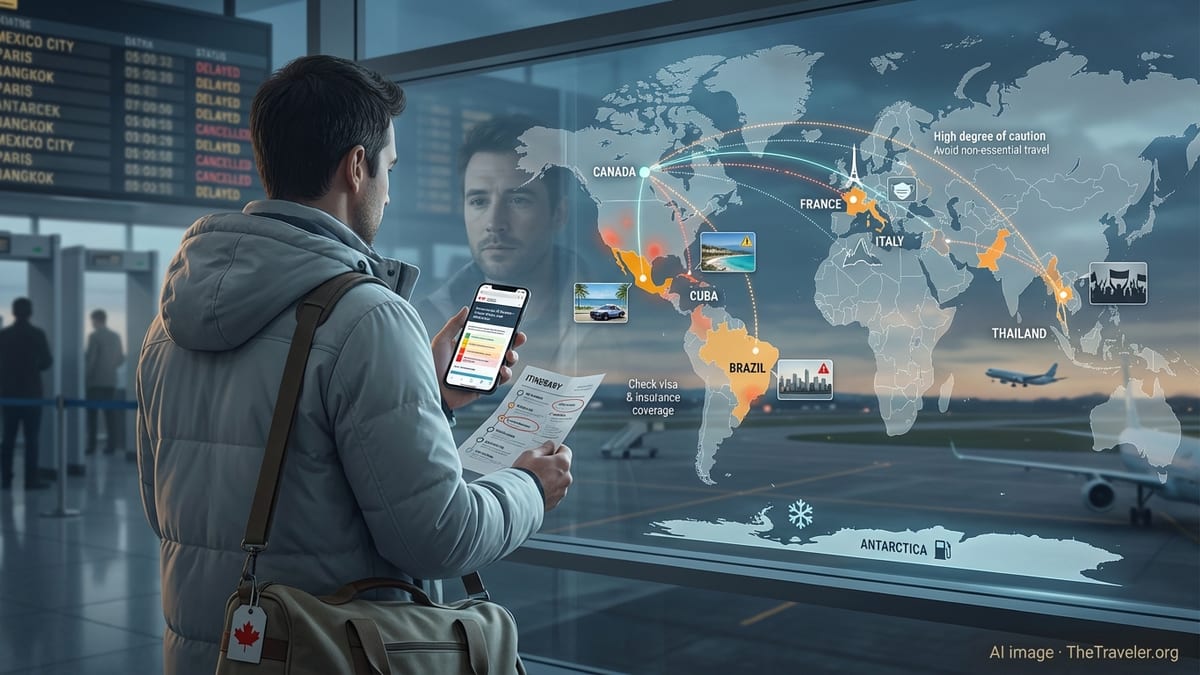
Canada has quietly but steadily raised the alarm on a widening list of popular destinations, and Mexico is now one of the most closely watched. From Brazil and Thailand to France, Cuba, Italy and even Antarctica, Canadian officials are issuing higher level advisories that reflect a turbulent mix of political tensions, visa complications, organized crime and unpredictable security risks.
For Canadian travelers planning winter beach getaways, big-city breaks or once in a lifetime expeditions, the message is increasingly clear: check the advisory before you book, and be prepared for plans to change quickly.
More News
- TSA Rolls Out $45 ConfirmID Fee for Travelers Without REAL ID at Security
- Flying Blue Launches February 25% Promo Rewards on Transatlantic and Regional Routes
- United Fast-Tracks Starlink Wi‑Fi Across Fleet, Free for MileagePlus Members
Mexico’s Rising Risk Profile for Canadian Travelers
Mexico remains one of the most beloved destinations for Canadians, drawing millions each year to its all inclusive resorts, colonial cities and archaeological sites. Yet the country now sits under a nationwide advisory to exercise a high degree of caution, with regional warnings that climb to avoid non essential travel in some states. Canadian officials point to persistently high levels of violent crime, kidnappings and cartel activity, combined with uneven policing and limited local protection outside tourist enclaves.
Recent guidance emphasizes that the risk in Mexico is highly uneven. Resort corridors in areas such as Cancun, Los Cabos and parts of the Riviera Maya are generally better policed, but violent incidents including shootings and targeted attacks have spilled over into hotels, restaurants and nightlife districts. Border states and interior regions like Guerrero, Michoacán, Colima, Sinaloa, Tamaulipas and Zacatecas have become particular flashpoints, prompting avoid non essential travel advisories due to clashes between criminal groups, roadblocks and sporadic attacks.
The advisory also underscores the threat of kidnapping, including so called express kidnappings in which victims are forced to withdraw cash from ATMs, as well as carjackings and robberies on intercity roads. Travelers are urged to avoid driving at night, stick to toll highways where possible and use only official taxis or regulated ride share apps. Even in resort zones, Canadian authorities recommend limiting after dark movements, keeping valuables secured and maintaining a low profile to avoid opportunistic crime.
For the 2026 FIFA World Cup, which will be co hosted by Mexico, Canada is issuing dedicated guidance that acknowledges both the attraction and the added risk. Fans are being told to consider flying between Mexico and the United States instead of driving through border regions, where cartel violence and sporadic roadblocks pose heightened dangers. Travelers who cross by land are advised to use only official border posts, remain extremely vigilant and understand that many travel insurance policies will not cover travel in zones under avoid travel warnings.
Brazil, Thailand, France, Cuba, Italy and a Growing Map of High Caution
Mexico’s status is part of a broader pattern in which Canada is urging increased vigilance across an expanding roster of major tourism hubs. In Brazil, persistent urban crime, gang violence in favelas and sporadic unrest linked to politics and policing have kept large parts of major cities such as Rio de Janeiro and São Paulo under elevated advisories. Travelers are frequently warned against venturing into informal settlements, wandering alone after dark or carrying valuables in crowded areas where armed robberies remain a concern.
Thailand, once synonymous with carefree backpacking and beach breaks, now appears in Canadian travel guidance as a country of high contrasts. While the main tourist islands and Bangkok’s central districts remain open, officials highlight ongoing political tensions, frequent and sometimes volatile protests in major cities, and active insurgencies in the deep south. Canada advises against all travel to some border areas with Cambodia and in several southern provinces where bombings, shootings and targeted attacks have made the security situation highly unpredictable.
In Europe, France and Italy remain headline destinations but are also subject to layered advisories tied to terrorism concerns, mass events and political demonstrations. French authorities have raised their own national alert system to one of its highest levels following recent attacks and disrupted plots, a move reflected in Canada’s guidance that warns of the possibility of further opportunistic or premeditated assaults in public spaces. Large gatherings, religious sites, transport hubs and tourist landmarks are emphasized as locations where travelers should be especially alert.
Italy, gearing up to host the 2026 Winter Olympics and Paralympics, is the focus of specific health and security notices related to large crowds and potential strain on local infrastructure. Travelers are advised to monitor local news, expect heightened security checks around stadiums, fan zones and major transport corridors, and allow extra time for screening and movement. Cuba, meanwhile, sits under a complex mix of advisories: while many resort areas remain open, economic strain, shortages of fuel and basic goods, sporadic protests and pressure on health services have prompted Canada to warn that conditions may deteriorate quickly in certain regions.
Antarctica and the Extreme Edge of Canadian Warnings
One of the most striking inclusions in Canada’s higher level travel guidance is Antarctica, a destination that has surged in popularity among adventure travelers. Unlike Mexico or Brazil, the concern here is not crime or political unrest but the sheer unforgiving nature of the environment. Canada currently tells travelers to exercise a high degree of caution on the frozen continent due to extreme and unpredictable weather, the near total absence of infrastructure and the lack of emergency response capabilities.
Canadian officials emphasize that there are no local consular services, no public communications network and almost no medical facilities beyond the basic capacity at scientific research stations, which are not designed to function as hospitals. Evacuation in the event of injury or sudden illness can be difficult, delayed by weather or in some cases impossible for extended periods. Travelers are strongly urged to purchase comprehensive evacuation insurance, travel only with experienced operators and be fully self sufficient from the moment they leave their last port of call.
The advisory also touches on regulatory and environmental hurdles unique to Antarctica. Canadians require a government issued permit to visit, usually obtained through their expedition operator, and are bound by strict rules aimed at protecting wildlife and minimizing ecological impact. Activities related to mineral resources, interference with native species, or the introduction of non native plants and animals are tightly controlled. The message is that Antarctica is not a casual destination: it demands preparation, physical fitness and a clear understanding that help may not arrive quickly, if at all.
Despite these warnings, tourism to Antarctica has grown steadily, driven by bucket list demand and a sense that climate change is transforming the region. Canada’s advisory is not a blanket prohibition but a reminder that as visitor numbers increase, so too do the stakes when things go wrong. Weather that shifts in minutes, powerful katabatic winds and prolonged periods of darkness in winter mean that even experienced adventurers face real and sometimes life threatening hazards.
Political Tensions, Protests and the New Normal for Travel Risk
Behind many of these higher level advisories lies a common thread of political volatility, social unrest and polarized domestic debates playing out in public squares and on city streets. In Thailand, activist movements and opposition groups frequently stage mass demonstrations that can swell with little warning and, in some cases, spark clashes with security forces. Even when such protests are peaceful, they can paralyze traffic, disrupt public transport and shut down tourist districts for hours or days.
France and Italy have seen repeated waves of strikes and rallies over labor reforms, pension changes, economic policy and geopolitical issues. While these actions rarely target tourists directly, they can lead to sudden closures of museums, rail lines and airports, along with a heavier security presence around government buildings and symbolic sites. Travelers may find themselves caught between competing instructions from organizers and authorities, or trapped in neighborhoods where tear gas, baton charges or vandalism erupt without warning.
Elsewhere, including in several Latin American and North African countries, advisory updates have followed episodes of contested elections, constitutional crises or border flare ups. In Morocco, for example, Canada urges particular caution in Western Sahara and near the berm that separates contested territory, where landmines, military patrols and restricted access mean conditions can change overnight. While these hotspots may seem remote from tourist cities, their influence on national stability feeds into the broader risk calculus that shapes Canada’s overall travel guidance.
For travelers, the practical consequence is a shift from static risk assessments to a more dynamic model. An itinerary that looks straightforward at the time of booking might run headlong into a week of protests, a transport strike or a sudden show of force near a border. Canadian officials now repeatedly encourage travelers to monitor local media, register their travel plans in advance and remain flexible enough to reroute or cut short a trip if conditions deteriorate.
Visa Hurdles, Entry Rules and the Hidden Cost of Travel Disruption
Layered onto the security picture is a growing set of visa and entry challenges that have become central to Canada’s messaging. Political frictions, shifting diplomatic relationships and post pandemic policy changes mean that requirements for Canadians can tighten with little notice. Some countries that long offered simple visas on arrival have introduced online pre clearance systems, mandatory proof of funds or detailed itinerary checks. Others have imposed new fees or altered exemptions in response to reciprocal moves by partners.
In practical terms, this has led to a rise in stories of Canadians turned back at borders for incomplete paperwork, outdated passports or misunderstandings about onward travel. Advisory updates are increasingly explicit about the need to confirm visa rules directly with official sources shortly before departure, not just at the time of booking. Special event periods, such as major football tournaments or Olympic Games, may bring additional registration systems, more frequent ID checks and longer queues at immigration counters.
Canada has also warned that travelers who enter regions under avoid all travel or avoid non essential travel advisories may find their options limited if they run into trouble. Insurance companies often exclude coverage for trips to destinations that carry the highest level of government warning. That can leave Canadians financially responsible for emergency medical evacuation, hospitalization or last minute route changes that can run into tens of thousands of dollars. Officials repeatedly stress the need to examine the fine print of policies and confirm that planned routes, including any high risk regions in transit, are actually covered.
Another emerging theme is the risk of being stranded by sudden policy shifts or transportation disruptions. In some countries facing internal tensions or economic strain, flights can be reduced with little warning, fuel shortages can curtail domestic travel, and local authorities can impose curfews or internal checkpoints. For Canadians relying on tight connections or remote airstrips, the latest advisory can offer an early signal that resilience plans, such as extra buffer days or alternative routes, may be necessary.
How Canadian Travelers Can Navigate a Landscape of High Level Advisories
For many Canadians, the drumbeat of advisories touching destinations as diverse as Mexico, Brazil, Thailand, France, Cuba, Italy and Antarctica raises a pressing question: is it still safe to travel abroad. Canadian officials are clear that an advisory is not necessarily a ban. Instead, it is a calibrated risk communication tool intended to help travelers weigh their personal tolerance, prepare appropriately and avoid the most dangerous situations. Exercising a high degree of caution means adopting behaviors that might once have seemed excessive, such as avoiding spontaneous road trips, skipping crowded late night venues and staying within well managed tourist areas.
Travel experts advise starting every trip plan with the official advisory for each country on the itinerary, including transit hubs. Travelers should read beyond the headline risk level to understand regional variations, common scam patterns, recent incidents and current political sensitivities. For Mexico, that can mean recognizing which states are effectively off limits, where kidnappings have been concentrated, and how to move between resorts and airports as safely as possible. For European destinations facing terrorism and protest risks, it may mean learning how to recognize police cordons, what to do if a demonstration sweeps through a historic center, and where to seek shelter during an attack.
Insurance and documentation are another critical layer. Canadians are encouraged to purchase robust policies that clearly include coverage for emergency medical care, evacuation and trip interruption, and to verify whether any parts of their route cross into zones under avoid travel advisories. Registering travel plans with the Canadian government can ensure that consular officials know who is on the ground if a crisis erupts, while keeping copies of key documents both in print and digitally can speed up assistance if passports or identification are lost or stolen.
Ultimately, the spread of high level advisories points less to a world closing to travel than to one where risk is more fragmented and fast moving. Canadians who stay informed, remain flexible and respect local conditions can still enjoy many of the destinations now flagged for political tension or crime. Yet the era when a beach or city break abroad could be planned and forgotten about until check in is fading. In its place is a more demanding form of travel that starts long before departure and continues with attentive monitoring until the traveler is safely home.
FAQ
Q1. What does it mean when Canada advises Canadians to exercise a high degree of caution in a country like Mexico
It means the government has identified significant safety or security concerns such as crime, instability or health risks. Travel is not prohibited, but Canadians are urged to be more vigilant than usual, avoid higher risk areas and closely follow local developments and official guidance.
Q2. Is Canada telling Canadians to avoid all travel to Mexico
No. The nationwide advisory for Mexico is to exercise a high degree of caution, with avoid non essential travel warnings for specific high risk states and regions. Many resort areas remain open to tourism, but travelers are urged to research regional risks carefully and adjust their plans accordingly.
Q3. Why are destinations like Brazil, Thailand, France, Cuba and Italy also under higher level advisories
These countries face a range of challenges, including organized crime, localized conflict, political protests, terrorism concerns and infrastructure or economic strains. Canada’s advisories reflect these issues and highlight particular regions, cities or events where risks to travelers are considered elevated.
Q4. Why is Antarctica included in Canadian travel advisories
Antarctica is subject to an advisory due to extreme and unpredictable weather, the absence of normal infrastructure and emergency services, and strict environmental regulations. Canadians traveling there must be prepared for limited access to medical care, difficult or delayed evacuations and the need for self sufficiency.
Q5. How do political tensions and protests affect Canadian travelers in countries like Thailand or France
Political tensions can lead to large demonstrations, strikes, roadblocks and sometimes clashes with security forces. Even when travelers are not targeted, they may face transport disruptions, sudden closures of attractions, curfews or being caught near areas where violence or heavy police operations occur.
Q6. What role do visa and entry rules play in these new advisories
Visa requirements and entry conditions can change quickly in response to political or security developments. Canada’s advisories increasingly stress the need to verify visa rules, registration systems and special event regulations shortly before travel, as failing to meet new conditions can result in denied boarding or refused entry.
Q7. Can travel insurance be affected by Canadian travel advisories
Yes. Many insurance policies exclude or limit coverage for travel to destinations under an avoid all travel or avoid non essential travel warning. Travelers should read their policies carefully and confirm with their insurer that all parts of their planned route are covered, including transit through higher risk regions.
Q8. How often should Canadians check the official advisory before a trip
Officials recommend checking the advisory when planning the trip, again shortly before departure, and periodically while abroad. Conditions can change rapidly because of elections, protests, natural disasters, health outbreaks or security incidents.
Q9. Are popular European destinations like France and Italy still safe to visit
Millions of people continue to visit France and Italy every year. However, due to terrorism concerns, protests and major events, Canada urges travelers to be more alert than in the past, pay attention to police instructions, avoid protest areas and be prepared for increased security checks and occasional service disruptions.
Q10. What is the single most important step Canadians can take when traveling to a country under a higher level advisory
The most important step is to stay informed. That means reading the full official advisory for your destination, monitoring local news once you arrive, registering your travel plans with Canadian authorities and being ready to change your itinerary quickly if security, political or health conditions worsen.