

Canada is quietly tightening its travel advice for trips touching the United Kingdom, warning citizens and residents to prepare for strict new Electronic Travel Authorisation rules, tougher passport demands for dual nationals, and persistent security risks on popular routes through Mexico, Italy, Turkey, Spain, France, Brazil and other major hubs.
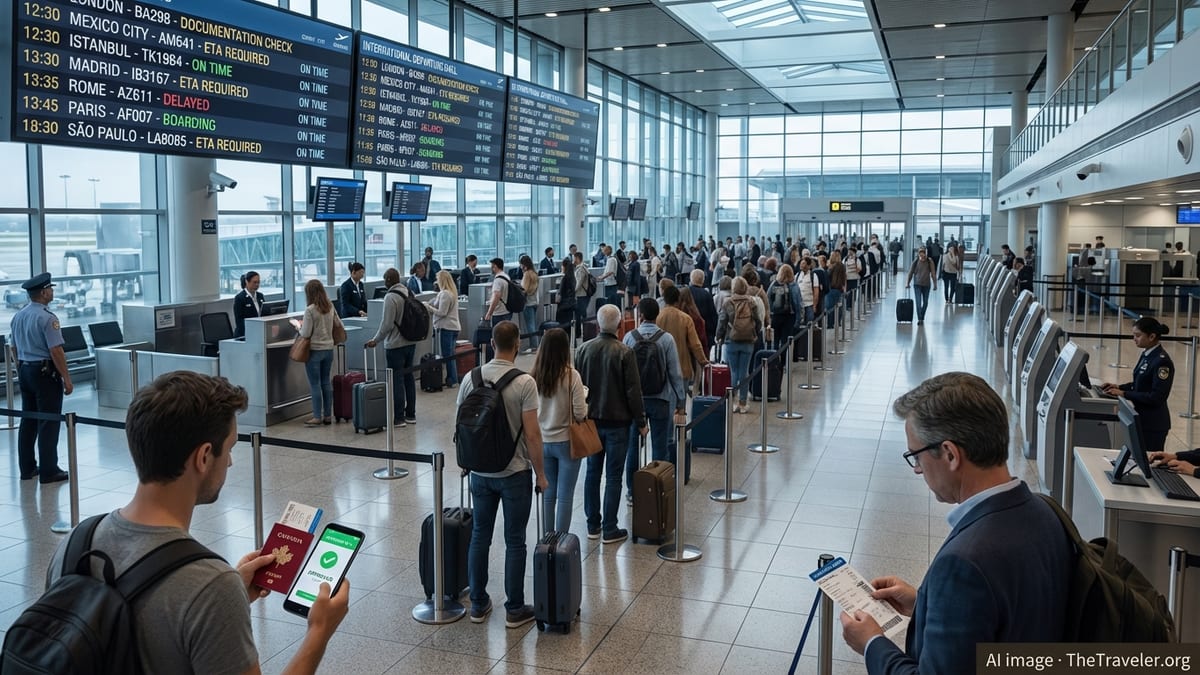
Ottawa Raises the Alarm as UK Border Rules Shift
Canada’s latest guidance comes as the United Kingdom completes a sweeping overhaul of its border system, centered on a mandatory Electronic Travel Authorisation for most visa-exempt visitors from February 25, 2026. For Canadian travellers used to relatively frictionless entry, the change marks a significant tightening that could see passengers denied boarding if they have not secured approval in advance. Travel specialists say the enforcement date effectively ends the era of last-minute, paperwork-light hops into Britain for business, study or tourism.
Officials and industry observers warn that the UK’s shift increases the risk of cascading disruption across some of Canada’s busiest international corridors. Many itineraries to and from Mexico, Brazil and major European destinations route through London and other British hubs, meaning a missed ETA or passport mismatch could strand travellers mid-journey. Airlines have been instructed to shoulder more responsibility for pre-departure checks, with carriers facing potential penalties if they transport passengers who do not meet the new standards.
Ottawa has stopped short of telling Canadians not to visit the United Kingdom or popular holiday markets such as Spain and Italy. However, the message to travellers is becoming more pointed: itineraries that once felt routine now require careful documentation, forward planning and a clearer understanding of local security conditions. The advisory system is being framed less as a deterrent than as a detailed risk map that Canadians ignore at their peril.
ETA Enforcement: What Changes for Canadians and Other Visa-Free Travellers
Under the UK’s new regime, citizens of about 85 visa-exempt countries, including Canada, the United States, Japan and most of the European Union, must obtain an Electronic Travel Authorisation before boarding a flight, train or ferry to the United Kingdom. The ETA, which costs 16 pounds, is generally valid for two years or until the traveller’s passport expires, and allows multiple short stays of up to six months for tourism, business, studies or family visits. British authorities cast the system as a security filter designed to identify higher-risk travellers before they arrive at the border.
For Canadian visitors, the most immediate impact is logistical. The ETA must be approved before departure, and while many applications are processed quickly, British officials warn that some may take up to several days to clear, especially if additional checks are required. Carriers are expected to verify approval before issuing boarding passes, and pre-clearance does not guarantee entry, as travellers may still be questioned or refused at the border. Ottawa is urging Canadians to apply well in advance of their travel date and to carry documentation supporting the purpose of their visit and proof of sufficient funds.
Travel agents and corporate travel managers say the shift is already influencing how Canadians book trips. Itineraries that use London as a same-day connection to or from Mexico, Brazil, Turkey or Spain now carry an added layer of bureaucracy and risk if an ETA is missing or incorrectly entered. Some firms are recommending that travellers avoid tight connections in British hubs during the early months of enforcement, when confusion and system glitches are more likely. Others are encouraging clients to build in longer layovers and to verify ETA status before leaving home.
New Pressures on Dual Nationals and Passport Validity
Alongside the ETA rollout, the United Kingdom is tightening rules for its own dual nationals, a development that has indirect implications for many Canadians. Effective February 25, 2026, individuals who hold British citizenship alongside another nationality will generally be required to enter the UK using a valid British passport or obtain a costly certificate of entitlement proving their right of abode. An ETA tied to their non-UK passport will not be sufficient to guarantee entry. The policy has already sparked criticism from campaigners who say it was poorly communicated and disproportionately affects dual nationals living overseas.
In practice, the rule shift raises the stakes for the large Canadian diaspora with British roots, as well as their spouses and children who may have claims to UK citizenship. Families who travel together could face complex scenarios in which some members require ETAs while others must carry British passports that meet strict criteria on names and expiry dates. There is particular concern for women whose legal names differ across jurisdictions, such as in Spain and Greece, where naming conventions do not align neatly with UK passport rules, potentially complicating family trips routed through British airports.
Canada’s updated messaging is also placing renewed emphasis on passport validity. While Britain officially requires passports to remain valid only for the duration of the stay, many countries that Canadians transit en route, including Turkey and Brazil, continue to enforce the common six-month validity rule. Travellers combining a UK visit with side trips to Mexico, Italy, Spain or other Schengen-area countries are being advised to check the most restrictive requirement on their route. A passport that meets UK standards may still fall short elsewhere, triggering denied boarding or last-minute itinerary changes.
Security Risks on Popular Routes via Mexico, Europe and Brazil
Passport and ETA rules are only one part of the picture shaping Canada’s travel advisories. Ottawa also factors in security and crime trends along the most heavily used leisure and business corridors. Mexico, one of the top foreign destinations for Canadians and a major gateway to South and Central America, continues to carry elevated warnings tied to organized crime, armed violence and localized instability in certain states. While resort zones remain busy and generally secure, Canadian officials stress that conditions can deteriorate quickly outside of tourist enclaves and along road corridors between airports and coastal areas.
In Europe, long-favored destinations such as France, Spain and Italy are still rated relatively safe, but they are not free of risk. Authorities in Ottawa and allied governments note a persistent threat of terrorism targeting public spaces, transportation hubs, festivals and major sporting events. As Canada and its partners prepare for large-scale gatherings linked to the 2026 World Cup and other marquee competitions, security planners are particularly attuned to the possibility of attacks near stadiums, fan zones and crowded urban centers. Travellers are being asked to stay alert in train stations, airports and popular squares where dense crowds and symbolic landmarks intersect.
Brazil and Turkey, which have seen strong rebounds in tourism from North America and Europe, similarly present a mix of opportunity and hazard. Petty crime, armed robbery and occasional civil unrest remain part of the risk calculus in several Brazilian cities and within some Turkish urban and border regions. While neither country is subject to an outright “do not travel” warning from Canada, both feature advisories that call for a higher level of vigilance, particularly after dark and in neighborhoods that are not part of the established tourist circuit. These warnings take on added weight when trips involve complex multi-country routes that include British or European transit.
Why Canada’s Advisory Level Matters for Travellers
Canada’s travel advisory system is tiered, ranging from general advice to exercise normal security precautions to calls to reconsider or avoid travel altogether. For the United Kingdom, Canada currently aligns with allied governments in urging travellers to exercise a higher degree of caution, largely due to the risk of terrorism and the operational impact of new border rules. That does not mean Canadians should cancel their trips, but rather that they should budget more time for planning, document checks and situational awareness once on the ground.
Advisories affecting countries such as Mexico, Turkey and Brazil can be more granular, flagging particular regions, cities or border areas where violence or instability is more acute. Ottawa’s latest messaging stresses that risk is rarely uniform within a country and that Canadians should read beyond the headline level to understand precisely which provinces or municipalities are of concern. The same applies to parts of Europe facing localized unrest tied to protests, strikes or political tensions that may disrupt transportation without rendering the entire country unsafe.
For travellers, the practical consequence of a heightened advisory can extend beyond personal safety. Insurance policies may treat certain levels or phrasings as triggers for exclusions or special conditions, especially for trips into regions labeled as high risk. Airlines and tour operators also track government advisories as they adjust schedules, staffing and security practices. The net result is that a change in Canada’s language around the UK, Mexico or other key markets can ripple through the broader travel ecosystem, influencing prices, capacity and flexibility.
Airlines, Tour Operators and the New Compliance Burden
As border authorities tighten screening through systems such as the UK ETA, airlines and tour operators find themselves on the front line of enforcement. Carriers operating flights from Canada, Mexico, Brazil and across Europe into British airports are now expected to verify that passengers have valid ETAs, appropriate visas and compliant passports before they board. Failure to do so can expose airlines to fines and operational delays if travellers are turned back on arrival. In response, many carriers are enhancing their digital check-in platforms to integrate real-time document verification.
Tour operators, especially those packaging multi-stop itineraries that weave together London, Mediterranean beach resorts and Latin American cities, are also revisiting their planning assumptions. Some are incorporating clearer warnings about passport validity, dual-citizen requirements and the risk of last-minute rule changes. Others are building advisory checks into the booking process, prompting customers to confirm that they understand and meet UK and transit-country entry conditions. Industry associations say the objective is to prevent distressing scenes at departure gates where families are told they cannot board.
Corporate travel managers are grappling with a more complex environment as well. Businesses that routinely send staff through London or other UK hubs to reach project sites in Europe, the Middle East or South America must now account for ETA processing times and the risk of refusal. In sectors where trips are often arranged at short notice, such as emergency engineering work or crisis response, the new requirements may force companies to hold pre-cleared ETAs on file or reroute critical personnel through alternative hubs in Paris, Madrid or Frankfurt when British rules present obstacles.
Preparing for a More Complicated Trip: What Canadians Can Do
For individual travellers, the flurry of regulatory and security changes may feel daunting, but experts stress that most disruptions are preventable with advance planning. Canadians booking trips that include the United Kingdom or routes via Mexico, Italy, Turkey, Spain, France or Brazil are being advised to start with the basics: verify passport expiry dates and names, check whether an ETA or visa is required for every leg of the journey, and apply for approvals well before departure. Travellers who hold dual nationality should pay particular attention to which passport they use to book tickets and whether that document aligns with the rules of the countries they intend to enter.
Once documentation is in order, the focus shifts to on-the-ground safety. Ottawa’s advisories, together with guidance from allied governments, emphasize the importance of staying informed through local news, official alerts and reputable travel channels. Simple habits, such as avoiding isolated areas late at night, securing valuables and knowing the location of the nearest embassy or consulate, remain central to mitigating risk in cities from London and Paris to Rio de Janeiro and Istanbul. Travellers attending major festivals, football matches or concerts are urged to factor in additional arrival time for security screening and to maintain awareness of exits and crowd patterns.
Industry voices note that, despite the heightened warnings and fresh bureaucracy, international travel for Canadians remains both possible and, for many, deeply rewarding. The new UK ETA system, stricter passport controls and persistent security risks do not close borders so much as recalibrate how they operate. For those willing to treat trip planning as a serious exercise rather than an afterthought, the evolving advisory landscape can be navigated safely, even as Ottawa adds the United Kingdom to a growing list of destinations where the phrase “exercise increased caution” has become the norm.