

More news on this day
Canada’s air travel system is experiencing a fresh wave of disruption, with publicly available flight-tracking data showing 82 cancellations and 828 delays across the country’s busiest hubs, snarling schedules from early morning departures to late-night connections.
Get the latest news straight to your inbox!
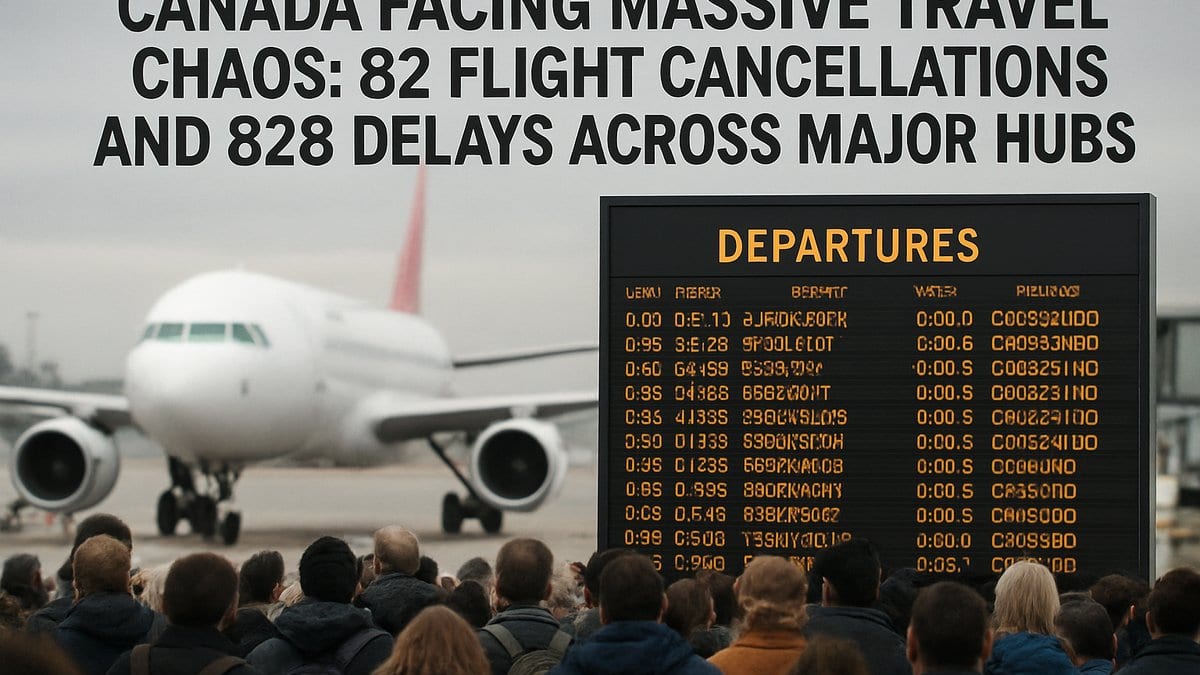
Major Hubs Bear the Brunt of Systemwide Disruption
The latest figures point to a pattern of concentrated disruption at Canada’s largest gateways, with Toronto Pearson, Montreal Trudeau, Vancouver, and Calgary accounting for the majority of the 82 cancellations and hundreds of delays. Reports indicate that these hubs are seeing extended check in lines, congested security lanes, and gate areas filled with passengers waiting for updated departure times.
According to published coverage and flight-tracking dashboards, Toronto Pearson continues to be the most heavily affected, with dozens of delayed departures and arrivals causing knock-on effects throughout the domestic and transborder network. Montreal Trudeau and Vancouver International are also experiencing sustained pressure, particularly on high frequency routes that connect major Canadian cities and U.S. destinations.
Calgary International, which has already seen waves of disruption in recent days, is again reporting a notable share of delayed services, especially on westbound and regional flights. The combination of rolling delays and targeted cancellations is creating a ripple effect that stretches far beyond these airports, with smaller communities and connecting hubs also feeling the impact.
Operational data suggests that the disruption is not limited to a single carrier. While Canada’s largest airlines remain at the center of the storm due to their scale, regional partners and international operators are also adjusting schedules, trimming frequencies, or retiming flights as they attempt to work around congested slots and crew constraints.
Weather, Congested Airspace, and Operational Strains Converge
Publicly available information shows that the current wave of cancellations and delays comes on the heels of a turbulent winter and early spring for North American aviation, marked by powerful storms, stretched airport infrastructure, and a series of high profile safety incidents in nearby U.S. airspace. While the latest disruption is centered on Canadian hubs, its causes appear to be intertwined with wider regional pressures.
Recent weeks have seen multiple weather systems track across Canada and the northern United States, leaving airports periodically operating at reduced capacity and forcing airlines to compress schedules into smaller operational windows. When combined with high passenger demand and limited slack in aircraft and crew rotations, even modest slowdowns have translated into significant same day schedule instability.
Industry analyses also highlight the role of congested airspace and air traffic control restrictions, particularly around large North American cities that serve as common waypoints for Canadian routes. When one or more of these nodes experiences constraints, holding patterns, ground stops, and arrival metering can quickly cascade into missed connections, aircraft arriving out of position, and forced cancellations to reset the network.
Operational bulletins and rebooking advisories from recent days suggest that airlines are continuing to balance safety margins, regulatory obligations, and fleet availability while attempting to minimize the total number of disrupted passengers. In practice, this has meant concentrating cancellations on lower demand frequencies while accepting a larger volume of delayed departures and arrivals.
Passengers Confront Long Lines, Missed Connections, and Tight Rebooking Windows
For travelers, the headline numbers of 82 cancellations and 828 delays translate into very tangible challenges on the ground. Reports from Canada’s major hubs describe long queues at airline service counters, heavy demand on call centers and mobile chat channels, and crowded gate areas as passengers monitor departure boards for the next status change.
Public traveler accounts and consumer coverage indicate that missed connections are a growing concern, particularly for those relying on same day links between domestic and international flights. When an initial leg is delayed beyond a critical threshold, passengers may find that onward options are limited, especially during peak travel periods where remaining seats are scarce.
Rebooking is also complicated by the tight spacing of many domestic and transborder services. Where multiple flights a day once offered ample flexibility, trimmed schedules and high load factors now mean that a cancelled or heavily delayed service can push travelers to departures many hours later, or even into the following day.
Consumer advocates and travel analysts consistently advise affected passengers to act quickly when disruption hits. Public guidance emphasizes using airline mobile apps and websites to secure alternative options as soon as a delay or cancellation appears, rather than waiting in physical lines, which can grow rapidly when multiple flights are affected at once.
Regulatory Protections and Compensation Remain a Key Focus
The latest round of disruption is again drawing attention to Canada’s air passenger protection framework, which sets out entitlements around rebooking, refunds, and in some cases compensation. Government publications and consumer guides outline different obligations depending on the size of the carrier, the nature of the disruption, and whether it is judged to be within the airline’s control.
Publicly available guidance notes that for cancellations or significant delays within an airline’s control, carriers are generally required to provide rebooking on the next available flight and, if the passenger chooses not to travel, a refund of the unused portion of the ticket. For larger carriers, additional standards around timing of rebooking and care, such as food vouchers or accommodation in cases of overnight disruption, may apply.
However, when disruptions are classified as outside the carrier’s control, such as those driven by severe weather or certain air traffic control restrictions, obligations can be more limited. In those cases, traveler protections may depend more heavily on the terms of individual travel insurance policies or credit card benefits, prompting renewed calls in consumer columns for passengers to review their coverage before peak travel seasons.
Legal and aviation analysts also point to ongoing debates over how cancellations and long delays are categorized, and how consistently rules are applied across different carriers and scenarios. The current spike in disruption, with its blend of weather, congestion, and operational factors, is likely to feed continued scrutiny of how Canada’s framework performs under sustained stress.
How Travelers Can Navigate the Continuing Turbulence
With disruptions still unfolding, travel experts are urging passengers with upcoming trips through Toronto, Montreal, Vancouver, Calgary, and other busy Canadian airports to take a more proactive approach to their journeys. Public advice emphasizes confirming flight status repeatedly in the 24 hours before departure, building in extra time for connections, and considering earlier departures where flexibility exists.
Many airline and airport advisories recommend checking in online as soon as windows open, monitoring gate and schedule changes through official apps, and keeping contact details updated so that notifications arrive promptly. Travelers are also encouraged in consumer reporting to keep digital or physical copies of booking confirmations, delay notices, and receipts for any extra expenses that arise because of disrupted travel.
For those whose trips are not time sensitive, some commentators suggest considering voluntary changes away from peak travel periods or through less congested hubs when possible. While such adjustments may not be practical for every traveler, they can reduce exposure to the most heavily affected time bands and routes during periods of widespread disruption.
With 82 cancellations and 828 delays recorded across major Canadian hubs in a single sweep of data, analysts note that the current turbulence in the system is unlikely to resolve overnight. As airlines, airports, and regulators work to stabilize operations, passengers are being told through public guidance to expect continued schedule adjustments and to plan their journeys with added flexibility and patience.