

More news on this day
Canada has issued some of its starkest travel warnings in years for the Middle East, urging citizens to avoid all travel to more than ten countries and to reconsider trips across much of the wider region as a spiraling conflict involving Iran, Israel and the United States sends shockwaves through aviation networks and regional security.
Ottawa Raises Middle East Risk Levels to the Highest Tier
The latest advisories from Global Affairs Canada elevate large parts of the Middle East to the government’s most severe risk category, “Avoid all travel,” reflecting the speed and scale of the current crisis. Officials say the regional environment has become too volatile and unpredictable for leisure or discretionary business trips, and even essential journeys now carry significant danger.
Canadians are currently advised to avoid all travel to a growing list of states that includes Iran, Iraq, Syria, Yemen, Afghanistan, Israel and the Palestinian territories, Lebanon and several Gulf countries such as Qatar, the United Arab Emirates, Bahrain and Kuwait. A parallel warning urges Canadians to avoid non essential travel to Saudi Arabia, Oman and Jordan, where authorities fear spillover threats and sudden airspace restrictions.
Global Affairs Canada stresses that these designations are not symbolic. An “avoid all travel” level means Ottawa believes it cannot reasonably assure consular help in the event of sudden escalation, infrastructure damage or border closures. Citizens already in affected destinations are being told to consider leaving while commercial options still exist and to be prepared for conditions to change with little or no notice.
The broad sweep of the warnings marks one of the most extensive sets of high level advisories Canada has issued for the Middle East in recent memory, underscoring how quickly a localized confrontation has morphed into a multi country security emergency.
Conflict Fallout Closes Skies and Strands Travellers
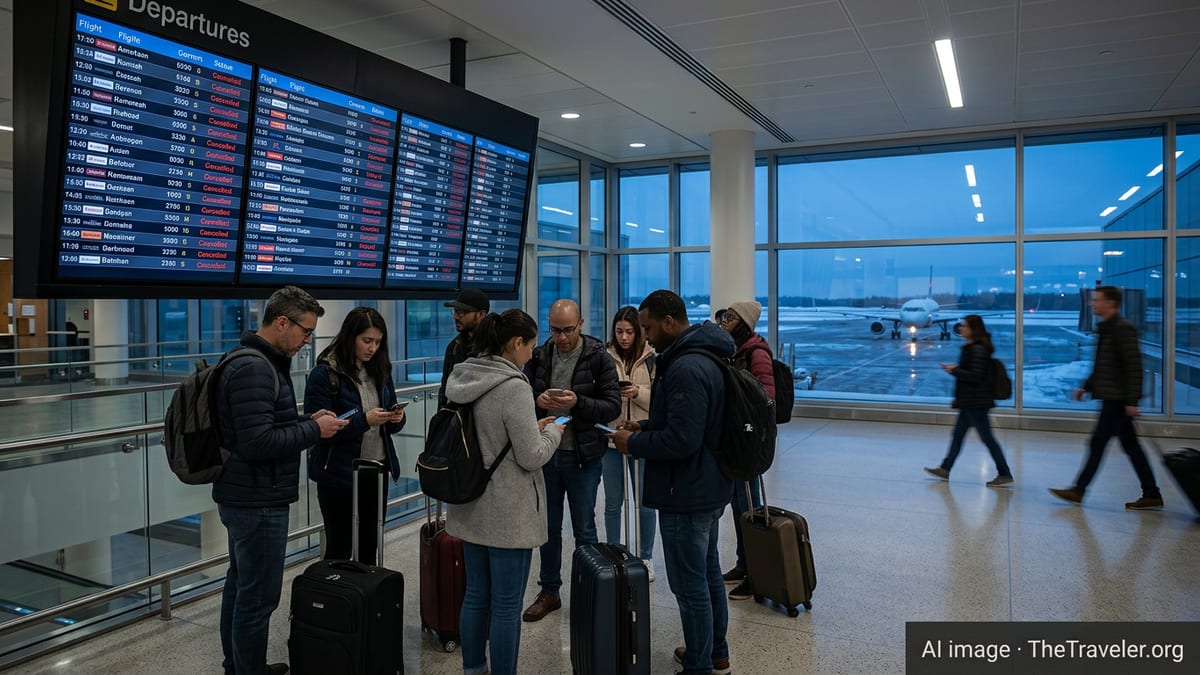
The Canadian alerts come as air travel across the Middle East is heavily disrupted by missile strikes, drone activity and precautionary airspace shutdowns. Major regional hubs in Iran, Israel, Iraq, Kuwait, Qatar and Bahrain are facing full or near total closures, while the United Arab Emirates and Saudi Arabia have imposed significant restrictions that sharply curtail normal passenger operations.
According to aviation risk consultancies tracking the situation, large swathes of airspace over the Gulf and Levant are either fully closed or only intermittently open to limited traffic. Airlines have cancelled or rerouted thousands of flights in recent days, and some carriers have suspended services altogether until at least later in the week, leaving Canadians and other foreign nationals scrambling to find ways out.
Canadian officials have warned that the ability to organize special repatriation flights could be constrained by these closures and by the risk profile of flying through contested air corridors. Travellers are being urged to secure commercial seats as soon as possible if they wish to depart, and to factor in the possibility of last minute cancellations, diversions or lengthy layovers in third countries.
For those still on the ground in high risk areas, the government advises maintaining a low profile, avoiding large gatherings and following local security instructions, while also registering their presence with Canadian authorities in case further emergency messaging or limited assistance becomes available.
Insurance Gaps and Financial Risks for Canadian Travellers
Beyond immediate safety concerns, the expanded advisories carry substantial financial implications for Canadians with existing bookings to the Middle East. Travel industry and insurance groups note that many standard policies exclude coverage for destinations under top tier warnings, particularly when official guidance explicitly urges citizens to avoid all travel.
Canadian insurers are encouraging customers to review their contracts closely and to contact providers to clarify whether trip cancellation, interruption and medical benefits still apply for itineraries touching the region. In many cases, once an avoid all travel advisory is in place, coverage for new bookings is limited or void, and claims for trips purchased after the update may be denied.
The warnings also interact with Canada’s Air Passenger Protection Regulations, which require airlines operating to, from or within Canada to offer refunds or rebooking when flights are cancelled or significantly delayed for reasons outside the carrier’s control, such as conflict or governmental airspace closures. Travellers are being told to approach their airline first to explore rebooking, voucher or refund options before turning to insurers for any residual losses.
Consumer advocates caution that call volumes are already high and that resolution may take time as carriers and insurers work through a surge of affected passengers. They recommend documenting all communications, keeping receipts for additional expenses and monitoring both carrier notices and Canadian government updates daily.
Canadians in the Region Urged to Prepare for Rapid Deterioration
For Canadians who live, work or have family ties across the Middle East, the new advisories arrive amid acute uncertainty. Ottawa has acknowledged that its capacity to provide on the ground support could be sharply limited if conflict zones expand, critical infrastructure is hit or foreign missions are forced to scale back operations for security reasons.
Authorities are strongly encouraging citizens in affected countries to enroll in the Registration of Canadians Abroad service so they can receive direct alerts about changing conditions, evacuation options if they materialize and any new restrictions on movement. Family members in Canada can also register on behalf of relatives who may not have reliable internet access or who are already contending with disruptions.
Canadians remaining in the region are urged to develop personal contingency plans that do not rely on government organized evacuation. That includes identifying multiple exit routes through relatively stable neighboring states where flights are still operating, maintaining extra supplies of food, water and prescription medication and ensuring travel documents remain valid and accessible at short notice.
Officials emphasize that even in countries where the current warning level is “avoid non essential travel,” the possibility of rapid deterioration is real. A fresh round of strikes, a major incident at a regional airport or a sudden policy shift by local authorities could tighten restrictions overnight, sealing off routes that remain open today.
What Prospective Travellers Should Do Now
For Canadians contemplating future trips to the Middle East, travel planners and risk experts are broadly aligned in advising a pause on non essential itineraries. With airspace patterns shifting daily and a complex military confrontation still in flux, forecasting safe windows for tourism or conferences is extremely difficult.
Prospective travellers are being urged to monitor the Canadian government’s destination specific advisories closely, rather than relying on airline schedules alone. A flight appearing as bookable in an airline system does not guarantee that it will operate as planned, nor that the underlying security situation is acceptable for discretionary travel.
Those who must travel for critical reasons are advised to work with experienced travel management companies or security specialists who can map viable routings, arrange vetted ground transport and offer real time intelligence. Flexible tickets, robust medical and evacuation coverage and a clear understanding of what is and is not covered under insurance policies are now considered essential, not optional, for trips touching the region.
Ottawa has signalled that further changes to its Middle East travel guidance are likely as events unfold. For Canadians at home and abroad, the message is that caution, flexibility and close attention to official advisories will be key to navigating a rapidly evolving crisis that shows little sign of easing in the near term.