

More news on this day
A fatal ground collision involving an Air Canada Express jet arriving from Montreal at New York’s LaGuardia Airport on March 22 has thrust Canada–United States transborder aviation safety under intense scrutiny, raising urgent questions for travelers planning cross-border trips in the coming weeks.
Get the latest news straight to your inbox!
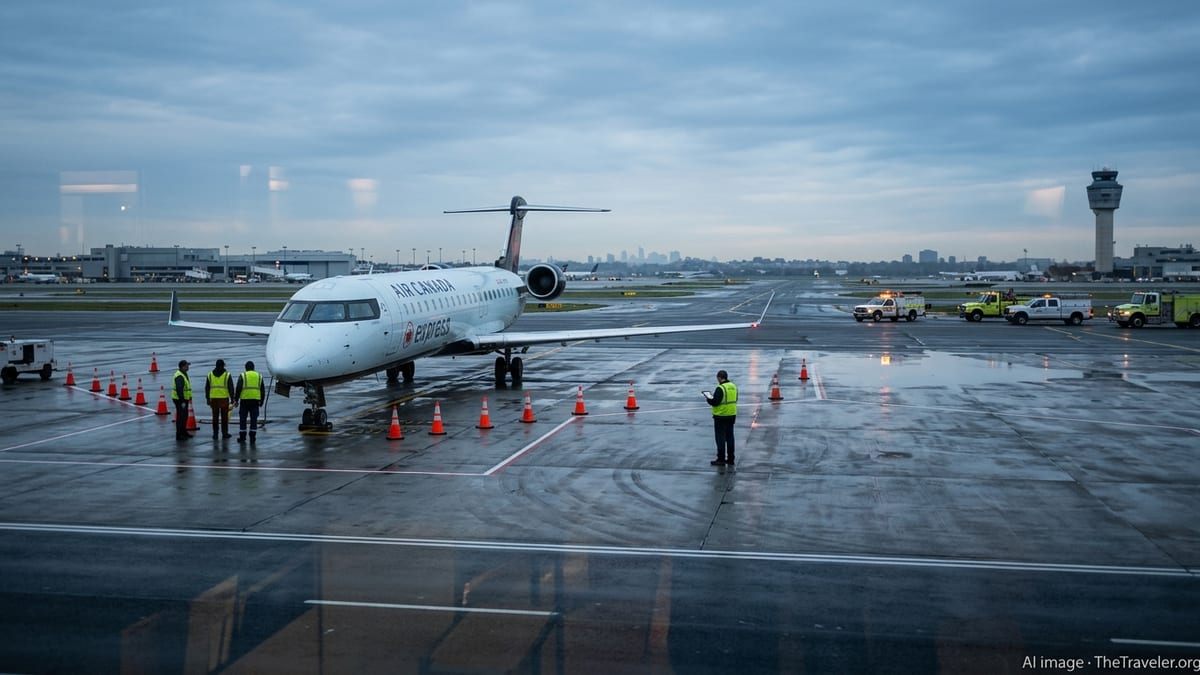
What Happened in the LaGuardia Ground Collision
According to widely circulated news reports and preliminary investigative updates, Air Canada Express Flight 8646, operated by Jazz Aviation, was landing at LaGuardia Airport late on March 22 after a routine trip from Montreal when it struck an airport fire truck crossing the active runway. The impact killed the Canadian pilot and copilot and injured passengers and crew, marking LaGuardia’s first fatal commercial aviation accident in decades.
Published coverage indicates that the fire truck had been dispatched to check on another aircraft that reported an unusual odor, and that ground controllers had cleared the vehicle to cross the runway shortly before the regional jet touched down. Subsequent reconstructions suggest only seconds separated the clearance from the moment of impact, leaving the flight crew with virtually no time to react.
Images from the scene, carried by multiple outlets, show severe damage to the front of the aircraft, with the cockpit section torn away and debris scattered along the runway. The jet’s passengers evacuated using emergency slides, with eyewitness accounts describing a chaotic but rapid self-organized escape amid smoke, fuel smells, and flashing emergency lights.
This collision is particularly significant for transborder travelers because it occurred on a Canada–US route operated by a regional affiliate under a major national brand, a model that underpins much of the cross-border network between the two countries.
How Regulators in Canada and the United States Are Responding
The collision has intensified an already active debate about runway and ground-movement safety in North American aviation. Publicly available information shows that the US National Transportation Safety Board has dispatched an investigative team focusing on air traffic control procedures, ground vehicle operations, and the performance of runway surveillance and alert systems at LaGuardia.
On the Canadian side, the Transportation Safety Board of Canada routinely participates when Canadian-registered aircraft are involved in major accidents abroad. Its broader statistical reporting has highlighted that risks of collision and loss of separation events remain a key category of incidents involving Canadian aircraft operating outside the country, even as commercial traffic returns to near pre-pandemic levels.
Regulators in both countries have, in recent years, emphasized safety management systems, data-driven risk analysis, and runway incursion prevention technologies as primary tools to reduce such occurrences. The LaGuardia crash adds urgency to ongoing policy discussions about staffing levels in control towers, mandatory ground-vehicle transponder use, and the robustness of automated warning systems that are intended to alert controllers to conflicts between aircraft and ground traffic.
Aviation analysts note that this incident follows other high-profile North American events, including a non-fatal crash of a Delta Connection flight on landing in Toronto in 2025, reinforcing a sense that ground operations and approach-and-landing phases require renewed focus from both carriers and infrastructure operators.
Impacts on Canada–US Transborder Routes and Passenger Disruption
Immediately after the collision, LaGuardia Airport suspended operations for several hours, halting both domestic and international flights and cascading delays across airline networks. Public schedules show that Montreal–New York and Toronto–New York routes, among the busiest Canada–US city pairs, experienced cancellations and diversions as investigators secured the runway and removed the damaged aircraft and fire truck.
In the short term, travelers on Canada–US routes can expect tighter spacing in schedules, limited spare capacity, and an elevated risk of missed connections as airlines reroute aircraft and crews. Past disruptions at major hubs, including recent operational breakdowns at Toronto Pearson that heavily affected US-bound services, illustrate how a single-point failure can reverberate through the cross-border system.
Airlines are also conducting internal safety reviews of ground procedures and coordination with airport emergency services. While much of this work remains behind the scenes, it can translate into temporary gate changes, extended ground times, and more conservative spacing between arrivals and departures, particularly during overnight or bad-weather operations.
For passengers, this means that itineraries involving tight connections between Canadian and US airports may face additional risk of disruption. Observers caution that these issues are likely to persist beyond the immediate investigation period as carriers and airports absorb lessons from the collision and adjust training and procedures.
What Travelers Should Watch Before Their Next Cross-Border Flight
Despite the severity of the LaGuardia crash, long-term data from Canadian and international aviation agencies continues to indicate that commercial air travel between Canada and the United States remains one of the safest forms of transportation. Most incidents do not result in fatalities, and major accidents are rare relative to the enormous volume of daily flights.
Even so, safety experts consistently highlight several practical steps that individual travelers can take to stay informed. Checking flight status repeatedly in the 24 hours before departure has become more important as cascading delays can develop quickly when a major hub suffers an incident or extended closure. Monitoring airline notifications and airport social media or bulletin channels can provide early warning of disruption on specific routes.
Within the cabin, passengers are advised to pay close attention to safety briefings, identify the nearest exits, and keep seat belts fastened whenever seated. Recent events underscore that serious injuries can occur during sudden runway events and abrupt decelerations, not only during turbulence at cruise altitude. Awareness of surroundings during taxi, takeoff, and landing phases helps travelers react more quickly if an evacuation is ordered.
Travelers connecting between regional jets and larger mainline aircraft, a common feature of Canada–US journeys, may also wish to build additional buffer time into itineraries, particularly at congested hubs such as New York, Toronto, Montreal, and Vancouver where ground operations are complex and vulnerable to knock-on effects.
How the Collision Fits Into the Bigger Aviation Safety Picture
Viewed against a broader backdrop, the LaGuardia ground collision forms part of a pattern of recent high-profile incidents that have prompted fresh scrutiny of North American aviation safety. These include runway and taxiway incursions, hard landings during winter weather, and, in the United States, a deadly midair collision near Washington, D.C., that drew attention to airspace congestion and technology gaps.
Canadian reporting on occurrences shows a steady flow of lower-level incidents, many of which are captured precisely because of stronger reporting cultures and safety management requirements. Regulators have emphasized that this data-driven approach is meant to identify and fix systemic issues well before they culminate in tragedies.
In response, airports and airlines are investing in upgraded surface radar, better lighting and signage on taxiways, more comprehensive ground-crew training, and improved cockpit alerting technologies. The LaGuardia disaster is expected to sharpen the focus on whether such systems are consistently installed, maintained, and used to their full potential at busy North American hubs that handle large volumes of Canada–US traffic.
For travelers, the key message emerging from the latest collision is not that flying between Canada and the United States has suddenly become unsafe, but that the industry is being pushed to close remaining gaps in ground safety and communication. As investigations proceed, new recommendations are likely to shape everything from tower staffing models to how emergency vehicles move around runways, with the aim of making future cross-border trips safer and more resilient to the unexpected.