

More news on this day
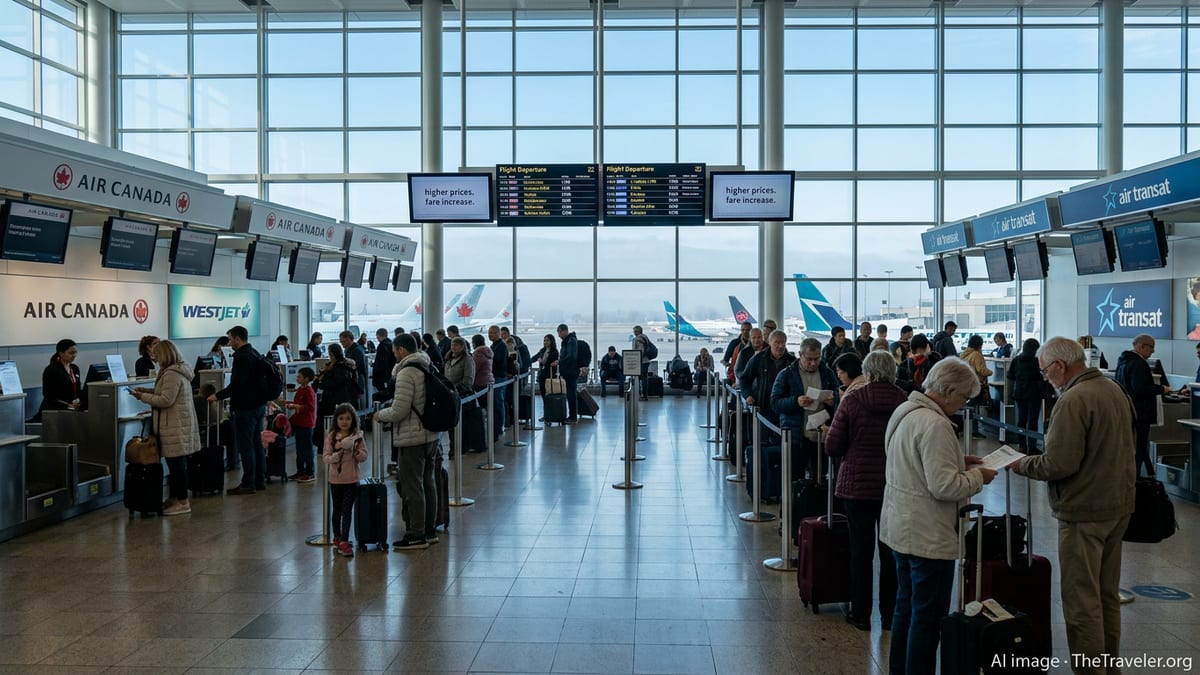
Canadian travellers are being warned to brace for airfares up to 20 per cent higher on some international routes this year, as Air Canada, WestJet and Air Transat signal a new round of price hikes driven by surging jet fuel costs linked to the escalating conflict in the Middle East.
Middle East Conflict Pushes Jet Fuel Costs Higher
The warning from Canada’s three largest leisure and long-haul carriers comes as global jet fuel prices spike on the back of heightened tensions and supply risks in the Middle East, a region that accounts for a significant share of the world’s aviation fuel production and refining capacity. Analysts say recent jumps in crude oil prices have been magnified in jet fuel markets, where supply is tighter and airspace closures are forcing longer routings for many airlines.
Recent estimates show jet fuel prices climbing from levels that were already higher than last summer to new peaks in early March, adding a fresh cost headwind for airlines heading into the busy spring and summer travel season. For many carriers, fuel typically represents between one fifth and one third of total operating expenses, leaving limited room to absorb sustained increases without passing at least part of the burden on to passengers.
Industry experts caution that while some airlines hedge a portion of their fuel needs, locking in prices months in advance, a prolonged period of volatility or further escalation in the region would eventually filter through to ticket prices worldwide. Canadian airlines, which have been adding capacity to transatlantic leisure markets, appear particularly exposed as they balance expansion with profitability.
Transatlantic Routes to the UK and France Under Pressure
Routes between Canada and Europe, especially to the United Kingdom and France, are emerging as some of the most vulnerable to the surge in fuel costs. These flights are typically longer-haul services where fuel consumption is higher, and many of them have seen steady capacity growth over the past two summers as Canadians flocked back to Europe for holidays and to visit friends and relatives.
Air Canada and Air Transat have both expanded their European networks from hubs in Montreal and Toronto, adding seats to London, Paris and regional French cities in response to strong demand. WestJet, traditionally more focused on Western Canada and sun destinations, has also been building its presence on key transatlantic corridors, including London services from cities such as Calgary and Toronto.
Now, with jet fuel prices jumping and flight times potentially lengthened by airspace restrictions and rerouting around sensitive areas, the economics of these routes are tightening. Analysts say that without fare increases in the high single to low double digits on some departures, carriers risk eroding margins during what is usually their most profitable period of the year.
Advanced fare data for the summer still shows a mixed picture, but travel agents are already reporting fewer deep-discount transatlantic promotions than in 2025 and more warnings from airline partners that base fares are likely to move higher as departure dates approach.
Mexico Holiday Market Braced for Steep Increases
Canadian sun-seekers bound for Mexico are also likely to feel the impact of higher fuel costs, even though these routes are shorter than transatlantic services. Mexico has become the default winter escape for many Canadians in recent seasons, particularly as operations to Cuba and some Caribbean destinations have been disrupted by local fuel shortages and operational constraints.
With WestJet, Air Canada and Air Transat all funnelling more leisure capacity into Mexican beach destinations such as Cancún, Puerto Vallarta and Los Cabos, any broad-based fuel-driven cost increase could quickly ripple through package prices and standalone airfares. Industry projections of up to 20 per cent fare hikes on select routes reflect not only the higher cost of fuel, but also strong underlying demand and limited spare capacity during peak travel weeks.
Tour operators and travel advisors say they are preparing customers for the likelihood that the era of widespread last-minute deals on Mexico packages may be fading, at least for the coming season. Higher fuel surcharges and tighter promotional activity are expected to show up first during school breaks and holiday periods, when planes are already near full.
At the same time, Mexico’s popularity as an alternative to destinations facing their own fuel or political headwinds means Canadians have fewer lower-cost substitutes if prices climb across the board. That could concentrate upward pressure on fares in a way that is felt particularly acutely by families and budget-conscious travellers.
How Air Canada, WestJet and Air Transat Are Responding
While none of the Canadian carriers has announced a uniform 20 per cent increase across their networks, executives and spokespersons have been signalling that fares will have to move higher on the most fuel-intensive and in-demand routes if current conditions persist. They describe the projected increases as a blend of higher base fares, adjusted fuel surcharges and more disciplined capacity management.
WestJet has acknowledged that fuel is now its largest operating cost and indicated that further price adjustments are likely as it seeks to protect the viability of its growing international schedule. Air Transat, which maintains some fuel hedging, is expected to be partially shielded in the short term but has warned that hedges only delay, rather than eliminate, the need to reprice tickets when underlying costs rise significantly.
Air Canada, the country’s largest carrier, faces particular scrutiny as it balances its role as a full-service global airline with the need to remain competitive on price-sensitive leisure routes. Analysts suggest it may rely more on targeted surcharges and yield management tools that nudge up average fares without eliminating entry-level price points entirely, especially on routes where low-cost or foreign competitors remain active.
All three airlines are also reviewing network plans for the summer, with industry observers expecting modest schedule tweaks rather than sweeping cancellations. Trimming marginal frequencies on underperforming routes while preserving high-demand services to major hubs such as London Heathrow and Paris Charles de Gaulle is one way carriers can limit fuel burn without ceding strategic ground.
What Travellers Can Do to Limit the Impact
For Canadian travellers, the emerging message is to plan earlier, budget more and be flexible about dates and departure points. With fares on some routes forecast to climb by up to one fifth if current fuel prices hold, booking several months ahead may offer better value than waiting in the hope of last-minute discounts that may never materialise in a constrained, high-cost environment.
Travel advisors recommend that passengers eyeing summer trips to the UK or France monitor fares closely and consider locking in prices when they see acceptable deals, rather than attempting to time the bottom of a volatile market. Those bound for Mexico might look at travelling slightly off peak, shifting to shoulder-season departures or midweek flights, where airlines sometimes retain more discretion to offer modest promotions.
Some travellers may also want to review travel insurance and fare rules, particularly if they are booking more expensive tickets further in advance. Policies or fare types that allow changes at reduced penalties can provide a measure of flexibility if prices or circumstances shift closer to departure, even as base fares trend higher.
Ultimately, how steep and how long-lasting any fare hikes prove to be will depend heavily on the trajectory of the conflict in the Middle East and the stability of global energy markets in the months ahead. For now, Canadian airlines are preparing customers for a more expensive year in the skies and urging them to adjust expectations accordingly.