

More news on this day
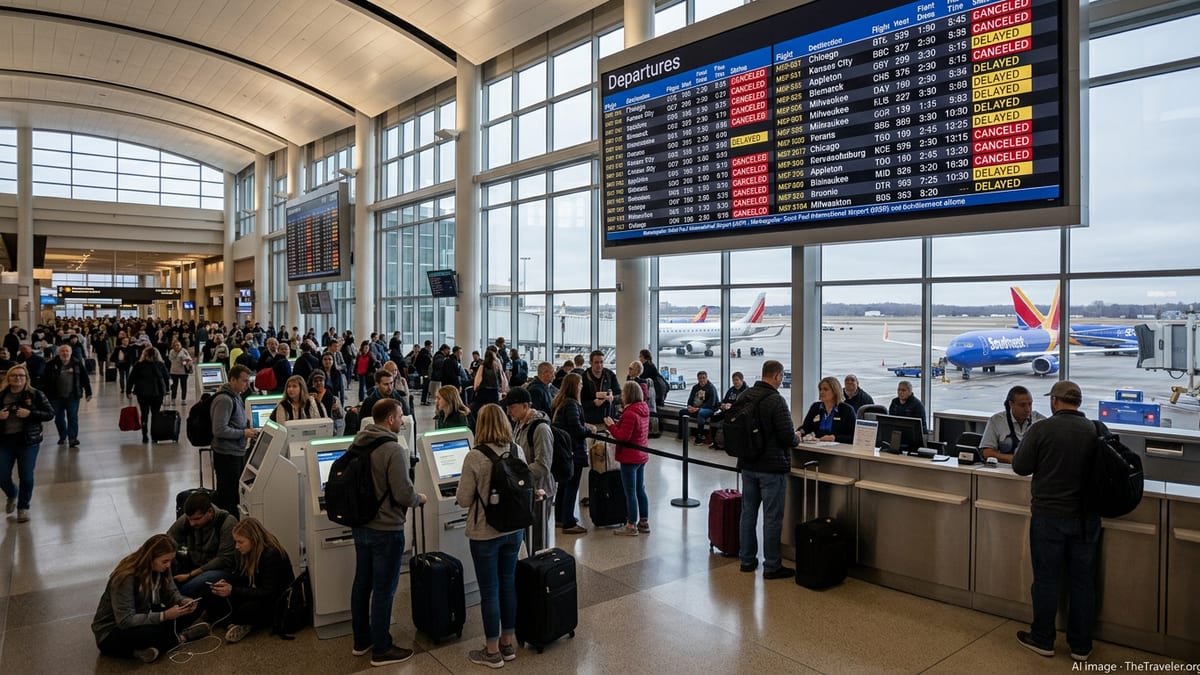
Passengers at Minneapolis–Saint Paul International Airport on March 6 faced a tense travel day as SkyWest Airlines, Envoy Air and Southwest Airlines collectively scrubbed 10 flights and posted multiple delays, disrupting connections to Saint Paul’s wider Twin Cities region and key destinations including Kansas City, Chicago, Appleton and Bismarck.
Frustration Builds as Cancellations Mount
By midafternoon, departure boards at Minneapolis–Saint Paul International showed a patchwork of canceled and late-running regional services, with SkyWest, Envoy Air and Southwest responsible for 10 outright cancellations and a growing roster of delayed departures. While the airport continued to operate, the interruptions were enough to strand scores of passengers in long rebooking lines and at crowded customer-service counters.
Travelers reported abrupt status changes from “on time” to “canceled” with little warning, particularly on regional routes that serve as vital connectors between the Twin Cities and smaller Upper Midwest communities. For many, the loss of a single rotation meant missed family events, disrupted business trips and last-minute scrambles for hotel rooms or rental cars.
Airport staff worked to direct passengers toward self-service rebooking kiosks and airline apps, but intermittent technology issues and high call volumes left some travelers relying on in-person assistance. Overhead announcements reminded passengers to monitor flight status frequently, as departure times for remaining services continued to shift throughout the afternoon.
Regional Routes to Kansas City, Chicago and Appleton Disrupted
The operational snags hit a cross-section of short-haul and regional flights linking Minneapolis–Saint Paul with other key Midwestern markets. Several SkyWest-operated services, which often fly under the banners of major carriers on codeshare agreements, were affected on routes to cities such as Appleton in Wisconsin and Bismarck in North Dakota, critical spokes in the region’s air network.
Envoy Air passengers bound for Chicago and Kansas City reported extended delays and at least one canceled rotation, complicating onward connections through those major hubs. Because many of these flights feed larger domestic and international networks, even a handful of cancellations at Minneapolis–Saint Paul rippled outward, forcing travelers to be rebooked on later departures from Chicago or Kansas City or shifted onto entirely different routings.
Southwest Airlines, which connects Minneapolis–Saint Paul with a range of domestic cities, also logged cancellations alongside rolling delays on selected departures. Some passengers on affected Southwest services opted to shift their trips to later in the weekend, concerned that tight turnaround times and broader congestion at other U.S. airports could trigger additional disruptions.
Weather and Congested National Airspace Add to the Strain
The disruptions at Minneapolis–Saint Paul occurred against a backdrop of wider turbulence across the U.S. air travel system, with other major hubs reporting heavy delay volumes tied to weather and airspace management programs. That broader congestion left limited spare capacity for airlines to reposition aircraft or crew quickly into the Twin Cities when early-morning irregularities began to appear on March 6.
Operational experts note that regional carriers such as SkyWest and Envoy Air are particularly vulnerable when storms, low visibility or traffic-management initiatives affect multiple airports at once. A single weather-related ground delay in a large hub can leave aircraft and flight crews out of position hours later in smaller markets, setting off a chain reaction of late departures and, ultimately, cancellations.
For Minneapolis–Saint Paul travelers, this meant that even flights not directly affected by local weather could still face knock-on delays as aircraft arrived late from other parts of the country. In several cases, passengers watched as scheduled departure times slid back in 30- or 60-minute increments while inbound aircraft remained en route from congested hubs.
Travelers Scramble for Alternatives and Compensation
With many regional flights operating only a few times a day, passengers on canceled services found limited same-day alternatives. Airline agents at Minneapolis–Saint Paul focused first on rebooking customers onto later departures to the same destination, but as seats filled, some travelers accepted routings through secondary hubs or even overnight stays to complete their journeys.
Families and business travelers alike described difficult choices: wait at the airport in hopes of a standby seat, pay out of pocket for a last-minute ticket on another carrier, or postpone the trip entirely. Those facing missed connections in cities like Chicago and Kansas City weighed whether to continue only as far as the hub or to abandon complex itineraries altogether.
Airlines reminded passengers to review their fare rules and carrier policies regarding meal vouchers, hotel accommodations and travel credits. While specific entitlements vary by airline and the underlying cause of disruption, many travelers queued at service desks to request assistance, underscoring how even a modest number of cancellations can create an outsized customer-service challenge when they hit high-demand routes.
Advice for Upcoming Flights Through Minneapolis–Saint Paul
With schedules still recovering and some aircraft and crews out of their normal positions, passengers with upcoming trips through Minneapolis–Saint Paul were urged to treat departure times on March 6 and the following days as provisional. Aviation analysts recommend checking in as early as possible on airline apps, enabling flight-status alerts and verifying gate assignments frequently at the airport.
Travel planners also encouraged flyers to build extra buffer time into connections involving regional links to or from cities such as Appleton, Bismarck and Kansas City, where limited daily frequencies reduce flexibility if a disruption occurs. Whenever possible, choosing earlier departures in the day can improve the odds of same-day recovery, as airlines have more opportunities to reroute passengers.
For those still considering whether to travel, customer advocates suggest reviewing flexible ticket options, including the possibility of no-fee changes or credits that some carriers offer during periods of sustained operational strain. As the situation evolves, the experience at Minneapolis–Saint Paul on March 6 serves as a reminder that even a relatively small cluster of cancellations can cascade into a difficult day for travelers across the Midwest and beyond.