

More news on this day
Passengers traveling through Patrick Leahy Burlington International Airport on Friday faced a patchwork of cancellations and rolling delays as regional carriers PSA Airlines, Endeavor Air and GoJet scrubbed five departures and pushed back numerous others, disrupting key connections to Washington, Newark, New York, Chicago, Fort Myers and other major hubs at the start of a busy travel weekend.
Get the latest news straight to your inbox!
Five Cancellations Ripple Across Key Regional Routes
Airport officials and airline status boards showed three regional jets scheduled to operate under major-carrier brands and two inbound legs canceled by midafternoon, a tally that quickly upended itineraries for dozens of travelers who rely on Burlington’s limited but vital links to major East Coast and Midwest hubs. The cancellations affected flights marketed by larger carriers but operated by PSA Airlines, Endeavor Air and GoJet, which handle much of the regional traffic into and out of Vermont’s primary commercial airport.
Among the most significant cuts were services touching Washington-area and New York-area airports, along with a disrupted rotation involving Chicago and a seasonal route to Fort Myers, Florida. With relatively few daily frequencies to some of these destinations, the loss of even a single flight left many passengers with same-day rebooking options that were either hours later, forced overnight stays in connecting cities, or, in some cases, unavailable altogether.
While each carrier cited a mix of operational reasons for the cancellations, from crew availability to knock-on effects from weather and congestion at larger hubs, the outcome for passengers in Burlington was the same: narrowed choices, longer days at the airport and mounting uncertainty about when they would reach their destinations.
The cancellations were particularly painful for travelers using Burlington as a launching point to reach onward international flights in New York and Chicago. Several passengers could be seen at airline service counters Friday morning trying to salvage overseas trips after losing their first short hop out of Vermont.
PSA, Endeavor and GoJet Under Pressure
The disruptions placed renewed scrutiny on the trio of regional operators, which fly under the banners of major U.S. airlines and are a backbone of connectivity for smaller markets like Burlington. PSA Airlines, a key regional affiliate for American Airlines, has faced recurring operational stress during peak periods in recent years, with staffing tight enough that delays at one hub can quickly cascade across the network.
Endeavor Air, which operates regional flights on behalf of Delta Air Lines, bore the brunt of several of Friday’s delays on routes linking Burlington to New York’s LaGuardia and other Delta hubs. As aircraft arriving late from congested East Coast airports cycled through the schedule, departure times in Burlington slid back in increments of 30 minutes or more, straining gate space and crowding departure lounges.
GoJet, which flies under United Express branding, was also contending with the ripple effects of congestion and weather in Chicago and Newark, two of the nation’s busiest and most delay-prone hubs. By midday, travelers heading to Chicago O’Hare were facing extended waits, and a canceled turn meant fewer seats available to clear the backlog of stranded passengers.
The regional carriers’ challenges underscore how dependent smaller airports are on a handful of contract operators that may have limited spare aircraft and crews on hand. When irregular operations hit, these airlines have far less flexibility than the major carriers whose logos appear on the boarding passes, often leaving passengers confused about who is actually responsible for the disruption and for providing assistance.
Major Hubs From Washington to Fort Myers Affected
Friday’s turmoil resonated well beyond Burlington, as the affected flights were part of larger networks feeding major hubs such as Washington, Newark, New York, Chicago and Fort Myers. A canceled or heavily delayed departure from Vermont can mean missed connections downline, especially at tightly banked hubs where flights are scheduled to arrive and depart within short windows to maximize connections.
Travelers booked to Washington-area airports reported missing onward government and business meetings, highlighting the importance of Burlington’s limited schedule of flights into the nation’s capital region. In New York, disruptions into LaGuardia and Newark narrowed options for passengers attempting to connect to transatlantic evening departures, a time-sensitive window that leaves little margin when feeder flights run late.
Farther south, a seasonal rotation to Fort Myers, popular with vacationers and snowbirds, saw its schedule punctured by the day’s irregular operations. For leisure travelers trying to reach Florida for weekend getaways, the impact was stark: with few alternative same-day routes from Burlington, some were rebooked via multiple connections or asked to postpone their trips by a day or more.
The pattern highlighted how disruptions at a small origin point like Burlington can send shockwaves through itineraries built around connections in larger cities. Even when the major hubs are operating relatively smoothly, a combination of regional airline constraints and tight schedules can turn what appears on paper to be a straightforward journey into a logistical puzzle.
Passengers Confront Long Lines and Limited Options
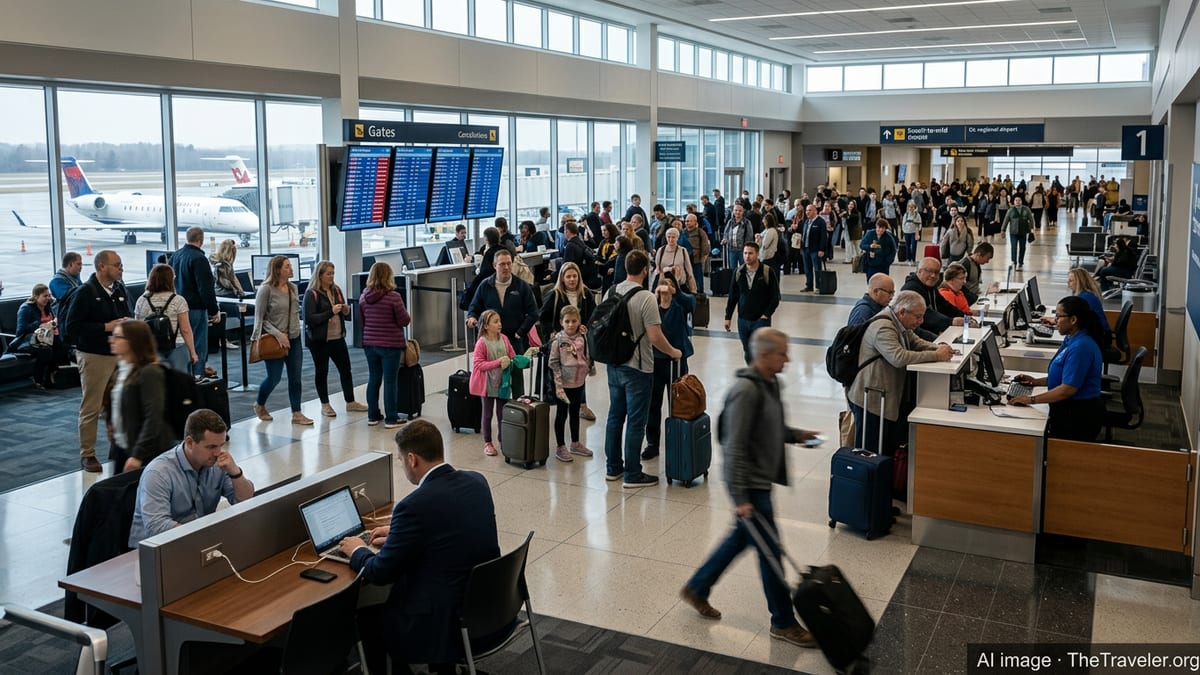
Inside Patrick Leahy Burlington International Airport, the human impact of the cascading delays and cancellations was immediately visible. Lines at airline customer service counters grew throughout the morning as agents tried to rebook passengers on the handful of remaining flights, manage hotel vouchers for those facing overnight disruptions and field a constant stream of questions about changing connection times.
Families with young children clustered around gate areas, juggling snacks and devices as departure times slid later. Business travelers worked on laptops at crowded charging stations, trying to salvage remote meetings from the terminal. Overhead announcements updated new boarding times for some flights even as others were abruptly marked canceled on the departure board.
Several passengers expressed frustration with what they described as inconsistent communication from the airlines operating the affected routes. Some said they received mobile app notifications only minutes before a delay or cancellation appeared on departure screens, while others reported that frontline staff lacked information about the likelihood of further schedule changes later in the day.
Local ground transportation providers also felt the strain, as some stranded travelers abandoned air travel altogether and sought last-minute rental cars or intercity bus options to reach destinations such as Boston or New York. For visitors arriving into Burlington, delayed inbound flights meant reshuffled plans for meetings, ski weekends and visits with family around Vermont.
Ongoing Vulnerability at Vermont’s Primary Air Gateway
Friday’s disruptions reinforced broader concerns about the resilience of air service at Patrick Leahy Burlington International Airport, which has seen fluctuations in carrier presence and route frequency over the past several years. With a relatively small portfolio of nonstop destinations and heavy reliance on a handful of regional partners, any period of irregular operations can quickly erode confidence among both leisure and business travelers.
Airport leaders have previously emphasized efforts to diversify airline service and maintain strong relationships with major carriers and their regional affiliates. Yet the events of the day again illustrated how factors largely outside the airport’s direct control, including crew scheduling decisions and hub congestion hundreds of miles away, can abruptly reshape the experience for passengers on the ground in Vermont.
Travel analysts note that regional aviation remains one of the most fragile segments of the U.S. air travel system, as carriers grapple with pilot shortages, cost pressures and evolving demand patterns between small and large markets. For airports like Burlington, that reality means continued vulnerability to sudden schedule disruptions, even when local weather and infrastructure are favorable.
As the day wore on, airlines worked to stabilize their operations and move delayed flights out, but many travelers were still bracing for late-night arrivals or unexpected overnight stays. With spring travel beginning to ramp up across the country, Burlington’s latest bout of travel turmoil served as an early warning of how quickly a small cluster of cancellations and delays can cascade into a full day of disruption for an entire region.