

More news on this day
Passengers moving through Patrick Leahy Burlington International Airport on March 13 faced an unusually turbulent day on the ground, as at least five regional flights operated by PSA Airlines, Endeavor Air and GoJet were cancelled and numerous others delayed, disrupting vital connections to Washington, Newark, New York, Chicago, Fort Myers and other major destinations.
Get the latest news straight to your inbox!
Cluster of Cancellations Hits Key Hub Connections
The spate of cancellations struck some of Burlington’s most critical connective routes, where regional carriers feed passengers into larger airline networks. PSA Airlines, Endeavor Air and GoJet, which operate regional jets on behalf of major U.S. carriers, scrubbed five departures and arrivals between them, while additional flights operated late, in some cases by more than an hour. The disruptions rippled through itineraries for business travelers, students and vacationers relying on Burlington for access to national and international networks.
Routes to Washington, Newark and New York were among the hardest hit, limiting same-day connections for travelers heading onward to the Midwest, West Coast and overseas. Flights linking Burlington with Chicago and Fort Myers also saw irregular operations, affecting both winter-weary Vermonters bound for warmer climates and visitors returning from seasonal holidays. Airline representatives described the day’s problems as an operational disruption concentrated in the regional system but acknowledged the outsized impact on a smaller hub such as Burlington.
While the total number of cancellations remained modest in absolute terms, the concentration across a handful of carriers and high-demand routes magnified the effect. At an airport where frequencies to each major hub are limited compared with larger metro fields, the loss of even a single rotation can wipe out most of a day’s remaining options for rebooking, forcing passengers to improvise travel plans or postpone trips altogether.
Passengers Confront Long Lines, Uncertain Timetables
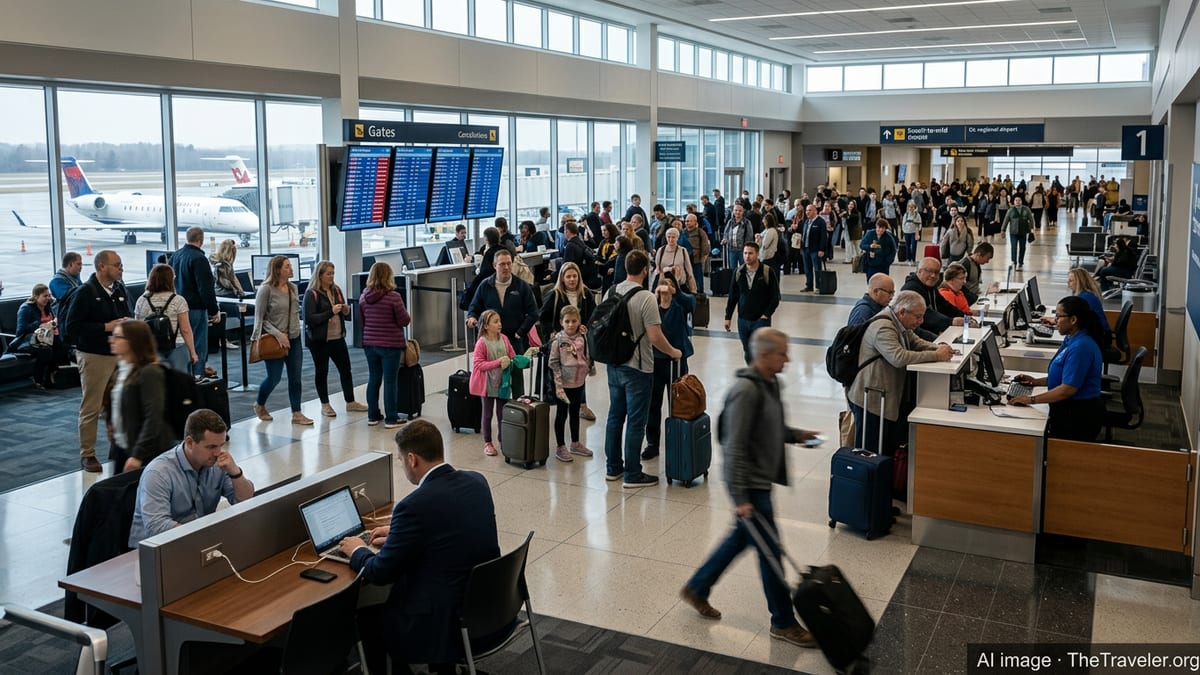
Inside the Patrick Leahy Burlington terminal, the operational snags quickly translated into visible stress on both travelers and staff. Check in counters and customer service desks for the affected carriers saw growing queues as passengers sought rebookings, meal vouchers and hotel arrangements. Some stood staring at departure boards that shifted repeatedly between delayed, estimated and cancelled statuses as operations teams tried to reroute aircraft and crew.
Families headed to Fort Myers and other Florida destinations for school vacations described scrambling to salvage their trips after early-morning flights were pulled from the schedule. Business travelers bound for Washington and New York to make same-day meetings reported weighing whether to drive to larger airports in Montreal, Boston or Albany after missing their original connections. For students and visiting relatives, even relatively short delays created knock-on challenges with ground transportation and campus schedules.
Airport staff, accustomed to heavy winter travel and periodic weather disruptions, worked to direct passengers to self-service kiosks and airline help points while security screening lines flexed to accommodate bunching around delayed departure waves. Though the terminal remained orderly, the day developed the familiar hallmarks of a regional travel crunch: rolling announcements, passengers camped near power outlets, and gate agents juggling full flights and limited seats for re-accommodation.
Regional Carriers Cite Tight Operating Conditions
The three regional operators at the center of Friday’s problems, PSA Airlines, Endeavor Air and GoJet, form critical links in the national air network, flying smaller jets under the brands of major carriers to connect smaller cities like Burlington with larger hubs. Industry analysts note that regional airlines continue to operate in a tight environment marked by crew availability constraints, high aircraft utilization and limited slack to recover from schedule disruptions.
In such a system, even localized issues can cascade quickly. A mechanical check on a single aircraft, a crew timing out after hitting federally mandated duty limits, or knock-on effects from earlier delays at a hub airport can combine to force multiple cancellations at a spoke city. When several regional operators face similar constraints on the same day at one airport, the result is a concentrated burst of disruption that is particularly visible to local travelers.
Recent years have also seen regional carriers adjust schedules and staffing as major airlines recalibrate networks and capacity. That has left some smaller markets with fewer daily flights on core routes than they had before the pandemic, narrowing the margin for recovery when a single departure is lost. For passengers in Burlington, this means that a day like Friday, with concentrated cancellations across multiple carriers, removes much of the network’s built-in flexibility.
Strategic Importance of Burlington’s Links to Major Hubs
Patrick Leahy Burlington International, despite its modest size, plays an outsized role in connecting Vermont and parts of northern New York to the broader U.S. and international air system. Routes to Washington, Newark, New York and Chicago are not only popular point-to-point services but also vital connectors to flights across the country and abroad. When several of these links are disrupted at once, the impact stretches beyond the immediate region, affecting travelers whose itineraries begin or end far from Burlington.
Connections to Florida, including Fort Myers, are equally important during the colder months, when leisure demand peaks and aircraft often depart near capacity. A cancelled or significantly delayed southbound flight can mean an entire day’s worth of sun-seeking travelers are forced to compress into later departures from other cities, or abandon plans altogether. For inbound visitors, missed connections can translate into shorter stays and rearranged lodging, affecting local hotels and tourism businesses.
Local travel observers say that maintaining reliable service on these key routes is central to the area’s economic health, supporting not only tourism but also higher education, state government and corporate travel. Episodes of concentrated disruption highlight how dependent the region remains on a relatively small number of daily departures to each major hub, and how swiftly those connections can be strained when regional carriers run into trouble.
Travelers Adjust Plans and Look for Workarounds
As the day unfolded and it became clear that some flights would not be restored, many Burlington-area travelers pivoted to alternative plans. Some sought seats on later departures operated by other carriers, while others looked to airports within driving distance, such as Montreal’s Trudeau International or Boston Logan, for replacement itineraries. A segment of passengers postponed non-essential trips entirely, opting to rebook in the coming days when schedules are expected to stabilize.
Frequent flyers familiar with regional volatility recommended that fellow passengers keep close tabs on airline apps and notifications, arrive early when widespread delays are reported elsewhere in the system, and consider holding backup routings for time-sensitive trips. For those connecting through Washington, Newark, New York or Chicago, that can mean choosing itineraries with longer layovers or favoring flights earlier in the day, when irregular operations have less time to accumulate.
By evening, operations at Patrick Leahy Burlington International showed signs of gradual normalization, but airline and airport officials anticipated residual effects on weekend travel as aircraft and crew were repositioned. For travelers in and out of Vermont’s largest airport, Friday’s turmoil served as another reminder that, even on clear days, the regional aviation system remains vulnerable to sudden pockets of disruption that can quickly reshape plans both close to home and far afield.