

More news on this day
Passengers at Louisville’s Muhammad Ali International Airport faced a bruising start to their travel plans on Sunday as a cluster of cancellations and rolling delays on PSA Airlines, Delta Air Lines and Mesa Airlines disrupted key routes to Charlotte, Atlanta, Washington, Denver, Detroit and other major hubs.
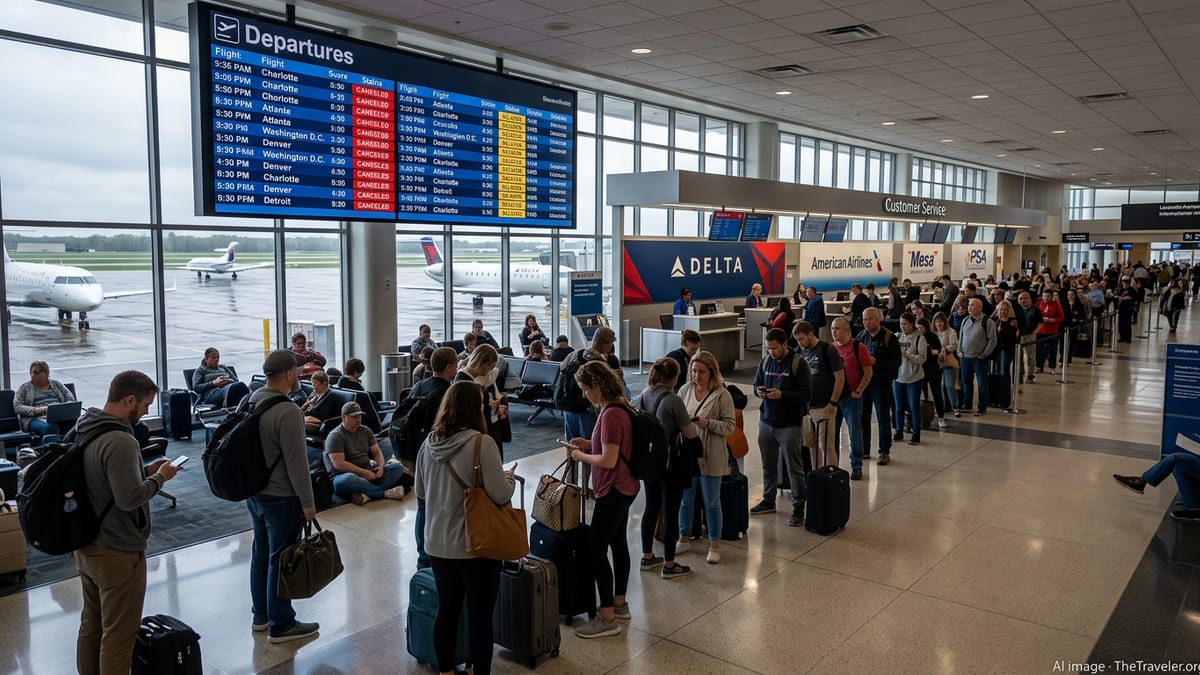
Chain Reaction of Cancellations at a Critical Midwest Gateway
Airport departure boards at Louisville’s Muhammad Ali International Airport filled with red and amber status updates through Sunday morning as at least seven regional flights operated by PSA Airlines, Delta Air Lines and Mesa Airlines were canceled or severely delayed, according to real-time flight-tracking data. The affected services included multiple departures to high-demand hubs such as Charlotte, Atlanta, Washington and Denver, along with a delayed Delta connection to Detroit, creating a cascade of missed onward connections across the country.
Regional carriers PSA and Mesa, which operate flights under the American Eagle and United Express brands respectively, were at the center of the disruption. One Mesa-operated United Express service from Louisville to Houston was marked canceled after repeated delays, while a series of PSA-operated American Eagle flights to the East Coast failed to depart on schedule, leaving passengers scrambling for alternatives at crowded service desks.
Delta, Louisville’s largest network carrier, added to the headache with rolling delays on its Louisville–Detroit and Louisville–Atlanta services, key links for travelers connecting onward to the Upper Midwest, Northeast and international destinations. While some Delta flights remained scheduled to depart with modest delays, uncertainty around departure times left passengers clustered around gate podiums, phones in hand, trying to rebook before remaining seats disappeared.
Local aviation observers say the pattern mirrors a broader vulnerability in the US air network, where disruptions at secondary hubs like Louisville can quickly ripple outward because many regional flights feed into a small number of megahubs. With Charlotte, Atlanta, Washington and Denver all serving as primary connection points, cancellations on a relatively small number of feeder flights can strand travelers far from their final destinations.
Travellers Stranded as Rebooking Options Narrow
Inside the terminal, lines quickly formed at airline counters as stranded passengers sought new itineraries or overnight accommodations. With popular business and leisure routes involved, same-day alternatives were limited and often required circuitous routings through secondary hubs or longer layovers than originally planned.
Families headed to school break vacations, business travelers bound for Monday meetings and sports fans connecting to weekend events were among those stuck in limbo. Many reported that by the time official cancellations appeared in airline apps, remaining seats on later departures out of Charlotte, Atlanta, Washington, Denver and Detroit were already heavily booked, forcing some to accept travel dates one or even two days later than planned.
Regional jets used by PSA, Mesa and Delta’s regional partners typically have fewer seats than mainline aircraft, which can make recovery from a cluster of cancellations particularly challenging. When a flight on a 70- or 76-seat regional jet is canceled, there is often not enough spare capacity on the next departure to absorb every displaced passenger, especially on routes that already operate close to full during peak periods.
At Muhammad Ali International, gate agents worked flight by flight to prioritize travelers with tight international connections or essential travel needs, while others were encouraged to consider rerouting through alternate hubs such as Chicago, Dallas or Houston where space was available. For some Louisville-based travelers, driving to nearby airports in Cincinnati, Indianapolis or Nashville in time to catch an alternate flight became the only realistic option.
Impact on Major Hubs: Charlotte, Atlanta, Washington, Denver and Detroit
The disruption in Louisville had outsized effects because of the strategic importance of its main connecting cities. Charlotte, a central hub for American Airlines and its regional partners, is a key jumping-off point for domestic connections across the Southeast and East Coast as well as transatlantic flights. Canceled PSA-operated services into Charlotte meant missed onward connections as far afield as Miami, New York and London.
Atlanta, the world’s busiest passenger hub and Delta’s primary fortress, was also affected as delays on Louisville–Atlanta services translated into missed banked connections downtown. Passengers with tight onward flights to Florida, Texas and the West Coast found themselves automatically rebooked onto later departures, often arriving at their destinations much later than expected.
Washington and Denver, crucial gateways for government, tech and mountain destinations respectively, saw knock-on effects as Louisville-originating passengers failed to materialize for onward segments. In Detroit, the delayed arrival of Louisville traffic complicated already tight midmorning connection windows, fueling crowding at customer service points as travelers jockeyed for seats on later flights to the Upper Midwest and Canada.
Although the number of affected Louisville departures was relatively small compared with disruptions at coastal megahubs, the concentration of cancellations on regional connectors magnified their impact. Travelers starting or ending their journeys in smaller cities reliant on a single daily link through Charlotte, Atlanta, Washington, Denver or Detroit were among those hardest hit, with some facing the prospect of entire trips becoming unviable.
Underlying Pressures on Regional Airlines and Operations
Aviation analysts say the problems at Louisville highlight ongoing operational strains facing US regional carriers. PSA and Mesa, both contract operators for major airlines, have spent the past several years juggling pilot shortages, fleet changes and shifting route assignments. While staffing levels have improved since the height of the pandemic, regional airlines often have less flexibility to swap aircraft or crews at short notice compared with their larger mainline partners.
Any disruption, whether mechanical, weather related or due to airspace constraints, can therefore trigger a domino effect as crews and aircraft fall out of position. Once a handful of flights are canceled at a spoke airport like Louisville, getting aircraft and crew back into the right place to operate later segments becomes more complicated, especially when those planes are due to fly on to multiple cities in a single day.
Delta’s regional operations are under similar pressure as the carrier leans heavily on feeder flights to maintain connectivity to smaller markets. Louisville, which serves both business travelers bound for corporate headquarters and leisure passengers heading to gateway hubs, relies on the reliability of these smaller jets to make the broader Delta network work as intended.
Industry watchers note that even when weather or air traffic control constraints play a role, the operational fragility of the regional system often determines how severe the fallout becomes for passengers. With tight schedules and few spare aircraft on hand, small hiccups can quickly snowball into multi airport disruptions such as those seen around Louisville on Sunday.
What Passengers Can Do When Disruptions Hit
With flight disruptions now a recurrent feature of US air travel, veteran passengers at Muhammad Ali International spent Sunday sharing strategies in terminal seating areas and at gate podiums. Many advised fellow travelers to keep a close eye on airline apps and flight-tracking tools rather than waiting solely for public address announcements, as early signs of creeping delays can offer a critical window to request rebooking before seats vanish.
Travel advocates recommend that stranded passengers first use an airline’s app or website to search for alternative routings, then approach agents with specific options in mind. At busy moments, having a concrete backup itinerary that still aligns with airline rules can speed up the rebooking process and improve chances of securing a seat on the next available departure.
For travelers with crucial time-sensitive plans, booking earlier flights than strictly necessary, avoiding the last flight of the day on a route and considering slightly longer layovers at major hubs can provide an extra buffer when irregular operations strike. Those departing from airports like Louisville that rely on regional connectors to major hubs may also want to research nearby alternate airports and ground transportation options before their trip.
As operations at Muhammad Ali International slowly stabilized later in the day, many passengers were still nursing frayed nerves and rewritten itineraries. With regional airlines PSA, Mesa and Delta’s partners playing an ever more important role in connecting US cities, the events in Louisville served as a fresh reminder that even a handful of cancellations in the wrong place at the wrong time can unravel travel plans far beyond a single airport’s walls.