

More news on this day
Hundreds of passengers were left stranded or facing long waits across Europe today as at least 45 flight cancellations and 82 delays disrupted operations for carriers including Finnair, KLM, Pegasus and SunExpress at major hubs such as Paris, Milan Malpensa, Athens, Frankfurt, Oslo and London, according to live airport and flight-tracking data.
Get the latest news straight to your inbox!
Patchy Operations Across Key European Gateways
Live departure boards and flight-tracking platforms showed a patchwork of disruption through the day at several of Europe’s busiest airports, with irregular cancellations and knock-on delays rippling through schedules. Paris Charles de Gaulle and Orly recorded clusters of cancelled short and medium haul services, while Milan Malpensa saw a mix of outright cancellations and rolling delays that pushed some departures beyond their scheduled time slots.
In Greece, Athens International Airport reported multiple late-running services, particularly on intra-European routes, with late aircraft and earlier air traffic flow restrictions contributing to extended turnaround times. Frankfurt, one of Europe’s main connecting hubs, registered a smaller number of outright cancellations but a noticeably higher volume of departures leaving more than 30 minutes behind schedule, affecting connections onward to North America, the Middle East and other European cities.
Further north, Oslo’s Gardermoen Airport and London’s main gateways, including Heathrow and Gatwick, showed a similar pattern of scattered cancellations but a more visible build-up of delays. Passengers on early morning and late evening waves of traffic appeared to be the most affected as schedule buffers thinned and minor operational issues translated into longer waits at the gate.
Across these airports, the headlines figures of 45 cancellations and 82 delays only partially captured the scale of disruption, as even flights that eventually departed broadly on time often did so with last-minute gate changes or revised boarding procedures that added stress for travellers in already crowded terminals.
Finnair, KLM, Pegasus and SunExpress Among Affected Carriers
The disruption cut across both traditional network airlines and low-cost or leisure-focused carriers. Publicly visible schedule data showed Finnair contending with late-running European sectors that fed into its wider network, amplifying the impact of individual delays on connecting passengers. Some flights touching Paris, Frankfurt and Oslo operated with reduced punctuality, adding to missed connections and impromptu overnight stays for travellers.
KLM flights operating to and from hubs such as Paris and London also recorded delays, in several cases attributed in operational summaries to late inbound aircraft and congestion within the broader northwest European airspace. The carrier’s reliance on tight connection windows meant that even modest departure slippages in one city created timetable pressure at its main hub later in the day.
Low-cost and hybrid carriers were not spared. Pegasus and SunExpress, which both move significant leisure and visiting-friends-and-relatives traffic between Europe and Turkey, appeared among the operators with cancelled or heavily delayed services at airports including Athens, Frankfurt and Milan Malpensa. For many passengers, especially those without through-ticket protection, rebooking options were limited to later flights with few remaining seats.
Other European and non-European airlines also showed scattered disruptions, underlining how shared airspace, ground handling capacity and crew availability tie carriers together operationally. Even when a given airline’s own fleet and crews were available, knock-on effects from congested airspace or ground delays at a previous airport sometimes forced schedule reshuffles with little notice.
Weather, Airspace Constraints and Staffing Pressure Intertwine
Operational notes and meteorological data pointed to a combination of factors behind today’s disruption rather than a single clear trigger. Pockets of adverse weather in parts of France, Germany and the United Kingdom contributed to temporary capacity reductions and required wider separation between aircraft, which in turn reduced the number of movements airports could accommodate during peak periods.
In parallel, previous reports on Europe-wide punctuality have highlighted how air traffic flow management measures, particularly in busy corridors over France, Germany and the Netherlands, can quickly translate into reactionary delays once daily schedules are running at near capacity. When regulations slow traffic through these bottlenecks, airlines face extended holding, rerouting and revised departure slots that cascade through the network.
Staffing constraints on the ground and among air traffic control units also remain a recurring theme. While many European hubs have invested in rebuilding capacity since the pandemic years, published industry data shows that even modest gaps in staffing during high-demand periods can cause slowdowns at bottlenecks such as security, check-in and aircraft turnaround. Those slowdowns often do not cancel a flight outright but extend delays far enough to disrupt onward connections and crew rosters.
The interaction of these elements created a fragile operating environment today in which minor issues, from slow baggage loading to brief technical checks on aircraft, were more likely to snowball into significant schedule impacts than they would on a day with more slack in the system.
Passengers Face Long Queues and Rebooking Challenges
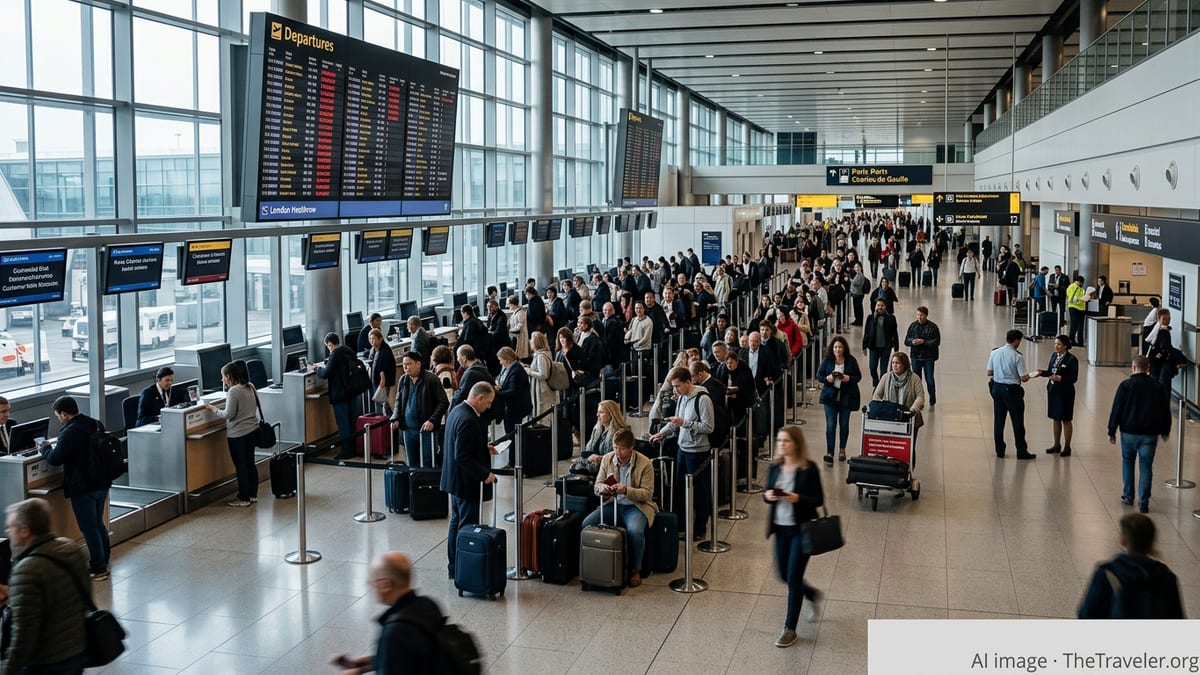
For travellers, the operational picture translated into crowded departure halls, long customer service queues and anxiety over missed connections. Images and reports shared across social platforms depicted passengers waiting at gate areas in Paris and London while departure times were repeatedly revised in increments of 15 to 30 minutes, often accompanied by limited real-time information on the exact cause of delays.
At transfer-heavy hubs such as Frankfurt and Athens, disruption on a handful of feeder flights created particular difficulty for those travelling on complex itineraries. Some passengers arriving from secondary European cities found that their onward flights had either departed or were heavily overbooked, leaving them reliant on same-day standby lists or overnight accommodation while they waited for the next available seat.
Airlines responded with a mix of automatic rebooking, voucher offers and guidance to use mobile apps or online portals for alternative arrangements. However, when large numbers of travellers attempted to change their plans at once, digital tools and call centres faced surges in demand, and airport ticket counters again became focal points for those seeking immediate assistance or paper boarding passes for reissued itineraries.
The uneven nature of today’s disruption also created regional disparities. Some passengers in Oslo and London reported relatively smooth journeys apart from modest delays, while others at Paris or Milan Malpensa experienced extended waits on the tarmac or at baggage reclaim as airport systems worked through backlogs of arriving and departing flights.
Spotlight on European Passenger Rights and Travel Planning
The latest wave of cancellations and delays has again drawn attention to the rules governing passenger compensation and care within Europe. Under European Union regulations, travellers departing from EU and EEA airports, or flying into them on EU carriers, can in many cases claim assistance and, in certain situations, financial compensation when flights are cancelled or significantly delayed for reasons within an airline’s control.
Travel industry advisories circulating today encouraged passengers affected by disruptions at airports such as Paris, Frankfurt, Athens and Milan Malpensa to retain boarding passes, booking confirmations and any receipts for meals or accommodation, as these may be required for later claims. Guidance also emphasized that entitlements can differ depending on the length of delay, total flight distance and the specific circumstances surrounding each cancellation.
The incidents have also reinforced calls from consumer advocates for clearer real-time communication when flights are at risk of disruption. Even in cases where airlines ultimately provided meals, hotel rooms or alternative routing, some travellers expressed frustration with receiving limited advance warning before cancellations or with rapidly changing estimated departure times on airport displays.
For those planning upcoming travel, the day’s events offer a reminder of the value of longer connection times, flexible tickets and comprehensive travel insurance, particularly when itineraries rely on busy European hubs and multiple carriers. While today’s total of 45 cancellations and 82 delays represents a small fraction of overall daily flights across the continent, the impact on individual journeys can be significant when disruptions occur at precisely the wrong point in an already tight schedule.