

More news on this day
Travellers at Vancouver International Airport faced a difficult start to the day as a series of cancellations and rolling delays involving Pacific Coastal Airlines, Air Canada, Jazz and Icelandair disrupted at least ten departures and arrivals, affecting key routes to cities including Edmonton, Penticton, Powell River, Toronto and Regina.
Get the latest news straight to your inbox!
Chain of Cancellations Hits Regional and National Routes
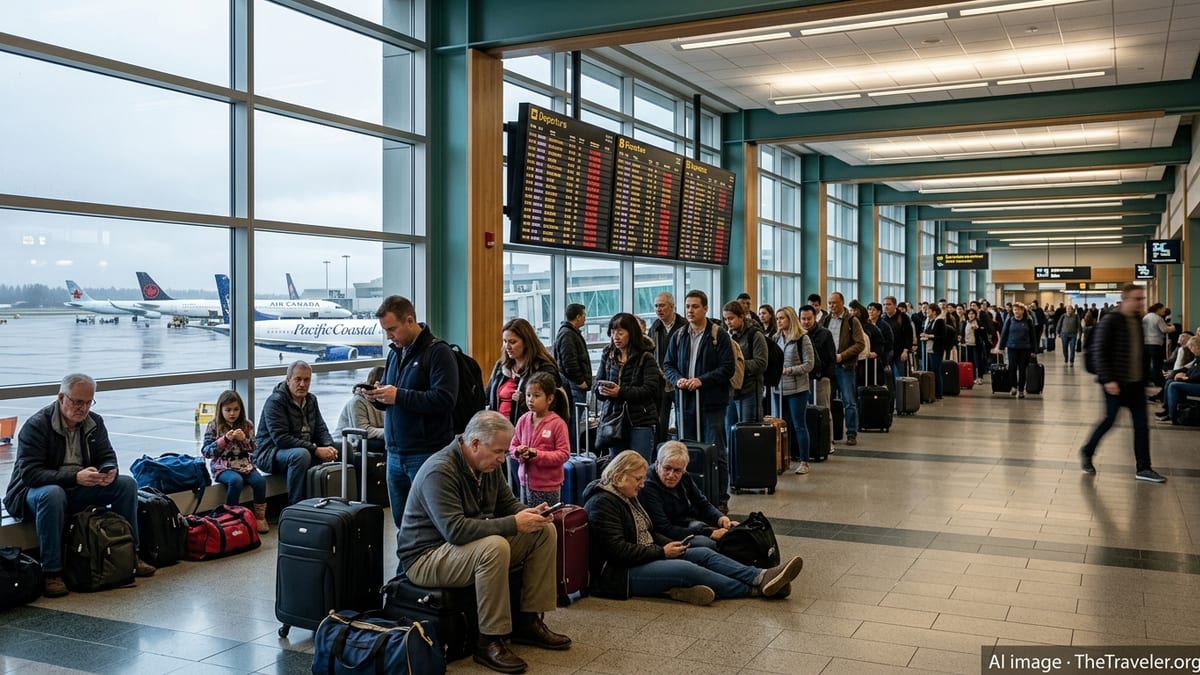
Publicly available flight information from Vancouver International Airport on Thursday indicates that a cluster of cancellations built rapidly through the morning, with at least ten flights scrubbed across several carriers. Pacific Coastal Airlines, Air Canada, its regional partner Jazz, and Icelandair were among those affected, leaving passengers queueing at service desks and monitoring departures boards for alternative options.
The disruption has been felt on both short-haul and longer domestic sectors. Regional links between Vancouver and smaller British Columbia communities such as Penticton and Powell River, operated primarily by Pacific Coastal Airlines, saw multiple cancellations and significant schedule changes. These services are vital connectors for residents who rely on Vancouver for onward national and international travel, magnifying the impact of each lost departure.
Major Canadian city pairs were also affected. Flights between Vancouver and Edmonton, Toronto and Regina experienced cancellations or substantial delays, narrowing options for business travellers and families attempting to make tight connections. According to published schedule data, some replacement services were quickly filled, pushing many travellers onto later flights or entirely different routings.
For Icelandair, the operational challenges at Vancouver added pressure to already busy transatlantic schedules. Passengers bound for European destinations faced the prospect of missed connections in Reykjavik and the need for rerouting, extending total travel times by many hours.
Knock-On Effects for Connections Across Canada and Beyond
The immediate cancellations in and out of Vancouver triggered a broader cascade of disruption along key domestic corridors. Travellers on the heavily used Vancouver to Toronto route reported extended waits and limited same-day alternatives, as aircraft and crews fell out of position and airlines attempted to consolidate services. Some passengers facing missed connections to Eastern Canada and the United States were rebooked on overnight or next-day flights.
Connections through Edmonton and Regina were also affected as inbound aircraft from Vancouver failed to arrive on schedule. National route maps published by Vancouver International Airport show these cities as important mid-continent links, meaning cancellations in the morning window can echo through the timetable for the rest of the day. Crowded gate areas and lines at transfer counters reflected the effort to rebuild disrupted itineraries.
Regional communities including Penticton and Powell River were left with fewer options than usual to reach Vancouver, heightening concerns about the resilience of smaller markets when irregular operations arise. In some cases, passengers faced long drives or bus journeys as same-day alternatives by air disappeared. Social media posts from affected travellers described confusion over revised departure times and difficulty obtaining up-to-date gate information.
Published guidance from several Canadian carriers stresses that passengers on disrupted flights may be entitled to rebooking and, in some circumstances, refunds or travel credits. However, as flights filled quickly, many customers found that theoretical options were limited in practice, especially for those needing to maintain tight onward connections.
Weather, Congestion and a Season of Operational Strain
The cancellations at Vancouver come during a winter marked by periodic storms and heavy demand across North American air travel. Meteorological reports for recent weeks have pointed to unstable weather patterns affecting coastal and inland routes, while operational data for Canadian carriers has reflected lower on-time performance during peak disruption days. Reports from aviation forums and passenger communities have highlighted how a single weather system can create knock-on effects at multiple hubs.
Vancouver International Airport’s own traffic summaries underline its role as a critical West Coast gateway, with a dense web of domestic, transborder and international routes. When ground operations are slowed by poor visibility, heavy rain or snow, or when air traffic flow restrictions are imposed, recovery can take many hours. Travellers today encountered that reality as delays compounded across morning and afternoon banks of flights.
Operational bulletins from airlines and airport authorities in recent seasons have repeatedly urged passengers to monitor flight status closely, arrive early and be prepared for schedule changes during periods of adverse conditions. The situation in Vancouver shows how quickly conditions can deteriorate even on days that begin with only modest disruption, especially when multiple carriers encounter challenges at the same time.
Industry analysts note that, while carriers have strengthened recovery plans since the pandemic, staffing levels, aircraft availability and congested airspace can all limit the speed at which normal operations are restored after a wave of cancellations.
Passenger Experience: Long Lines and Limited Options
Inside the terminal, the operational difficulties translated into long lines at check-in, ticketing and customer service counters. Many travellers arriving to find their flights cancelled joined queues to secure alternative itineraries or claim hotel and meal support where available. Others turned to airline apps, call centres and social media channels in search of faster solutions or clearer information on rebooking rules.
Accounts shared on public forums from recent disruption events at Vancouver describe frustration with communication delays, particularly when gate screens and mobile notifications lag behind real-time operational decisions. Today’s irregular operations appeared to follow a similar pattern, with some passengers learning of cancellations only upon reaching the airport or passing through security.
Families with small children, elderly travellers and visitors unfamiliar with Vancouver or Canadian consumer protection rules were among those most affected. With hotels near the airport known to fill quickly during mass disruptions, some passengers faced the prospect of overnight stays in terminal seating or last-minute searches for accommodation further from the airport.
Travel advisors frequently recommend that passengers facing cancellations retain all receipts, document interactions with airlines and review carrier policies and federal air passenger regulations to understand potential compensation or reimbursement eligibility. The events at Vancouver are likely to renew interest in such guidance as travellers look to minimize both financial and practical fallout from disrupted journeys.
What Travellers Can Do When Disruption Strikes
The latest difficulties at Vancouver underscore several practical steps that can help travellers navigate sudden cancellations and extended delays. Publicly available airline tariff documents stress the importance of providing up-to-date contact details when booking, enabling carriers to send notifications about changes before passengers depart for the airport. Many airlines also encourage the use of mobile apps, which can sometimes offer self-service rebooking options faster than in-person queues.
Passenger advocates often advise travellers to research alternative routings as soon as a disruption appears likely, including flights through secondary hubs or nearby airports that might not yet be heavily affected. In Canada, awareness of consumer protections under national air passenger regulations can be especially important, as entitlements may differ depending on whether delays are within an airline’s control or driven by weather and air traffic constraints.
For those booked on regional routes from Vancouver to communities such as Penticton or Powell River, it can be useful to consider backup ground options in advance, particularly during winter months. While such contingencies cannot fully replace the speed and convenience of air travel, they may provide a workable last resort if flights are cancelled and same-day alternatives are unavailable.
As operations gradually stabilize, airlines typically focus on restoring core domestic and international connections, which may help ease pressure on routes linking Vancouver with major centres like Edmonton, Toronto and Regina. Until then, passengers passing through the airport can expect busy terminals, shifting departure times and a premium on flexibility and patience as the system works to recover.