

More news on this day
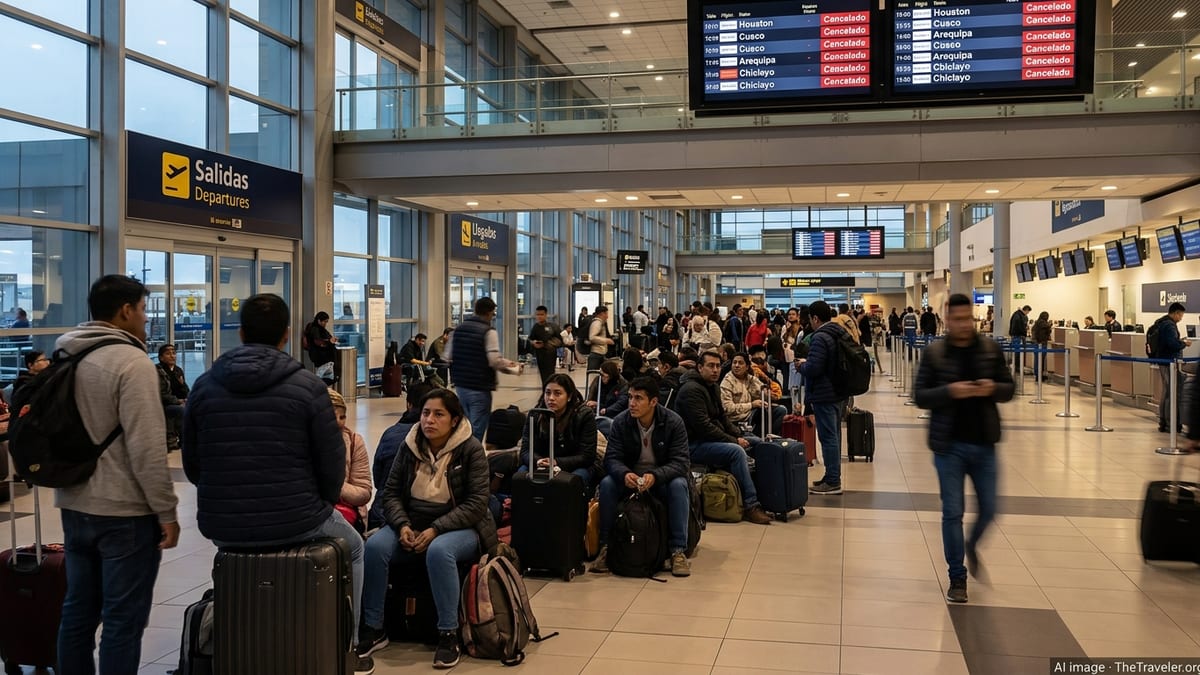
Passengers connecting through Lima’s Jorge Chávez International Airport faced unexpected isolation this week after a cluster of cancellations on services operated by LATAM Airlines, Sky Airline and United disrupted routes to Houston and several Peruvian cities, stranding travelers in the country’s main hub.
Get the latest news straight to your inbox!
Cluster of Cancellations Hits Lima Hub
A wave of cancellation notices affecting flights in and out of Jorge Chávez International Airport has interrupted both domestic and international itineraries at one of South America’s busiest hubs. Publicly available flight information and media monitoring show that at least four key services, including connections to Houston and to high-demand domestic destinations such as Cusco, Arequipa and Chiclayo, were withdrawn from schedules or grounded at short notice.
The disruption appears to span multiple carriers. LATAM, Sky Airline and United all show scrubbed rotations or heavily adjusted timetables involving Lima, undercutting the usually dense network that links the capital to Peru’s regional cities and to North American gateways. For transit passengers relying on Lima as a bridge between Andean tourist centers and long-haul departures, those schedule gaps have translated into long unplanned layovers and missed onward connections.
International aviation monitoring platforms list Jorge Chávez as Peru’s primary international gateway and a central node for LATAM’s operations in the country, with Sky Airline and United feeding additional domestic and intercontinental traffic. When several of those airlines simultaneously remove or retime key flights, the options for rebooking within the same travel day narrow quickly, particularly on routes that already operate with limited daily frequencies.
Reports from recent travelers through Lima indicate that the impact has been felt across both economy and premium cabins, with passengers on package tours, independent itineraries and business travel all facing last-minute itinerary changes. Social media posts describing overnight delays and hurried rebookings illustrate how a handful of cancellations at a constrained hub can cascade into multi-day disruptions for those connecting onward.
Domestic Links to Cusco, Arequipa and Chiclayo Disrupted
The knock-on effect has been especially acute on domestic sectors linking Lima with Peru’s tourism and commercial centers. Flights between Lima and Cusco are among the country’s busiest routes, serving travelers bound for Machu Picchu and the Sacred Valley as well as local residents. According to routing data compiled for Peru’s aviation market, LATAM and Sky Airline normally operate multiple daily frequencies on this corridor, with additional links to Arequipa, Chiclayo and other regional hubs.
When rotations on those routes are cancelled or consolidated, seat availability on the remaining services can vanish quickly, particularly during peak visitor periods and around major events in the capital. Accounts shared by passengers in recent months describe similar patterns of disruption, with schedule changes, weather challenges in Cusco’s valley airport and high demand combining to create bottlenecks that leave travelers unable to depart on their planned dates.
Arequipa and Chiclayo, important gateways for southern and northern Peru respectively, face their own vulnerabilities when Lina-centered schedules are cut back. These cities typically rely on Lima for onward international connections; cancellations on their Lima links can isolate travelers regionally, forcing them to wait for the next available flight rather than rerouting over alternative domestic hubs. Public timetable data for Peruvian carriers show that many secondary cities are served only a few times per day, meaning that even a small number of cancellations can create gaps of 24 hours or more.
Domestic aviation in Peru has grown steadily over the past decade, but observers note that it remains highly centralized around Jorge Chávez. This centralization magnifies the impact of operational problems, whether they stem from airline scheduling decisions, weather or infrastructure constraints. When traffic through Lima encounters disruptions, regional cities such as Cusco, Arequipa and Chiclayo can quickly become harder to reach on short notice.
International Connections to Houston and Beyond Affected
The current round of disruptions has also affected long-haul itineraries, most notably the link between Lima and Houston, a key gateway for travelers connecting between North and South America. Airline schedule services list United as a primary operator on the Lima to Houston route, with passengers frequently connecting onward to cities across the United States and beyond.
When Lima departures to Houston are cancelled or significantly delayed, travelers may lose access to same-day onward flights, turning what was intended as a smooth overnight or early-morning connection into a prolonged stay in the terminal or in nearby hotels. Recent traveler commentary about itineraries involving Lima and Houston suggests that relatively tight connection windows, while normally workable in standard operations, leave little margin when cancellations or rolling delays occur.
Other international connections from Lima, including services to regional hubs in South America and to major cities in North America and Europe, can also be indirectly affected when aircraft and crew are out of position. If airlines redeploy limited resources to prioritize certain trunk routes, less frequent services may be suspended temporarily or operate with altered schedules. Public announcements from carriers in recent years regarding schedule adjustments into and out of Lima illustrate how operational decisions at the hub level ripple across networks.
Travel industry analysts note that Lima’s importance as a connecting point has increased as more travelers combine domestic Peruvian itineraries with multi-country trips across South America. In this context, disruptions on a single long-haul link such as Houston can affect not only point-to-point travelers but also those planning multi-leg journeys that depend on tight coordination between domestic and international operations.
Stranded Passengers Face Long Waits and Limited Options
For travelers already at Jorge Chávez when cancellation notices appear, the immediate challenge is often finding space on alternative departures. Accounts from affected passengers in Peru and neighboring countries describe long queues at service desks and competing demands for limited seats on later flights, particularly where multiple airlines have trimmed capacity on the same day.
Because many visitors to Peru travel on fixed itineraries tied to tour start dates or entry tickets for attractions such as Machu Picchu, a missed domestic leg can quickly translate into nonrefundable losses or a need to rearrange complex schedules. Travelers who planned same-day connections from Cusco or Arequipa to international overnight flights from Lima are especially exposed when those regional flights are cancelled. Public commentary about recent travel through Peru’s air network indicates that some passengers have opted to stay extra nights in Cusco or Lima to secure more reliable departure options.
For those arriving from abroad and intending to connect directly to regional destinations such as Chiclayo or Juliaca, cancellations can mean an unplanned night in Lima or the need to purchase replacement tickets on competing carriers, often at elevated last-minute prices. Reports from traveler forums suggest that some stranded passengers have had to split their groups across different flights or even different airlines in order to reach their destinations within a reasonable timeframe.
Consumer advocates highlight that while compensation and support policies vary by carrier and jurisdiction, passengers frequently face uncertainty about what assistance they can expect when cancellations are described as operational or weather related. Guidance from national aviation regulators and customer-protection agencies encourages travelers to document communications with airlines and to review fare conditions and travel insurance provisions when seeking reimbursement or alternative arrangements.
Ongoing Infrastructure Transition Adds Complexity
The disruptions come as Lima’s airport undergoes a complex transition period linked to the development of a new terminal and expanded infrastructure. Officially published information on the project notes that while parts of the new facilities have begun limited operations, full-scale transfer of all passenger services has been delayed, creating a hybrid operating environment across terminals and support systems.
Aviation briefings on the Jorge Chávez expansion describe a multi-year modernization effort aimed at increasing capacity and improving the passenger experience, but also acknowledge that construction phases and shifting timelines can add operational strain. During such transitions, airlines must adapt gate assignments, baggage handling flows and ground transport arrangements, raising the potential for misalignments that contribute to delays or cancellations.
Peru’s broader tourism sector depends heavily on reliable air links through Lima, especially for travelers bound for coastal cities and the Andean and Amazonian regions. Industry analysts have pointed out that while the upgraded airport is expected to bolster capacity over the long term, short-term growing pains may periodically affect punctuality and service continuity. In this context, episodes where multiple carriers cancel or retime flights on the same day can be viewed as symptoms of a wider system under pressure.
Observers also note that the country’s geography and weather patterns compound these operational challenges. High-altitude airports like Cusco are more susceptible to weather-related constraints, and any resulting delays can propagate through the tightly scheduled domestic network back to Lima. When combined with infrastructure changes at the hub itself, the system becomes more fragile to shocks, making clusters of cancellations more likely during periods of stress.
What Travelers Can Do When Cancellations Hit Lima
Travel specialists tracking developments in Peru recommend that visitors build additional buffer time into itineraries that rely on connections through Jorge Chávez, particularly when linking regional flights to long-haul departures. Recent traveler experiences shared publicly suggest that allowing at least several hours between domestic arrivals and international departures can reduce the risk of missed flights, especially during peak travel seasons.
Monitoring airline apps and airport departure boards closely in the days leading up to travel can also provide early warning of schedule changes. Some carriers operating in Peru have been adjusting timetables and aircraft types as they respond to demand and infrastructure constraints, and these changes may not always trigger immediate notifications for passengers who booked through third-party agencies.
Travel advisors emphasize that booking flexible fares where possible and considering travel insurance that specifically covers cancellations and missed connections can provide additional protection. Public guidance from consumer organizations encourages passengers to familiarize themselves with airlines’ rebooking and refund policies before departure, as these rules can determine whether an extended delay results in compensation, alternative routing or only a travel credit.
As Lima’s airport navigates its current transition and airlines continue to fine-tune their schedules, episodes of concentrated disruption like the recent cancellations affecting Houston, Cusco, Arequipa, Chiclayo and other routes serve as a reminder of the importance of contingency planning. For travelers, building in time and flexibility may be the most practical way to mitigate the risk of being left isolated at Peru’s principal air hub.