

More news on this day
Hundreds of travelers were left scrambling across Peru this week after a string of abrupt flight cancellations by United Airlines, Sky Airline, LATAM and other carriers severed key links between Lima, Cusco and major international hubs including Houston, Arequipa and Bogotá, raising new questions over airline reliability during the Southern Hemisphere’s busy late-summer travel period.
Get the latest news straight to your inbox!
Five Key Flights Axed in Fast-Moving Disruption
The latest wave of disruption began on March 11 at Lima’s Jorge Chávez International Airport, when four flights operated by United Airlines, Sky Airline and LATAM were scrubbed within hours, affecting services to Houston, Arequipa, Trujillo and other regional destinations, according to local aviation reports and airport operations data.
Among the most high-profile cancellations was a United Airlines service linking Lima with Houston, a route that functions as a vital northbound gateway for both Peruvian travelers and international tourists returning to North America. The loss of this departure forced many passengers into overnight stays in Lima or lengthy rebookings via other hubs.
Domestic connectivity was also hit hard. Sky Airline cancelled a Lima to Arequipa service, while additional adjustments affected links between the capital and secondary Peruvian cities. At roughly the same time, LATAM scrubbed at least one international departure from Lima to Bogotá, further reducing capacity on a heavily trafficked Andean corridor and compounding the regional knock-on effects.
Travel industry analysts note that, taken together with prior operational hiccups in late January that saw LATAM and Sky Airline cancel or delay dozens of flights between Lima and Cusco, this new cluster of five pivotal cancellations has deepened a pattern of intermittent instability across Peru’s busiest corridors.
Passengers Stranded in Lima and Cusco as Options Vanish
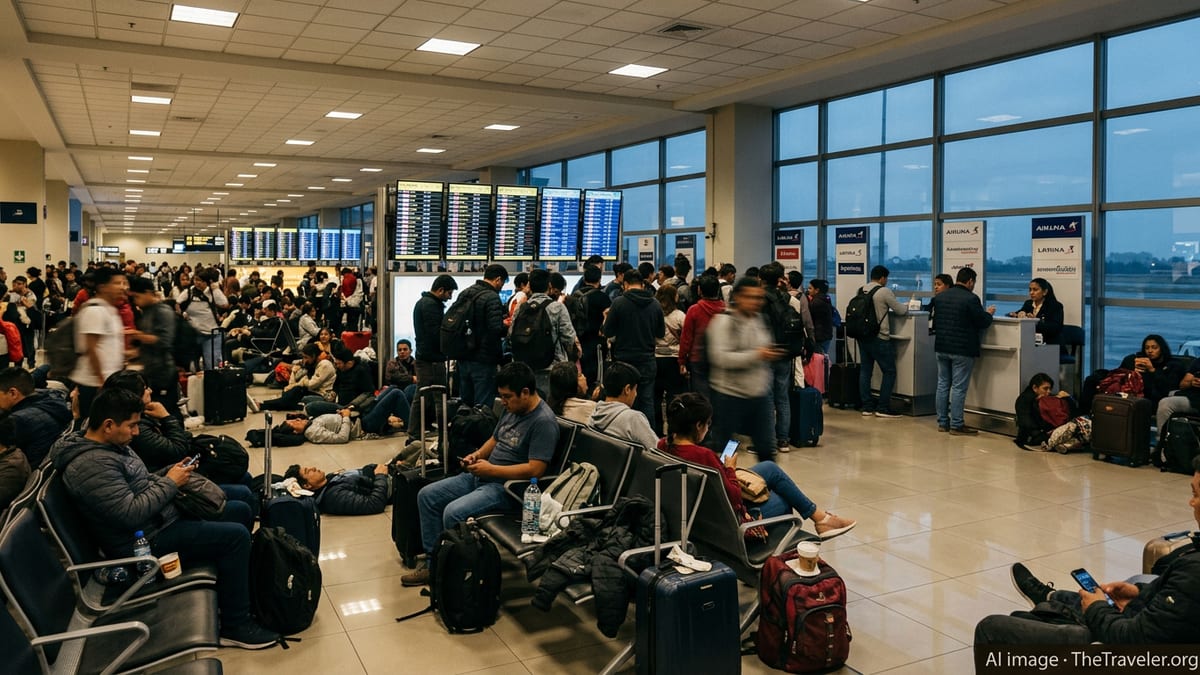
The immediate impact was felt in Lima’s crowded departure halls, where stranded passengers queued at airline counters late into the night seeking rebookings, hotel vouchers and meal assistance. Travelers reported difficulty securing alternative itineraries, with many northbound and regional flights already operating near capacity during the March shoulder season.
In Cusco, a key gateway for Machu Picchu and Sacred Valley tourism, the cancellations reverberated quickly. Some passengers whose connections depended on Lima–Houston and Lima–Bogotá links found their onward journeys abruptly severed, leaving them marooned in the high-altitude city for an extra night or more as they awaited new routings through Santiago, São Paulo or Bogotá.
Tour operators based in Cusco said they spent much of March 11 and 12 reworking itineraries for clients who faced missed connections, lost hotel nights and tour rescheduling charges. Many visitors with tightly packed schedules found that even a single long-haul cancellation from Lima could unravel carefully planned multi-country South America trips.
At both Lima and Cusco airports, local media captured scenes of families sleeping on floors, travelers holding hand-written signs describing their destinations, and long lines forming at check-in and customer service desks as passengers demanded clearer communication from airlines on the causes of the cancellations and the timing of recovery flights.
Airlines Cite Operational Adjustments as Wider Disruptions Mount
While detailed explanations varied by carrier and flight, airlines largely framed the cancellations as operational adjustments tied to broader regional and global pressures. Industry trackers reported that South America has experienced a spike in disruption in recent weeks, with dozens of cancellations and hundreds of delays affecting airlines such as LATAM, Avianca and low-cost carriers across Peru, Colombia, Argentina and Chile.
Operational challenges range from aircraft availability and crew scheduling constraints to congestion at key hubs and knock-on effects from airspace issues on other continents, which can ripple into long-haul fleets serving Latin America. Even small changes, such as a delayed inbound arrival or an aircraft taken out of service for unscheduled maintenance, can trigger the cancellation of a single but strategically important flight.
In Peru, these stresses are layered on top of a network that has been recalibrating following route closures and tariff disputes at Lima’s main airport. Earlier decisions by LATAM and Sky Airline to trim certain international routes from the capital have concentrated traffic on remaining services, potentially reducing the system’s resilience when new disruptions occur.
United, Sky Airline and LATAM have all emphasized their efforts to re-accommodate affected passengers on the next available flights, offering refunds or travel credits where appropriate. However, traveler advocates argue that the recurring pattern of abrupt cancellations suggests deeper structural strains in airline operations that are not fully explained by short-term technical or weather issues.
Know Your Rights: What Stranded Travelers Can Expect
The spate of cancellations has also focused attention on passenger rights in Peru and on international routes. For flights departing Peru and bound for destinations such as Houston and Bogotá, compensation and assistance rules depend on a complex mix of local regulations, airline policies and, in some cases, international agreements that govern care obligations when disruptions are within the carrier’s control.
Consumer organizations note that travelers whose flights are cancelled for operational reasons, rather than severe weather or extraordinary security events, are generally entitled to options that may include rebooking at no additional cost, refunds of unused segments and, in some circumstances, hotel accommodation and meal vouchers during extended waits. The specifics can vary widely by airline and ticket type.
Experts advise passengers to document all communication with airlines, keep receipts for essential expenses like lodging and food, and request written confirmation of the reason for the cancellation, which can be important if they later seek reimbursement or file a complaint with aviation authorities. Travelers booked through third-party agencies are encouraged to contact both the agency and the airline, as responsibility for processing changes can sometimes be shared.
Given the recent pattern of cancellations in Peru, legal specialists say this latest incident could prompt renewed scrutiny from regulators and stronger calls for harmonized passenger-protection rules across South America, particularly for cross-border routes that link hubs such as Lima, Bogotá and São Paulo.
How to Navigate Peru Flights in the Coming Weeks
With airlines and airports still working to normalize schedules after the cancellations of the five key flights, travel planners are urging passengers flying to or from Peru in the next several weeks to build in extra time and flexibility. That includes allowing longer layovers when connecting through Lima or Cusco and avoiding last-flight-of-the-day options on critical legs whenever possible.
Travel agents recommend that travelers monitor flight status closely in the 24 to 48 hours before departure, use airline mobile apps or text alerts, and reconfirm any tight same-day connections that depend on specific long-haul departures, such as the Lima to Houston and Lima to Bogotá routes affected this week.
For those already in Peru, experts suggest having a contingency plan that might include alternative domestic routes between Lima, Cusco and Arequipa, as well as awareness of bus or rail options for shorter segments if domestic capacity becomes constrained. While air travel remains the fastest way to traverse Peru’s mountainous geography, surface transport can sometimes provide a practical backup when flights fall through.
Despite the disruption, airlines insist that the situation should stabilize in the short term. However, for travelers looking ahead to peak Easter and winter holiday periods, the recent cancellations serve as a reminder that even well-trodden routes between Lima, Cusco, Houston, Arequipa and Bogotá are not immune to sudden changes, making proactive planning more critical than ever.