

More news on this day
Travelers relying on the short-hop air link between Sidney–Richland Regional Airport and Billings Logan International Airport are facing fresh disruption this week, after Cape Air scrubbed 10 flights on the route, highlighting the fragility of eastern Montana’s federally supported regional air network.
Get the latest news straight to your inbox!
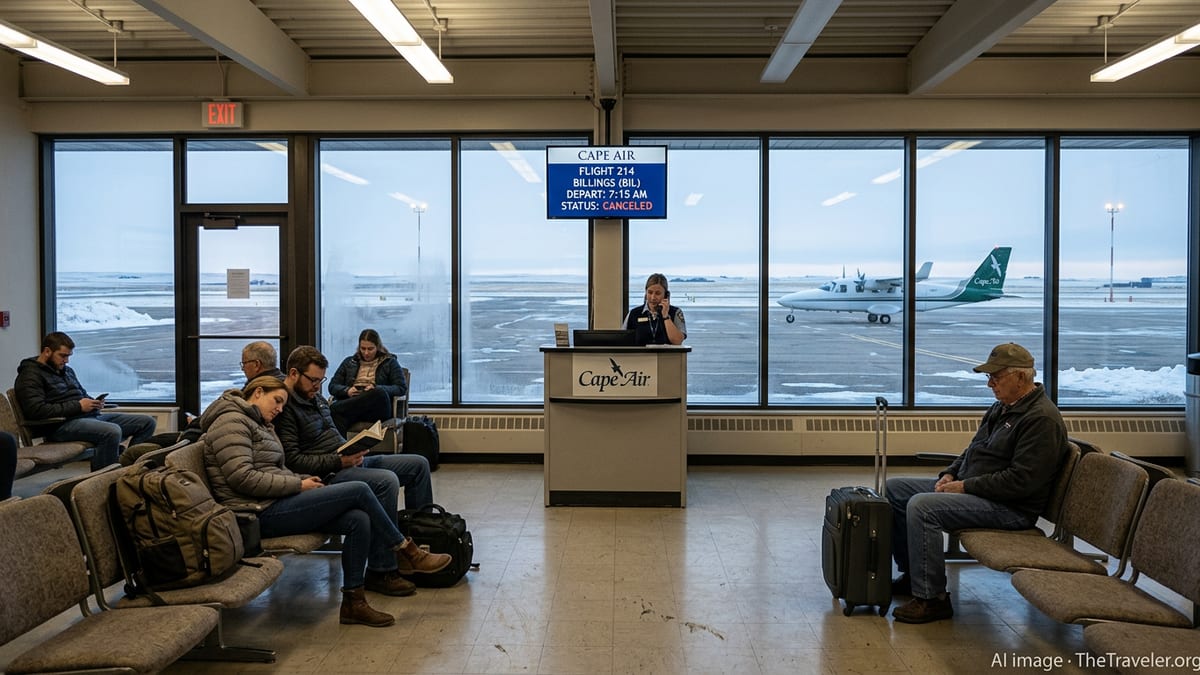
Wave of Cancellations Disrupts Key Eastern Montana Route
According to recent schedule and status data for Cape Air’s Sidney–Billings services, a cluster of cancellations has hit the typically reliable commuter corridor, forcing passengers to rebook, reroute by car, or abandon trips altogether. While individual flights on the route have operated normally in recent days, the airline confirmed that 10 rotations were withdrawn from the schedule over a short period, affecting both northbound and southbound legs.
The cancellations struck a route that normally sees multiple daily frequencies, providing a roughly 1 hour 50 minute hop between Sidney–Richland Regional Airport and Billings Logan International Airport. For many residents, the service is the only practical alternative to a several-hour drive across the state’s rural highways, especially during late-winter weather and limited daylight.
The disruption comes at a time when Cape Air is in the midst of a new multi‑year Essential Air Service contract to connect several eastern Montana communities, including Sidney, with Billings as the primary regional hub. That federal support underscores how critical the route is considered for medical travel, business links and access to onward national and international flights.
Local officials say they are closely monitoring reliability on the route, mindful that repeated disruptions could undermine confidence in a service that has been painstakingly built up under successive federal agreements.
Passengers Stranded, Rebooked and Rerouted by Road
For passengers, the practical impact of 10 canceled flights in a thin schedule is immediate and personal. Travelers reported same‑day cancellations, with some learning of the disruption only after arriving at the airport, forcing rapid decisions on whether to wait for a later departure, request refunds, or attempt the drive to Billings.
Because Cape Air’s eastern Montana network feeds into Billings rather than larger hubs like Denver or Minneapolis, missed connections can cascade through an entire itinerary. A canceled morning shuttle from Sidney can mean missed national departures from Billings and, in some cases, lost days on trips for work, medical appointments or family emergencies.
Car rental counters and regional bus options offer only limited alternatives when multiple flights drop out of the schedule at once. In winter and early spring, driving conditions along the long stretches between Sidney and Billings can also be unpredictable, heightening anxiety for travelers who suddenly find themselves behind the wheel instead of in the air.
Some passengers are turning to travel insurance or credit‑card protections to recoup costs linked to hotel stays and missed connections, as they wait to see whether reliability on the Sidney–Billings link stabilizes in the coming weeks.
Cape Air Cites Operational Strains on a Subsidized Lifeline
Cape Air has not pointed to a single root cause for the spate of cancellations, but regional carriers typically juggle several pressures at once: aircraft availability, pilot and crew scheduling, maintenance needs and challenging late‑winter weather patterns across the northern Plains. Any combination of those factors can quickly ripple through a small fleet serving short sectors.
The airline operates under a federal Essential Air Service agreement for Sidney and neighboring communities, with subsidies designed to keep small‑community routes viable despite low passenger volumes and high per‑seat operating costs. While those agreements guarantee a baseline of scheduled service, they do not insulate communities from short‑term operational disruptions, particularly on days when storms or mechanical issues sideline aircraft.
Industry analysts note that regional carriers like Cape Air tend to have less redundancy than major airlines, meaning that the loss of a single aircraft to unscheduled maintenance or a crew timing out on duty limits can force a cancellation rather than a simple delay. In a network built around thin routes with limited backup, ten cancellations in quick succession can be a sharp shock to both travelers and local economies.
The situation at Sidney–Richland also revives broader questions about whether current subsidy levels and fleet planning are sufficient to deliver the level of reliability that rural communities increasingly expect from their air links.
Economic Jitters for Sidney and the Wider Region
In Sidney and the surrounding Richland County area, business and civic leaders worry that any perception of an unreliable air link to Billings could deter investment and complicate efforts to attract workers, visitors and conferences. For companies tied to energy, agriculture and services, a dependable air bridge to Montana’s largest city is both a selling point and a logistical necessity.
Health care providers are also keeping a close eye on the situation. Many patients use the Sidney–Billings route to access specialist care and procedures not available locally. When flights are canceled, rescheduling those appointments can take weeks, adding stress for families and straining already tight medical timetables.
Tourism officials argue that while visitation to far‑eastern Montana is still largely drive‑based, an air option from Billings remains critical for out‑of‑state visitors with limited time. A pattern of cancellations, they warn, risks pushing travelers to choose other destinations that offer more predictable regional connectivity.
Local chambers of commerce are urging residents and businesses to document disruptions carefully, providing data that can be shared with state and federal transportation officials as they evaluate future service levels and support mechanisms.
Calls for Better Communication and Long‑Term Fixes
In the wake of the cancellations, frequent fliers on the route say better real‑time communication from Cape Air and airport authorities would at least help travelers make quicker decisions when flights are in jeopardy. Many are signing up for text alerts, keeping a close eye on flight‑status tools, and building extra time into itineraries that hinge on a Sidney–Billings connection.
Aviation planners and local officials, meanwhile, are weighing longer‑term responses. Options on the table include reassessing minimum service levels in future contracts, exploring fleet upgrades with more resilient aircraft types, and enhancing coordination between ground transportation providers and the airline so that substitute options can be organized more rapidly during disruptions.
For now, the focus in Sidney is on restoring confidence. Regular travelers say that once flights operate consistently for several weeks, the memory of the ten canceled services may begin to fade. But they also emphasize that in a region where a single carrier provides the only commercial lifeline to the wider air network, every cancellation carries outsized weight.
As spring travel ramps up and demand increases along the eastern Montana corridor, Cape Air’s performance on the Sidney–Billings route will be closely watched by passengers, businesses and regulators alike, all keen to see whether the latest setback proves to be a brief turbulence or a warning sign of deeper reliability challenges ahead.