

More news on this day
Capri’s latest tourist tax and behavior rules are emerging as a flashpoint in a wider European shift, as Poland, Sweden, Romania, Germany, Spain, Greece, France and other destinations tighten travel controls, border checks and visitor conduct regulations that collectively make holidays across the continent more complex to plan.
Get the latest news straight to your inbox!
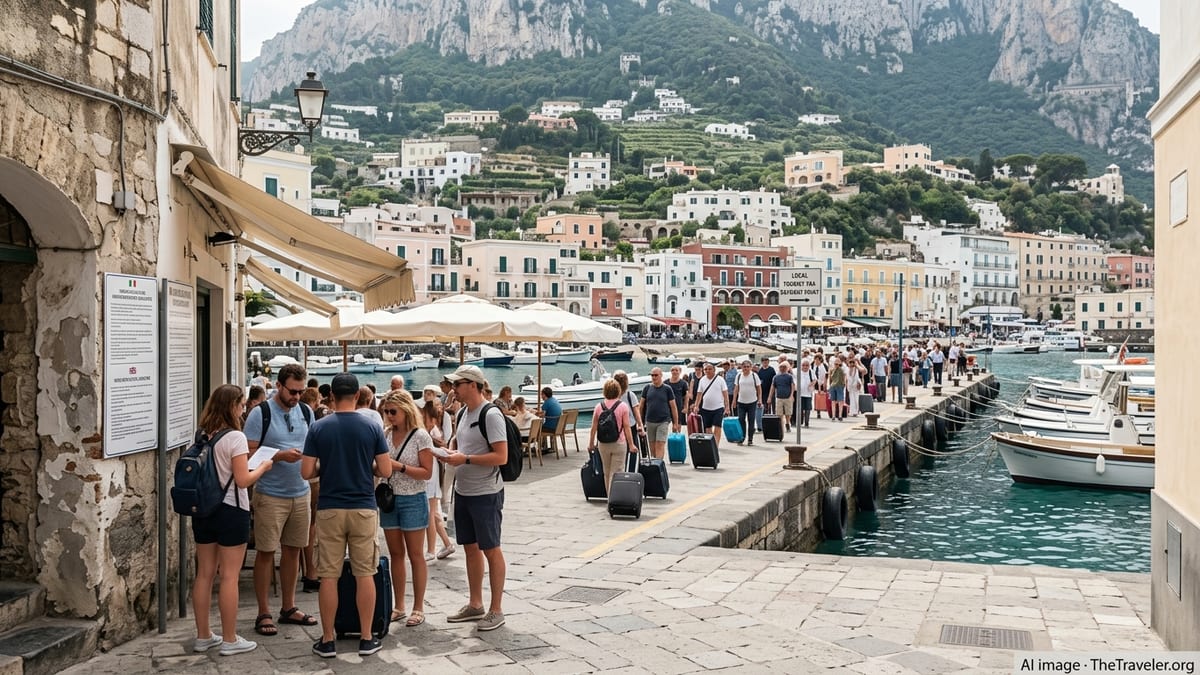
Capri Sharpens Its Stance on Mass Tourism
Capri, one of Italy’s most visited islands, has moved to strengthen local rules on visitor conduct while reinforcing its long-running tourist tax, a combination that places the popular destination at the center of Europe’s crackdown on unruly or high-impact tourism. Reports from Italian and international travel media describe stricter enforcement of existing levies on day-trippers, alongside renewed campaigns warning visitors about fines for noise, inappropriate clothing and behavior considered disruptive to local life.
The tourist tax on Capri, charged via ferry and cruise operators, is intended to help cover the strain on essential services that peaks in summer, when the island’s narrow streets and limited infrastructure struggle with crowds. Local measures target what authorities regard as low-spend, high-impact tourism, with particular focus on very short, high-volume day visits that leave little economic benefit beyond pressure on waste, water and transport systems.
Behaviour rules, some of which date back decades, have gained fresh attention as enforcement increases. Coverage in Italian outlets and international travel guides highlights fines for wearing noisy wooden-soled footwear on historic lanes, for example, as well as tighter expectations around dress and decorum in village centers and near religious sites. The combined effect is a clearer message that visitors are welcome, but only if they adapt to local norms and accept higher costs tied to their presence.
Capri’s moves sit alongside a broader Italian trend, with cities such as Venice, Florence and Rome already rolling out new penalties and charges to address overcrowding, short-term rentals and disruptive gatherings. In this context, Capri’s reinforced tourist tax and behavior rules are being interpreted as another signal that Italy is prepared to use pricing and fines to rebalance tourism on its own terms.
Poland Enters the Spotlight on Tougher Travel Rules
While Italy focuses on visitor conduct and funding pressures from mass tourism, Poland has become more prominent in discussions about evolving travel hurdles inside the Schengen Area. Publicly available government guidance and recent policy analyses show that Poland, like several neighbors, has relied on periods of intensified border checks in response to regional security, migration and logistics concerns, complicating the previously seamless experience many travelers expected within the bloc.
Temporary controls, conducted under the Schengen Borders Code, have periodically affected crossings between Poland and other EU states, including Germany and Lithuania. Logistics briefings aimed at freight operators highlight how these measures can extend wait times for trucks and cross-border services, but they also serve as a reminder to leisure travelers that even within Schengen, journeys may involve document inspections, queues and occasional secondary screening.
At the same time, official Polish information campaigns aimed at visitors emphasize the need to understand visa rules, carry valid identification and comply with entry conditions when arriving from outside the European Union. A 2024 tourist guide issued by Poland’s customs and border services outlines document requirements, import rules and the importance of confirming visa status before departure, underscoring a more rules-focused environment for travelers entering the country by air, rail or road.
For those connecting through Poland to other European destinations, these shifting practices mean that advance preparation is increasingly important. Travelers are urged by official and industry sources alike to check for any temporary border measures, airline documentation requirements and potential delays, especially during periods of heightened security or political tension.
Schengen’s New Era: Digital Borders and Recurrent Checks
The challenges unfolding in Poland are part of a wider recalibration of how Europe’s border-free travel zone operates. Recent updates to the Schengen Borders Code, adopted at EU level, give member countries more structured tools to reintroduce internal checks temporarily when facing perceived threats to public order or security. Although these measures are intended to be exceptional and time-limited, their repeated use has made border controls within Schengen more common than many travelers expect.
In parallel, the European Union is preparing to overhaul its external border management with the Entry/Exit System, a biometric scheme scheduled to begin operating in October 2025, and the forthcoming ETIAS travel authorization for visa-exempt visitors in 2026. Public briefings from EU institutions and industry advisories note that these systems will replace manual passport stamping with automated recording of entries and exits, collecting fingerprints and facial images for most non-EU travelers entering Schengen countries such as France, Germany, Spain, Greece, Sweden and Poland.
For tourists, the new digital infrastructure will add steps before and during travel, from advance online pre-authorization to biometric capture at automated gates or staffed booths on arrival. While these changes are designed to increase security and standardize procedures, they also risk adding queues and confusion in the early months of rollout, particularly at busy airports and land crossings.
Romania’s ongoing integration into Schengen’s air and sea borders, and eventual full participation, further illustrates how layered the rules have become. Once fully implemented, a traveler moving between Romania, Poland, France and Spain will still rely on the same ninety days in any 180-day limit, but with more checkpoints digitized and more data logged across the shared border management systems.
Western Mediterranean Hotspots Tighten Behaviour Rules
Capri is not alone in Europe’s turn toward tougher conduct regulations in popular holiday hotspots. Across Spain, Greece and France, local councils and tourism boards have introduced or expanded fines targeting public drunkenness, noise, street drinking in designated zones, and behavior considered disrespectful around residential neighborhoods and historic sites. Travel features in European media increasingly highlight these localized rules as a core part of trip planning, especially for visitors heading to beach resorts and historic centers.
In Spain, municipalities in coastal regions and party towns have been rolling out behavior codes supported by street signage, social media campaigns and occasional high-profile fines. Similar approaches can be seen in Greek islands struggling with the seasonal influx of cruise passengers and nightlife tourism, where rules address issues from noise to improper use of scooters and quad bikes on narrow lanes. French resort areas have likewise experimented with curbs on late-night alcohol sales, noise regulations and codes of conduct on beaches.
The cumulative effect for travelers is a landscape in which regulations vary significantly from one municipality to the next, even within the same country. A short ferry ride or train journey can take visitors from a relatively relaxed environment into a jurisdiction where specific outfits, loud music, or certain forms of street gatherings can draw fines. Travel advisories and guidebooks increasingly advise visitors to look up local ordinances on behavior, noise and dress in addition to standard information on museum hours or restaurant recommendations.
These measures are often framed as efforts to protect residents’ quality of life and preserve the character of historic centers suffering from overcrowding. Yet they also underscore a broader pivot in European tourism policy, in which destinations such as Capri, Barcelona or Mykonos expect visitors to shoulder more of the social and financial costs associated with peak-season crowds.
Planning a European Trip in a Stricter Regulatory Climate
The combination of Capri’s stricter tourist tax and conduct enforcement, Poland’s periodic border checks, and the EU’s broader shift toward biometric border systems illustrates how travel to and within Europe is changing. For holidaymakers, the most immediate consequence is the need to engage more closely with official travel information and to build greater flexibility into itineraries. What was once a straightforward hop across open borders can now involve extra documentation, variable waiting times and localized rules that change the experience from one stop to the next.
Travel industry guidance increasingly recommends that visitors monitor border and security updates in the days before departure, particularly when routes involve crossing between countries that have recently relied on temporary checks. At the same time, airlines, rail operators and ferry companies are encouraging passengers to arrive earlier than they might have done a few years ago, in order to accommodate potential queues at passport control or check-in desks where documentation is being examined more thoroughly.
Budgeting also requires adjustment. Tourist taxes are becoming more common across Europe, ranging from nightly levies on accommodation in major cities to per-visitor fees collected on islands and coastal towns. Capri’s reinforced charges on arrivals, combined with fines for certain behaviors, sit within a rising cost layer that travelers must factor into accommodation, transport and daily spending.
For now, Europe remains accessible and attractive, but the regulatory environment is undeniably tightening. From Capri’s narrow lanes to Poland’s busy border crossings, visitors are discovering that successful trips increasingly depend on careful preparation, respect for local conduct rules and a clear understanding of how digital and physical borders are reshaping the continent’s famed freedom of movement.