

More news on this day
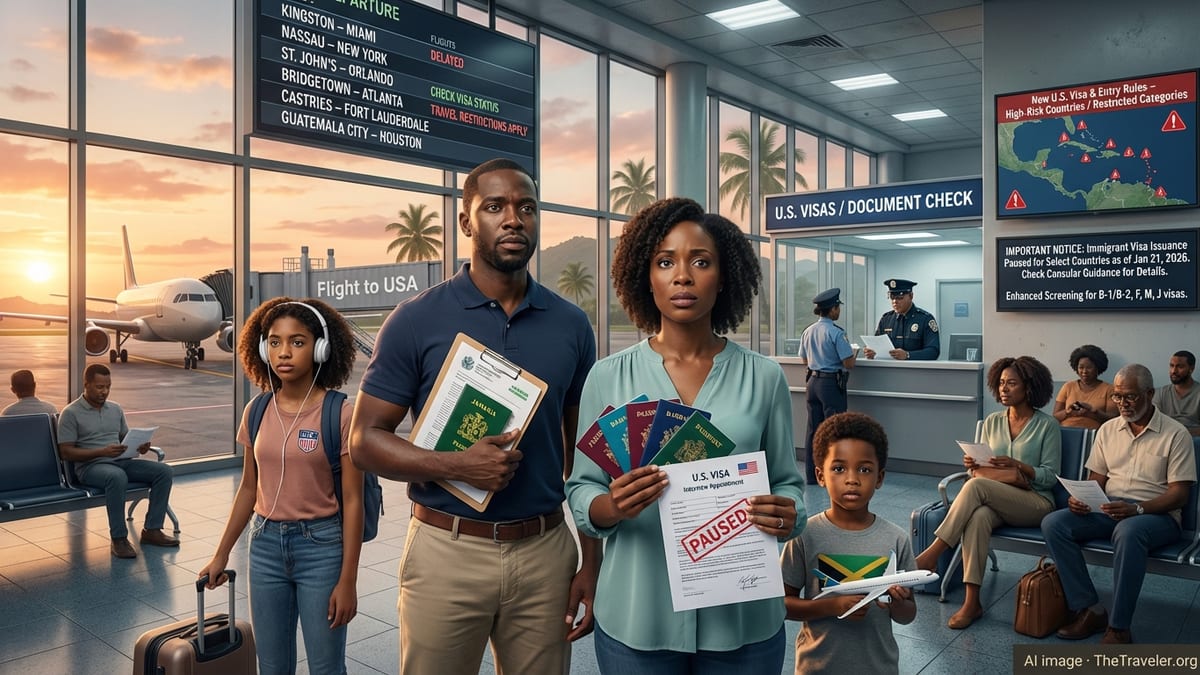
Caribbean travelers are confronting a new and fast‑moving obstacle to visiting the United States, as Jamaica joins a growing list of countries across the region now caught in the crosshairs of Washington’s latest visa and entry restrictions.
A series of overlapping moves, including a nationwide “pause” on immigrant visa issuance for nationals of 75 countries and expanded security‑driven travel bans, is reshaping mobility for families, students and workers from Jamaica, the Bahamas, Guatemala, Saint Lucia, Barbados, Dominica, Antigua and Barbuda and other states that have long relied on easy air links with American gateways.
More News
- TSA Rolls Out $45 ConfirmID Fee for Travelers Without REAL ID at Security
- Flying Blue Launches February 25% Promo Rewards on Transatlantic and Regional Routes
- United Fast-Tracks Starlink Wi‑Fi Across Fleet, Free for MileagePlus Members
What Has Changed In U.S. Visa Policy For The Caribbean
The most dramatic shift came on January 14, 2026, when the U.S. Department of State announced that it would pause the issuance of immigrant visas at consulates worldwide for nationals of 75 countries deemed at “high risk” of relying on public assistance. The measure, which takes effect January 21, effectively freezes new immigrant visas for a swath of the globe that includes many Caribbean and Central American nations, from Jamaica and the Bahamas to Guatemala and Saint Lucia. Nonimmigrant visas such as tourist, student and work visas are not directly suspended under this public‑charge‑focused policy, but they now face enhanced scrutiny and longer vetting.
This pause sits on top of an already complex web of travel and visa restrictions introduced since mid‑2025 under two presidential proclamations aimed at “restricting and limiting” the entry of foreign nationals for security and public safety reasons. Those proclamations expanded or renewed existing travel bans and partial suspensions of entry for nationals of multiple countries, including several Caribbean states, especially in categories such as B‑1/B‑2 visitor visas and F, M and J study and exchange visas. For travelers and travel planners, the result is a confusing patchwork of rules that differ depending on nationality, visa type and intended length of stay.
Although the State Department emphasizes that these measures contain exceptions and case‑by‑case waivers, they collectively represent the most far‑reaching tightening of U.S. visa policy for Caribbean travelers in years. Advocacy groups in the United States have already filed lawsuits challenging the new public‑charge‑based immigrant visa freeze, arguing that the blanket suspension by nationality departs from decades of case‑by‑case decision‑making and will keep families separated.
Jamaica Joins The List Of Countries Facing An Immigrant Visa Freeze
For Jamaica, the inclusion in the 75‑country immigrant visa pause is a sharp turn for one of the Caribbean’s most closely connected partners with the United States. According to the January 2026 State Department guidance and legal summaries circulated by immigration law firms, Jamaican nationals will not be issued new immigrant visas at U.S. consulates abroad once the pause begins, except in a narrow set of exempt categories. This affects Jamaicans applying to move permanently or reunite with close family in the United States, although it does not apply to existing valid immigrant visas or to petitions already filed with U.S. immigration authorities inside America.
Nonimmigrant travel from Jamaica to the United States, including popular B‑1/B‑2 visitor visas and student visas, technically remains permitted but subject to tougher public‑charge vetting. Consular officers are being instructed to apply more stringent checks on applicants’ financial stability and likelihood of relying on government assistance after arrival. That means more documentation, more interviews and, in many cases, longer waits for a decision. For Jamaican families with mixed immigration status, the practical distinction between immigrant and nonimmigrant visas can be blurry, turning what was once a straightforward consular visit into a protracted process.
Local travel agents in Kingston and Montego Bay report a surge of calls from worried clients who either have immigrant visa interviews scheduled after January 21 or were preparing to start the process. While official guidance urges applicants to monitor embassy announcements, many Jamaicans fear that their plans for family reunification or retirement in the United States could be delayed indefinitely. The timing is particularly disruptive for those who have already spent considerable sums on medical exams, document translation and travel to third countries for consular appointments.
Antigua, Dominica And Other Islands Hit By Expanded Travel Bans
Jamaica’s immigrant visa freeze is unfolding alongside a separate, security‑framed set of restrictions that has landed especially hard on smaller Eastern Caribbean states. Under proclamations and State Department guidance updated at the end of 2025, Antigua and Barbuda as well as Dominica are now subject to a partial suspension of entry for several key visa categories, including both immigrant visas and common nonimmigrant visas such as B‑1/B‑2 tourist and business visas, and F, M and J student and exchange visas, with only narrow exceptions.
These measures build on earlier steps in late 2025, when the White House expanded its long‑running travel ban to add Antigua and Barbuda and Dominica to a list of “countries of identified concern.” While nationals of these countries who already hold valid visas or permanent residence face fewer obstacles, new applicants find the bar for entry significantly higher. Consular officers have instructions not only to suspend or limit visa issuance in certain categories, but also to shorten visa validity periods for any other categories that remain open.
One stated rationale is concern over citizenship‑by‑investment programs in Antigua and Barbuda and Dominica, which allow foreign nationals to obtain passports via investment without long residence requirements. U.S. officials argue that such schemes complicate vetting and information sharing. Caribbean leaders, however, counter that these programs are tightly regulated and form an essential part of their small island economies, supporting jobs, infrastructure projects and tourism marketing.
The upshot for would‑be travelers is that, compared with Jamaica or the Bahamas, Antiguan and Dominican nationals find themselves under some of the toughest new constraints. Even short leisure trips to long‑time favorites like Miami, New York and Orlando may now require special waivers or be postponed altogether, introducing unprecedented uncertainty into a travel market that once moved largely on autopilot with predictable seasonal flows.
Bahamas, Barbados, Saint Lucia And Guatemala Caught In The Immigrant Visa Pause
Beyond the high‑profile travel bans, the January 21 immigrant visa freeze pulls a much wider circle of Caribbean and Central American countries into a fresh phase of disruption. The list of 75 countries subject to the pause includes the Bahamas, Barbados, Saint Lucia, Saint Kitts and Nevis, Saint Vincent and the Grenadines, Grenada, Dominica, Antigua and Barbuda and Guatemala, among others. For these countries, the key impact is on people seeking to migrate permanently to the United States, whether through family sponsorship, employment‑based categories or diversity visas.
In many of these nations, immigrant visa pipelines are relatively small in absolute numbers but disproportionately important for extended families that span the Caribbean‑U.S. corridor. A sister in Miami petitioning for a brother in Saint Lucia, or elderly parents in Barbados waiting to join adult children in New York, may now find their cases suddenly stalled. And while the State Department stresses that nonimmigrant travel for tourism and business remains open, most Caribbean economies know that permanent migration and circular migration are deeply intertwined with seasonal travel and remittance flows.
Guatemala, though geographically in Central America, is part of the same dynamic. It is one of the region’s largest sources of both immigrant and temporary workers to the United States. The new suspension of immigrant visa issuance for Guatemalan nationals complicates long‑planned family reunifications, especially for relatives applying through consulates after years of living apart. Analysts warn that any prolonged freeze could fuel irregular migration as people seek alternative paths to join relatives or pursue work opportunities.
Even before the latest policy wave, Caribbean and Central American travelers were facing record wait times for U.S. visa interviews due to pandemic backlogs, staffing shortages and surging demand. In late 2025, regional media reported interview delays ranging from several months to nearly a year, with Antigua, Grenada and Saint Lucia among those struggling with particularly long queues. The new restrictions risk compounding these bottlenecks, as consular posts retool procedures and reallocate staff to more intensive security and public‑charge screening.
Economic Fallout For Tourism, Education And Air Connectivity
While the January pause explicitly targets immigrant visas, the ripple effects for travel, tourism and education across the Caribbean are expected to be significant. Travel industry analysts point out that many Caribbean households depend on relatives living in the United States, both for remittances and for regular visits that sustain passenger loads on regional airlines. If family‑based immigration slows and some itineraries are cancelled or deferred, airlines and tour operators could feel the hit in reduced demand and greater uncertainty around advance bookings.
In tourism terms, the direct flow is overwhelmingly from the United States to the Caribbean rather than the other way around. However, Caribbean residents do represent an important share of regional outbound travel to American shopping hubs, medical centers and cruise departure ports in Florida and along the Gulf Coast. Restrictions on visa issuance, heightened denials and mounting uncertainty may lead some travelers to redirect trips to Canada, the United Kingdom or intra‑Caribbean destinations, subtly reshaping long‑standing patterns of mobility.
Higher education is another area of concern. Several Caribbean countries, including Jamaica, the Bahamas, Barbados and Saint Lucia, send a steady stream of students to U.S. universities and community colleges each year. While the immigrant visa pause does not directly cover student visas, the broader environment of tougher scrutiny and overlapping security bans in parts of the region may make consular officers more cautious. Prospective students could face closer questioning about financial resources and post‑studies plans, as well as the risk that evolving policies might change the rules mid‑course.
Airlines that operate high‑frequency routes between Caribbean hubs and U.S. cities are monitoring developments closely. Even modest drops in Caribbean‑origin traffic can complicate route planning, especially for smaller carriers and low‑cost airlines that rely on consistent year‑round demand. In the medium term, some carriers may adjust capacity or reorient aircraft to other markets if they see a sustained downturn in visa‑dependent traffic from affected islands.
Government Reactions And Calls For Clarity
Governments across the Caribbean Community have responded with a mix of alarm, diplomacy and domestic reassurance as details of the U.S. visa changes emerge. Several foreign ministries have requested clarifications from Washington on the practical impact of the immigrant visa pause and on the criteria used to include countries in the list of 75 “high risk” nations. In states affected by the security‑driven travel bans, such as Antigua and Barbuda and Dominica, officials argue publicly that their security vetting and passport programs meet international standards and should not be conflated with broader global security concerns.
Jamaica’s authorities are expected to engage both bilaterally with the United States and through regional bodies to seek exemptions or tailored arrangements, particularly in cases involving family reunification and critical skills migration. Officials also face domestic pressure to provide clear guidance to citizens who have already invested time and money in the immigration process. Embassies and consulates in Washington, New York and Miami have stepped up outreach, issuing advisories and setting up hotlines to field questions from anxious nationals.
Regional organizations, including Caribbean intergovernmental bodies and diaspora groups in American cities, are likely to play a growing role in shaping the debate. Advocacy networks based in the United States are already challenging the immigrant visa suspension in federal court, describing it as discriminatory and contrary to the spirit of U.S. immigration law. Caribbean diaspora associations, which have long campaigned on issues such as Temporary Protected Status and family reunification backlogs, now see a new front opening in their efforts to safeguard mobility rights for Caribbean nationals.
At the same time, U.S. officials insist that the measures are neither permanent nor targeted at any one region, but rather part of a global recalibration intended to protect security, ensure that immigrants are self‑sufficient and encourage better information‑sharing from foreign governments. The tension between these official assurances and the lived experience of Caribbean travelers caught by sudden policy changes will shape the tone of diplomatic engagement in the months ahead.
How Travelers And Families Can Navigate The New Landscape
For individual travelers and families in Jamaica, the Bahamas, Guatemala, Saint Lucia, Barbados, Dominica, Antigua and Barbuda and neighboring states, the immediate question is what they can realistically do in light of the new restrictions. Immigration lawyers advise that nationals of affected countries first determine whether their planned trip involves an immigrant or nonimmigrant visa. Those in the immigrant visa pipeline may face postponements regardless of preparation, given the blanket nature of the pause. Where possible, applicants are encouraged to stay in close contact with their attorneys or with U.S. consulates for updated guidance rather than cancelling plans prematurely.
Prospective tourists, students and business travelers seeking nonimmigrant visas should anticipate more detailed scrutiny of their financial situation, ties to home and intended length of stay in the United States. That means ensuring that application forms are complete and consistent, gathering robust supporting documents and allowing much more lead time than in the past to secure an appointment. Given persistent backlogs, would‑be visitors from islands such as Grenada, Saint Lucia or Antigua and Barbuda may need to apply several months in advance of intended travel dates.
Travel industry professionals across the region stress the importance of flexibility. Airline tickets and hotel bookings that can be changed or refunded offer a buffer against unpredictable consular delays or last‑minute policy shifts. Some travelers may temporarily shift their focus to destinations with less restrictive entry regimes, including intra‑Caribbean tourism, while they wait for greater clarity on U.S. rules. Others may consider alternative pathways such as study‑abroad programs in Canada or Europe if U.S. student visa processing becomes too uncertain.
Above all, experts warn against relying on rumors circulating on social media. With multiple overlapping policy announcements, travelers can easily confuse immigration bans with temporary consular slowdowns or mix up country lists. The most accurate information will come from official government statements and reputable legal or travel advisory sources, even if these updates sometimes lag behind headlines. For now, the only constant is that the rules are in flux, and Caribbean travelers will need to stay informed and adaptable.
FAQ
Q1. Does the new U.S. policy mean Jamaicans can no longer travel to the United States at all?
For now, the policy pauses the issuance of new immigrant visas for Jamaicans at U.S. consulates, which affects those planning permanent relocation or family reunification. Tourist, business and student visas remain legally available, but they face tighter scrutiny and could take longer to obtain.
Q2. How are Antigua and Barbuda and Dominica affected differently from some other Caribbean countries?
In addition to being part of the 75‑country immigrant visa pause, Antigua and Barbuda and Dominica are subject to separate security‑related restrictions that partially suspend entry for several visa categories, including common visitor and student visas, and allow consular officers to limit the validity of other visas.
Q3. Are Bahamian and Barbadian travelers included in the full travel ban list?
No, the Bahamas and Barbados are not currently on the core travel ban list that fully suspends entry, but they are among the 75 countries where immigrant visa issuance is paused. Their citizens can still apply for nonimmigrant visas such as B‑1/B‑2, although processing may be slower and more stringent.
Q4. What is the main difference between the immigrant visa pause and the security‑based travel bans?
The immigrant visa pause targets permanent immigration pathways for nationals of 75 countries based on public‑charge concerns, while the security‑based bans focus on national security and overstay risks, sometimes fully or partially suspending both immigrant and nonimmigrant entry for specific countries.
Q5. Does the policy affect people who already hold valid U.S. visas or green cards?
Current guidance indicates that existing valid immigrant visas and lawful permanent resident status are not automatically revoked by the new pause. Similarly, nonimmigrant visa holders from affected countries who already possess valid visas can, in most cases, continue to travel, although they remain subject to normal inspection at the border.
Q6. What options do families have if a sponsorship case is now caught by the immigrant visa freeze?
Families with pending immigrant visa cases may have limited immediate options beyond monitoring official updates and consulting legal counsel. Some may explore whether any qualifying exceptions or waivers apply, but for many, the policy will likely translate into delays rather than outright cancellations, at least in the short term.
Q7. Are student visas from the Caribbean being cancelled under these measures?
Student visas are not categorically cancelled for Caribbean nationals under the current immigrant visa pause, which focuses on permanent migration. However, in countries affected by security‑based restrictions, student visa issuance can be partially suspended or subject to tighter conditions, so applicants should review country‑specific guidance carefully.
Q8. How will these changes impact Caribbean tourism to the United States?
The effects are expected to be more subtle than a sudden collapse in travel. Some leisure and family‑visit trips may be postponed or rerouted to other destinations because of uncertainty and longer processing times, which could modestly reduce outbound Caribbean traffic to U.S. gateways over the coming months.
Q9. Could these visa suspensions be lifted or changed quickly?
Yes. Both presidential proclamations and State Department policy guidance can be modified, narrowed or extended depending on political, legal and security developments. Court challenges, diplomatic negotiations and periodic policy reviews could all result in adjustments to country lists or visa categories.
Q10. What should Caribbean travelers do right now if they plan a future trip to the United States?
Travelers should check which visa type they need, verify how their nationality is classified under the latest U.S. rules, allow extra time for appointments and processing, gather thorough supporting documents and maintain flexible travel plans. Consulting reliable official sources or qualified advisers is essential in a period of rapid change.