

More news on this day
A routine workplace safety inspection turned into a flashpoint on Sydney Harbour this week, after the cruise ship Carnival Adventure refused to allow state safety officials and union representatives to board, triggering threats of prosecution and intensifying scrutiny of the booming Australian cruise sector.
Get the latest news straight to your inbox!
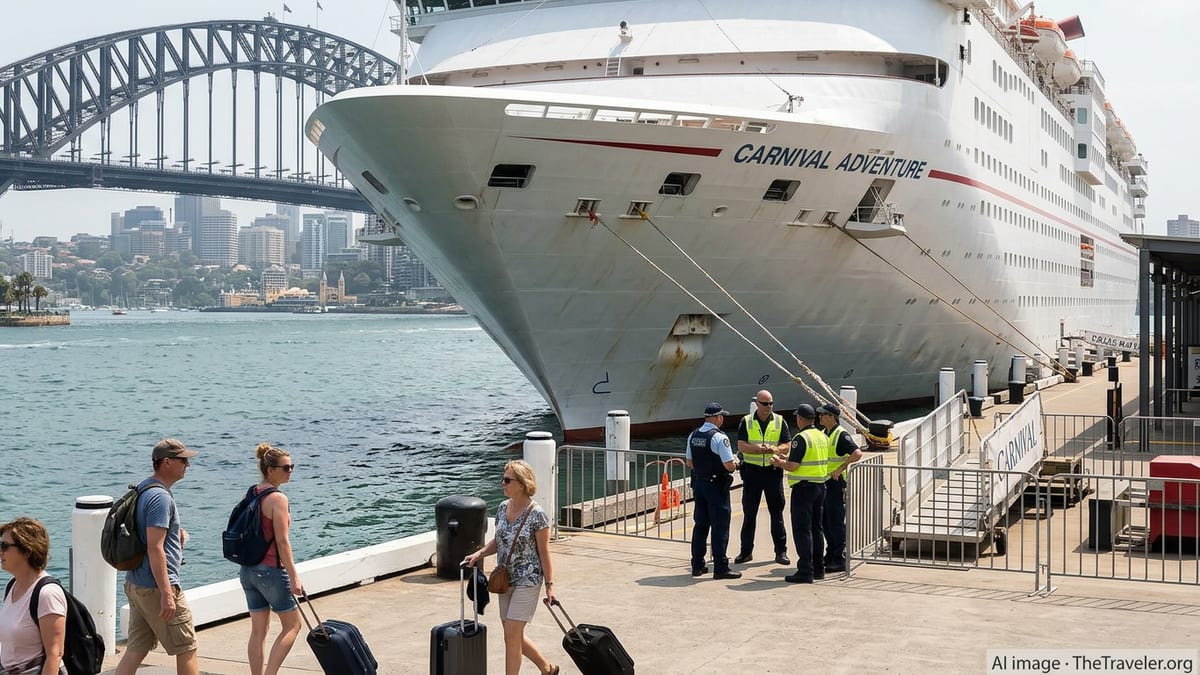
Stand-Off at Circular Quay Raises Legal Stakes
The confrontation unfolded as the Carnival Adventure lay alongside the New South Wales government-owned passenger wharf at Circular Quay, preparing for its next departure. SafeWork NSW inspectors, accompanied by representatives from the Maritime Union of Australia, sought to board the vessel to conduct what they described as a lawful workplace health and safety inspection under state legislation.
Union officials say the ship’s operator declined to grant access, arguing that the officials did not have jurisdiction on the foreign-flagged vessel despite it being berthed in a state-owned terminal and marketed as home ported in Sydney. The Maritime Union of Australia has labelled the move a clear breach of New South Wales safety laws and has vowed to initiate proceedings in the state’s industrial courts.
Under workplace legislation in New South Wales, authorised health and safety representatives are entitled to enter workplaces to investigate potential safety risks and consult with workers. The union contends that by blocking access to the Carnival Adventure, the company effectively shut down a legitimate attempt to check compliance with basic safety standards on board.
The dispute has quickly escalated from a single port visit into a test case over the reach of Australian safety laws into the cruise industry, which often operates at the intersection of state regulations, federal maritime rules and international conventions.
Union Alleges “Sham” Home Porting and Unsafe Conditions
The Maritime Union of Australia has used the incident to sharpen its broader campaign against what it calls a “sham” home porting model used by major cruise brands. The union argues that while the Carnival Adventure is heavily promoted as an Australian-based ship, the company sidesteps many domestic obligations by relying on a foreign flag and largely international crew.
Union officials say complaints from workers on Carnival vessels have highlighted long hours, low pay denominated in US dollars and cramped accommodation below deck. They claim that denying inspectors access at Circular Quay suggests the company is seeking to avoid independent scrutiny of those conditions at a time when new state laws have given worker organisations a stronger role in enforcement.
Changes to workplace health and safety provisions in New South Wales, which took effect this month, allow unions to bring prosecutions in state industrial courts where they believe employers are defying safety regulations. The Maritime Union of Australia has signalled that it will use those powers against Carnival over the Sydney stand-off, warning that multinational cruise lines should not be able to operate “floating workplaces” in Australian waters while ignoring domestic safety regimes.
The latest confrontation follows a string of allegations about low wages and pressure on crew across parts of the cruise sector, intensifying debate about whether the economic benefits of home ported ships to local tourism outweigh concerns about labour standards at sea.
Carnival Points to Maritime Regulators as Proper Authority
Carnival has not publicly detailed its version of the events at Circular Quay, but industry sources say the company maintains that regulatory inspections should be coordinated through national maritime authorities, not state workplace agencies accompanied by union representatives. Cruise operators typically work with the Australian Maritime Safety Authority on matters such as vessel seaworthiness, safety drills and compliance with international maritime conventions.
The company has previously said it welcomes inspections by recognised maritime regulators and insists that its vessels meet or exceed safety and security standards applied globally. It argues that a patchwork of state-level interventions risks creating conflicting requirements for ships that call at multiple Australian ports on the same itinerary.
Behind the scenes, the dispute highlights a long-running tension between global cruise brands, which rely on uniform international rules to manage their fleets, and local regulators and unions who want stronger oversight of working and living conditions on board. The Carnival Adventure, a 108,000-tonne vessel based year-round in Sydney, has become symbolic of those competing perspectives as it shuttles thousands of Australian holidaymakers on short coastal cruises and longer Pacific voyages.
Travel industry analysts say that while the average passenger focuses on entertainment, dining and destinations, regulatory battles over inspections and access to crew can shape everything from cost structures to the reputation of cruising as a safe and responsible holiday choice.
New South Wales Flexes Fresh Enforcement Powers
For state authorities, the Sydney incident is an early test of recently strengthened workplace safety laws. Amendments that came into force in New South Wales this month expanded the ability of worker organisations to initiate proceedings where they believe employers are obstructing safety inspections or failing to consult properly with staff and representatives.
SafeWork NSW has not yet outlined potential penalties in the Carnival Adventure case, but the Maritime Union of Australia has said it expects the cruise line to be prosecuted. Legal observers note that any court action is likely to probe complex questions around jurisdiction, including whether a foreign-flagged cruise ship, berthed at a state-controlled terminal and serving predominantly Australian passengers, must submit to state workplace inspectors in the same way as shore-based employers.
The outcome could set an important precedent for how far state protections extend into the maritime domain. A ruling that upholds the inspectors’ right to board would strengthen unions’ ability to check safety and welfare standards on ships trading out of Australian ports. Conversely, a decision favouring the company’s position could reinforce the primacy of national maritime regulators and international frameworks in overseeing cruise operations.
Regardless of the legal pathway, the high-profile dispute is already prompting calls for clearer protocols between cruise lines, federal agencies and state regulators to avoid future standoffs on the quay.
Passengers Caught Between Holiday Hype and Regulatory Scrutiny
The inspection dispute comes at a delicate moment for the Australian cruise market, which has rebounded strongly as travellers return to sea holidays. Carnival Adventure and sister ships sailing from Sydney, Brisbane and Melbourne have been promoted heavily to domestic travellers seeking short breaks and family-friendly itineraries on familiar home shores.
For passengers stepping aboard at Circular Quay, the legal headwinds swirling around the vessel may be invisible, but the outcome could indirectly affect their future cruise experience. Stronger state oversight could lead to enhanced safety briefings, more transparent reporting on crew welfare and potentially higher operating costs that might eventually filter through to fares.
On the other hand, a perception that cruise lines are resisting legitimate inspections risks damaging confidence among some travellers, particularly those already cautious about health and safety after the pandemic years. Travel agents report that while the immediate impact on bookings appears limited, questions about regulation and corporate responsibility increasingly surface in conversations with well-informed clients.
As the case against Carnival Adventure develops, Australian authorities and the cruise industry will be under pressure to demonstrate that the rapid growth of home ported ships is matched by robust protections for the people who work on them, not just the holidaymakers who enjoy their decks and dining rooms.