

More news on this day
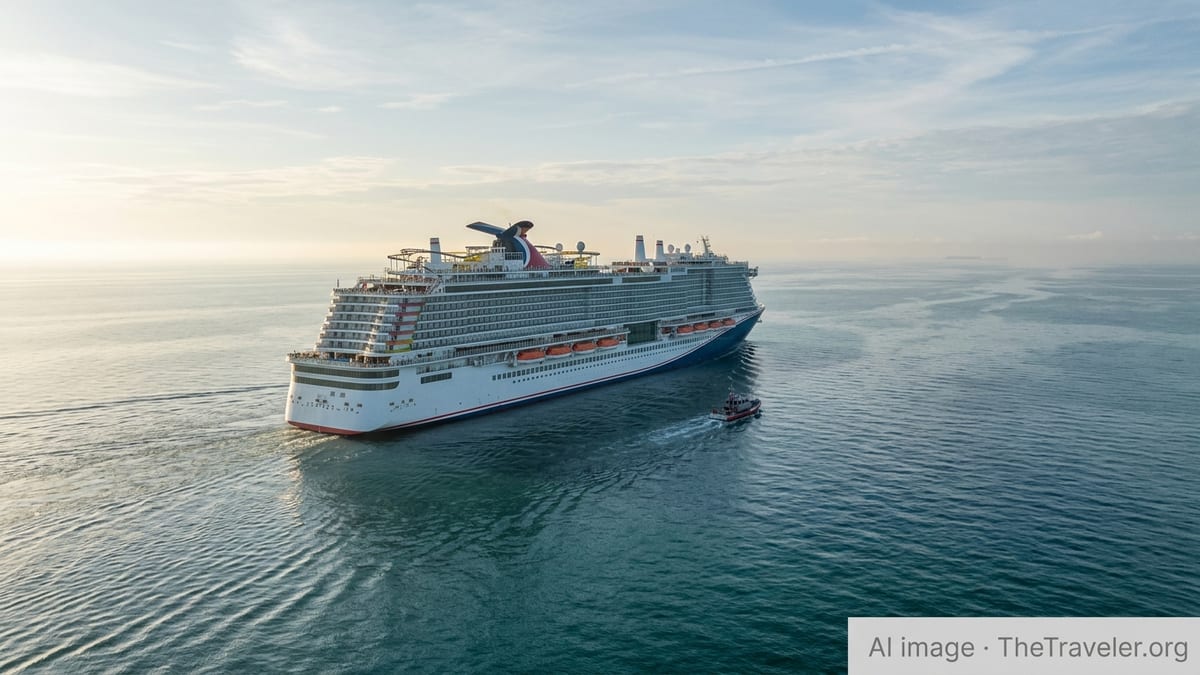
Carnival Cruise Line’s flagship Carnival Jubilee made an unscheduled diversion in the Gulf of Mexico for a passenger medical evacuation, according to cruise tracking data and published coverage, with the line indicating that the ship is still expected to arrive on time in Galveston, Texas.
Get the latest news straight to your inbox!
Diversion in Gulf of Mexico for Medical Emergency
Tracking information for Carnival Jubilee shows that the ship temporarily altered its course in the Gulf of Mexico during a Western Caribbean sailing to facilitate a medical evacuation. Publicly available voyage data indicates that the Excel class vessel slowed and adjusted its heading to rendezvous with a specialized response craft so that an ailing guest could be transferred off the ship for shoreside care.
The incident occurred while Carnival Jubilee was returning toward the United States after calls at popular Western Caribbean ports. Based on online tracking records, the deviation took place well offshore, in deep Gulf waters commonly used by cruise and commercial traffic, and involved a brief reduction in speed while the transfer was completed.
Reports indicate that the maneuver was conducted under stable conditions, with no broader operational disruption beyond the immediate need to coordinate the rendezvous. The ship subsequently resumed its original track toward the Texas coast once the evacuation was completed.
No Impact Expected on Scheduled Galveston Arrival
Despite the unplanned diversion, schedule information available for Carnival Jubilee’s current voyage continues to show an on time return to the Port of Galveston. The ship’s itinerary calls for early morning arrival at the Gulf Coast homeport, a key embarkation point for Western Caribbean cruises serving U.S. travelers.
Marine tracking platforms suggest that any delay from the slowdown was offset by an increase in cruising speed after the medical transfer, allowing the vessel to remain within its planned arrival window. Itineraries and port schedules reviewed after the incident have not been updated to reflect any change, reinforcing indications that guests should complete their cruise and disembark in Galveston as originally planned.
For travelers booked on upcoming sailings, publicly available deployment data for Carnival Jubilee continues to list round trip itineraries from Galveston with standard departure and arrival times, pointing to a limited operational impact from the single medical diversion.
Carnival Jubilee’s Role in Galveston Cruise Market
Carnival Jubilee is among the newest and largest ships in the Carnival Cruise Line fleet, deployed year round from Galveston to serve the Western Caribbean market. The LNG powered ship is part of Carnival’s Excel class and is scheduled on a series of seven day itineraries that typically feature ports such as Cozumel, Costa Maya, and Roatan, making it a central player in the region’s cruise offerings.
Industry materials describe the ship as a major investment in the Texas cruise sector, with capacity for thousands of guests and a broad range of entertainment and dining venues. Its deployment has strengthened Galveston’s position as one of the leading cruise homeports in the United States, drawing fly in travelers as well as drive market guests from across Texas, the central United States, and the Gulf Coast.
As the ship operates high demand sailings on a relatively fixed schedule, maintaining on time operations is considered important for both guests ending their cruises and those preparing to embark on the next voyage. The ability to manage an at sea emergency while still protecting schedule integrity illustrates the operational flexibility built into modern cruise deployments.
Medical Evacuations as a Routine Safety Measure
Although diversions of this kind can be unsettling for travelers tracking their voyage, medical evacuations are treated as a routine safety measure across the cruise industry. Ships operating in the Gulf of Mexico, Caribbean, and other busy sea lanes often coordinate with shore based medical facilities, coast guard assets, or other authorized craft when a guest requires treatment that exceeds the shipboard medical center’s capabilities.
Public guidance from maritime and cruise industry sources notes that captains are expected to prioritize health emergencies, which can involve altering course to meet a helicopter capable vessel, a fast response boat, or a port facility where the patient can be received. These maneuvers are generally planned to minimize risk and disruption to the wider voyage while ensuring the individual receives timely care.
In most cases, such operations are completed in a matter of hours, after which the ship returns to its regular route. Depending on distance to the next port and the vessel’s service speed, the impact on arrival times can often be absorbed without major consequence for the larger itinerary.
What Passengers Can Expect After the Diversion
For guests currently sailing on Carnival Jubilee, available reports suggest that onboard activities and services continued after the medical evacuation, with the vessel resuming its scheduled path toward Galveston. Cruise lines typically inform guests in general terms when a medical diversion or evacuation is in progress, while also prioritizing the privacy of the individual involved.
Travelers on future sailings from Galveston are unlikely to see any change to check in procedures or departure times resulting from this incident. Published itineraries for Carnival Jubilee continue to list the same pattern of Western Caribbean ports and sea days that have defined the ship’s deployment since its introduction to the Texas market.
More broadly, the episode serves as a reminder that cruise ships operating from U.S. homeports are equipped to respond to medical needs far from land and to coordinate with coastal infrastructure in the Gulf of Mexico. For many travelers, the presence of these well rehearsed protocols is viewed as part of the overall safety framework that underpins modern ocean cruising.