

More news on this day
Cruise passengers from the United States, Canada and the United Kingdom arranging ashes-scattering ceremonies with Carnival Cruise Line are being advised to expect tighter limits on how many friends and family can attend, as the company refines its policies around increasingly popular memorials at sea.
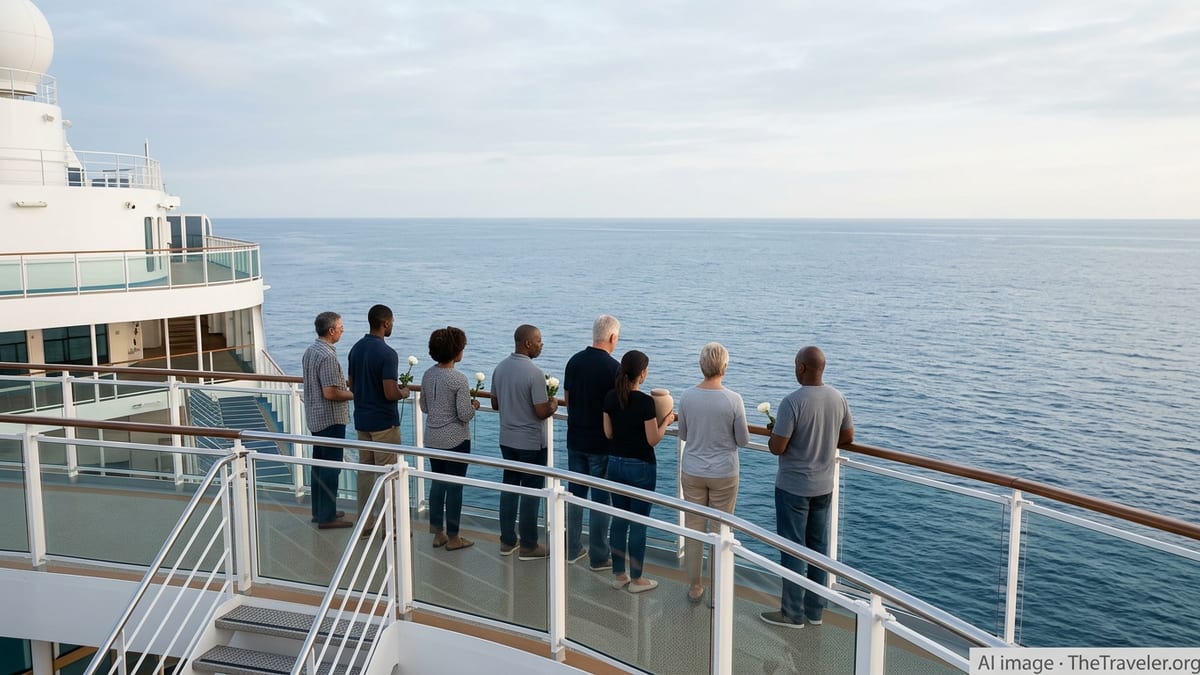
Growing Demand Meets Operational Constraints
Carnival has quietly updated and clarified its guidance for guests wishing to scatter a loved one’s ashes during a cruise, reflecting a steady rise in requests for these services. The line now emphasizes that attendance at onboard ceremonies may be capped, and that larger groups can be split into smaller gatherings depending on the ship and location.
The company has for years allowed ashes to be brought aboard, provided families carry key documentation such as a death certificate and proof that cremation was performed by a licensed facility. What is shifting is not the permission itself but how the ceremonies are staged, with Carnival’s shoreside management and onboard staff asked to manage numbers more closely to avoid crowding and to protect the privacy of mourners.
While Carnival has not published a single fleetwide figure for a maximum headcount, its official procedures now caution that “large groups may be separated based on event location” and that party size must be confirmed with Guest Services before a ceremony is approved. That note, seemingly small, has significant implications for extended families who might have envisioned dozens of relatives gathered at the ship’s rail.
The demand is not theoretical. Industry reporting in recent years has highlighted that Carnival organizes hundreds of scattering ceremonies annually. As repeat cruisers age and more families choose cremation, sea memorials have evolved from a rare request into a regular part of the onboard experience.
How the New Limits Affect Families From Different Markets
The refined approach is being felt most directly by guests sailing from North American and British homeports, where Carnival brands dominate mainstream cruising. Passengers from the United States and Canada typically embark from large turnaround ports such as Miami, Port Canaveral, Galveston, Vancouver and Seattle, and many of those ships now host ashes-scattering ceremonies several times a week on certain itineraries.
For these guests, a tighter cap on attendance means families who might have planned to include a broad circle of relatives, friends and even neighbors could be asked to prioritize a smaller core group. In some cases, Guest Services may arrange multiple back-to-back ceremonies if operationally feasible, allowing one set of mourners at a time to visit a restricted deck area while the ship is beyond the minimum distance from land required by environmental rules.
In the United Kingdom, where Carnival Corporation operates brands such as Cunard and P&O Cruises that also accommodate ashes at sea, the same underlying pressures apply. British sailings attract a high proportion of multi-generational family groups, and those arranging memorials are being reminded that confined spaces, safety rules and crew-only access areas limit how many individuals can safely gather at once.
Travel agents in all three markets say the message to clients is increasingly consistent: ashes-scattering is welcome, but it will be structured, supervised and potentially intimate rather than a large, public event. Advisors are encouraging early conversations with the cruise line so that expectations on guest numbers can be set well before final payment.
Onboard Procedure: Privacy, Safety and Environmental Rules
Carnival’s formal procedure starts when the traveling family contacts Guest Services after boarding. Staff members collect the preferred date and time, verify documents and record how many guests hope to attend. That number is then weighed against the ship’s itinerary, weather, availability of a suitable deck or crew-access area, and environmental requirements that the ceremony take place beyond twelve nautical miles from land and outside designated special areas.
On the appointed day, mourners are typically escorted by a Guest Services representative to a quiet section of an outer deck, often not accessible to the general passenger population. There, the group is given a brief period of privacy to say a few words and release the remains in accordance with local and international regulations that forbid non-biodegradable items from entering the sea.
These environmental obligations are a core reason Carnival cites for supervising ceremonies closely and for limiting attendance. Only ashes, biodegradable urns or containers and certain types of flowers without ribbons or plastic adornments are permitted. Larger crowds are harder to monitor for compliance, particularly when emotions are high and well-wishers may bring mementos that inadvertently violate the rules.
Safety also plays a role. The chosen locations are often on narrower working decks, where crew normally handle lines or maintenance tasks. Too many guests in these spaces can create trip hazards and obstruct emergency routes. By capping numbers, or splitting larger parties into separate groups, officers can maintain safe access while preserving the quiet atmosphere families expect.
Practical Advice for Planning a Memorial Cruise
For would-be passengers in North America and the United Kingdom, the practical effect of Carnival’s tougher stance on group size is a need to plan early and think carefully about who attends. Funeral directors and cremation providers that coordinate with cruise lines increasingly advise families to select a small representative circle of mourners and to consider separate land-based services to include those who cannot be present on the ship.
Travel planners suggest notifying Carnival of the intent to scatter ashes as soon as a sailing is chosen and then reconfirming with Guest Services on embarkation day. Families should be prepared with all documentation, including multiple copies of certificates in case authorities or airline staff request them during the journey to the port.
Because guest limits may differ by vessel, itinerary and even by the specific deck where the ceremony can be held, experienced agents recommend avoiding promises about exact attendance numbers until the line has confirmed what the ship can accommodate. Some families are choosing to designate one cruise as the formal memorial and a different itinerary later as a broader remembrance trip that does not involve handling remains.
Despite the stricter approach to group size, the underlying service remains complimentary and emotionally resonant, according to families who have shared their experiences. Many describe receiving a signed note from the ship’s captain with the coordinates where the ashes were released, and some say the intimacy created by a smaller, closely managed gathering has made their goodbye at sea feel even more personal.