

More news on this day
Carnival Cruise Line is reminding guests sailing to Mexico, Belize and Caribbean ports that keeping an eye on the correct time is ultimately their responsibility, as recent incidents have highlighted how confusing differences between ship time and local time can leave late passengers stranded on the pier.
Get the latest news straight to your inbox!
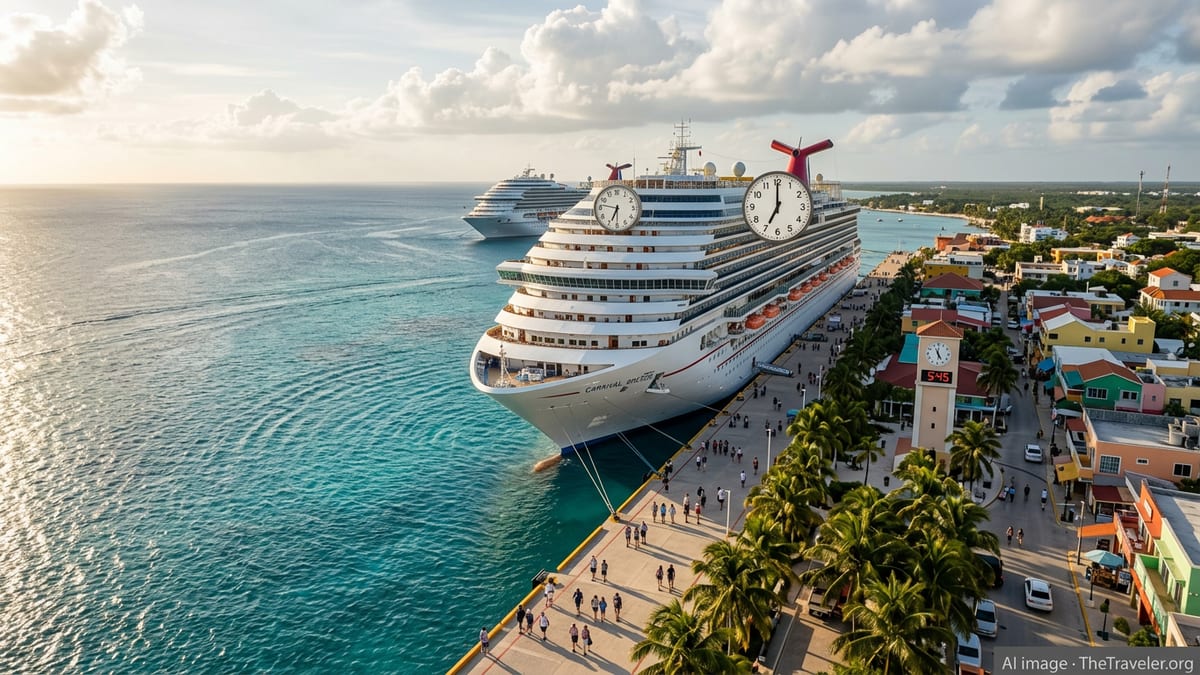
Fresh Reminder After Guest Misses Ship in Mexico
The latest warning comes after a Carnival guest shared that they missed their ship’s departure from a Mexican port by minutes, partly because local clocks did not match the time used onboard. The account, widely discussed in cruise forums and picked up by cruise news outlets this week, described how the traveler’s independently booked excursion ran according to local time, while the vessel maintained its own schedule.
That gap was enough to cause a painful and expensive lesson. By the time the guest returned to the pier, the ship had already sailed, leaving them to arrange last-minute transport and accommodation at their own cost. The story has reignited a long-running conversation among cruise travelers about how easily time discrepancies can disrupt Caribbean itineraries, particularly in destinations that do not observe daylight saving time.
With many U.S. states changing clocks in early March and several nearby cruise destinations keeping a fixed time year-round, the conditions are ripe for confusion. Carnival’s renewed emphasis is intended to make clear that guests must verify which time standard is being used in each port and plan their day ashore accordingly.
While such incidents remain relatively rare compared with the number of port calls the line operates each year, they tend to draw outsized attention on social media, reinforcing the importance of understanding the difference between ship time and local time before disembarking.
Mexico, Belize and Caribbean Ports Pose Special Time Challenges
The issue is especially pronounced on popular Western Caribbean routes that include Cozumel and Costa Maya in Mexico, as well as Belize and island ports across the region. Many of these destinations sit in different time zones than major U.S. homeports such as Galveston, New Orleans and Port Canaveral, and several do not shift clocks for daylight saving time.
For example, much of Mexico no longer observes daylight saving time, while many U.S. states still do. A ship departing from Texas may remain on Central Time throughout the voyage, even when local clocks in a Mexican port are an hour behind. Conversely, some itineraries adjust ship time to match local time at select ports, especially when multiple destinations share a common time zone.
Belize can also complicate matters for guests, particularly when itineraries span the date when U.S. clocks change. Travelers may find that their phones, set to update automatically, switch to local networks and display a time that differs from the official ship schedule by an hour or more.
Across the Caribbean, islands such as those in the Eastern Caribbean often remain on Atlantic Standard Time year-round, creating another layer of potential discrepancy with U.S. homeports that alternate between Eastern Standard and Eastern Daylight Time. For cruisers eager to maximize limited hours ashore, these small differences can have major consequences if misunderstood.
How Carnival Communicates Ship Time to Guests
Carnival has long stated in its ticket contract and pre-cruise documentation that guests are responsible for returning to the ship on time in every port of call. The line reiterates that message through daily announcements and printed materials delivered to cabins, which highlight all-aboard times and specify whether ship time will change overnight.
Onboard, the Carnival Hub app is designed to be the primary reference for ship time once guests connect to the vessel’s Wi-Fi network. The app displays the current ship time prominently and aligns all listed activities, dining hours and excursion meeting times with that standard, regardless of what local clocks might show ashore.
In addition, many ships use announcements from the bridge to note any time changes, and cabin televisions typically display the current ship time on information channels. Crew members at the guest services desk and shore excursion counter are also trained to remind guests that all-aboard times are set by ship time, not local time, and that any guest who misses departure in a port of call is responsible for their onward travel.
Carnival has also promoted its mobile text travel alert service for U.S. guests, which can be used to send timely updates, including changes to arrival and departure times. While these tools improve communication, company representatives emphasize that technology is a supplement and not a substitute for guests personally confirming the correct time before planning their day ashore.
Independent Excursions Increase Risk of Missed Departures
The latest case in Mexico involved an excursion arranged independently rather than through Carnival, a choice that often offers lower prices or more personalized experiences but can carry additional risk when timing is tight. Excursions booked directly with the cruise line are scheduled around the vessel’s movements and use ship time as a reference, minimizing the chance of misalignment.
When guests book tours on their own, however, local operators may follow the time observed by the town or island, not the time set by the ship. In destinations where clocks differ by an hour or where mobile phones automatically adjust to local networks, travelers may not realize the discrepancy until it is too late.
Cruise industry analysts note that missed-ship incidents most commonly occur in ports that require tender boats rather than a direct gangway, or in destinations where traffic, weather or distance to popular attractions add additional unpredictability. Mexico’s larger mainland ports and Belize’s offshore tender operations can both introduce delays if guests misjudge how long it will take to travel back to the pier.
For guests who do choose independent tours, longtime cruisers routinely advise setting watches manually to ship time before stepping off the gangway and building in a generous buffer before all-aboard. Carnival’s own communications echo that advice, urging guests to return well ahead of the final boarding time printed in their daily schedules.
Practical Advice for Travelers on Upcoming Sailings
With spring break and summer cruise seasons approaching, thousands of Carnival guests are preparing to sail itineraries that include Mexican Riviera ports, Western Caribbean stops such as Cozumel, Costa Maya and Belize, and island calls throughout the broader Caribbean. The company’s renewed warning serves as a timely reminder to factor time management into shore plans.
Travel advisors recommend that guests verify time details in multiple places: the daily newsletter delivered to cabins, the Carnival Hub app, and announcements from the cruise director or captain. If the ship is changing time overnight to match or diverge from a port, that information is usually highlighted prominently.
Turning off automatic time updates on smartphones while in port, and instead relying on a watch or device manually set to ship time, is another common strategy. Some experienced cruisers also suggest aiming to be back at the pier at least an hour before all-aboard, particularly in ports that require tendering or that are known for heavy afternoon traffic.
For Carnival and its guests, the core message is straightforward: while the line can provide tools, reminders and updates, the final responsibility for making it back before the gangway comes up rests with each traveler. In ports across Mexico, Belize and the Caribbean, a few minutes of confusion about the clock can mean the difference between a carefree vacation memory and a costly travel detour.