

More news on this day
Cathay Pacific has suspended all flights to Dubai and Riyadh for March as the war in the Middle East disrupts airspace and airport operations across the Gulf, creating fresh uncertainty for travelers from Singapore, Thailand, and Malaysia who rely on Hong Kong as a key transit hub.
Get the latest news straight to your inbox!
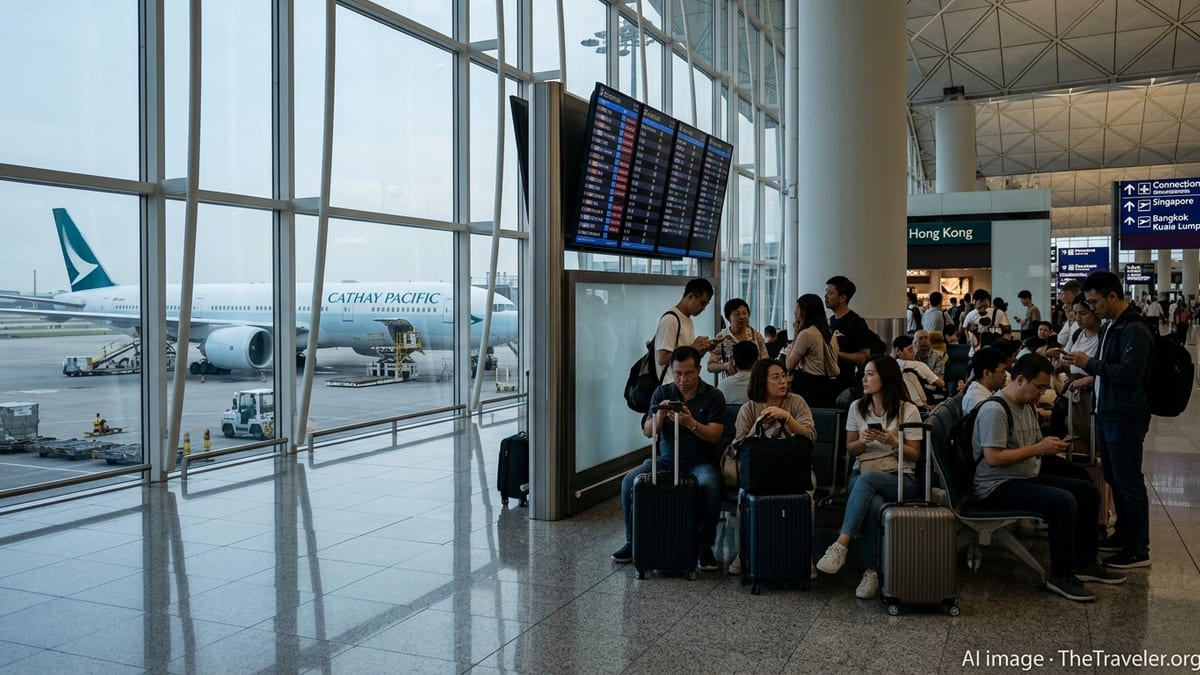
Middle East Conflict Forces Fresh Route Suspensions
The latest escalation in the Middle East, including reported missile and drone strikes and temporary airspace closures over parts of the Gulf, has prompted a new wave of cancellations by global carriers. Publicly available information indicates that Cathay Pacific is among the Asian airlines that have suspended services to several Middle East destinations while the conflict continues to unfold.
Recent coverage focused on the economic and aviation impact of the 2026 Iran war notes that multiple international airlines, including Cathay Pacific, have withdrawn or curtailed flights into the region amid concerns over flight safety and routing constraints. The combination of conflict-affected airspace and the vulnerability of major hubs such as Dubai and Abu Dhabi has severely curtailed east–west connectivity.
Hong Kong based Cathay Pacific has historically treated the Gulf as an important bridge between Asia and Europe, with services linking its home hub to Dubai and, more recently, plans to expand further into Saudi Arabia. The carrier’s decision to suspend operations on key Middle East routes represents a marked reversal of its post pandemic rebuilding in the region.
Cathay Pacific Pulls March Flights to Dubai and Riyadh
Travel industry discussions and airline commentary indicate that Cathay Pacific has extended earlier disruption measures and has now suspended all flights to Dubai and Riyadh for the month of March in response to the conflict. Reports suggest that the airline is prioritizing safety and operational predictability, opting to halt passenger services rather than fly through or around increasingly complex airspace corridors.
The suspension of Dubai flights is especially significant because the emirate functions as one of the busiest hubs for connections between Asia, Europe, and Africa. With Cathay Pacific stepping back from the market for at least several weeks, passengers who once favored itineraries via Hong Kong and the Gulf now face a patchwork of alternative routings, many of which are already heavily booked due to broader regional disruptions.
Services to Riyadh are also affected. Cathay Pacific had only recently highlighted its ambitions in Saudi Arabia, flagging the Saudi capital as a growing financial and commercial center and announcing passenger flights from Hong Kong to Riyadh. The suspension arrives just as the airline was seeking to tap demand to and from the kingdom, underscoring how quickly geopolitical instability can upend network planning.
Knock-on Effects for Travelers from Singapore, Thailand, and Malaysia
Passengers from Southeast Asia are feeling the secondary effects of the Gulf disruption, even if they are not flying directly into the conflict zone. Publicly available commentary from stranded travelers shows that Singapore, Thai, and Malaysian passengers who would normally route through Hong Kong and then onward to Dubai or Riyadh with Cathay Pacific are now facing cancellations, last minute rebookings, and extended layovers.
For many travelers starting in Singapore, Bangkok, or Kuala Lumpur, Cathay Pacific has long been one of several options for one stop connectivity to the Middle East and beyond. The Hong Kong hub is often used as a springboard to Europe, the Gulf, and South Asia, with itineraries finely balanced on tight connection windows. With the Dubai and Riyadh segments removed for March, some of those carefully planned journeys no longer exist in the schedules, forcing passengers to search for space on already crowded routes via alternative hubs such as Istanbul or key European gateways.
Reports from regional media and traveler forums also indicate that Southeast Asian passengers currently overseas are struggling to complete multi segment journeys that included Cathay Pacific flights to or from the Gulf. Some have been offered rerouting onto partner or competitor airlines where seats are available, while others report waiting for clearer guidance and new itineraries as airlines update timetables day by day.
Airlines Reroute Around Conflict Zones and Closed Airspace
The suspension of Cathay Pacific services to Dubai and Riyadh is part of a broader pattern as airlines adjust to the evolving risk profile around the Gulf and wider Middle East. According to published analyses of the conflict’s aviation impact, international carriers are contending with partial closures of airspace in the United Arab Emirates, Qatar, Kuwait, Bahrain, and neighboring states, alongside heightened caution over routes that could bring civilian aircraft near potential military targets.
Many long haul flights between Europe and Asia have already adopted northern or southern detours, sometimes routing over Central Asia and the Caspian region or via the eastern Mediterranean and Egypt. These diversions add flight time and fuel burn, and in some cases erode the economic viability of particular routes. For airlines like Cathay Pacific, which must weigh crew duty limits, aircraft availability, and passenger demand, temporarily stepping away from sensitive destinations can appear more sustainable than operating complex detours for a limited number of flights.
Analysts note that these disruptions arrive on top of existing constraints from earlier conflicts, including restrictions over Russian and Ukrainian airspace. As a result, the Middle East, once a vital corridor between continents, has become a chokepoint. The latest war has magnified that bottleneck and forced airlines to redraw their maps yet again, with Hong Kong, Singapore, Bangkok, and Kuala Lumpur all having to adapt to shifting flows.
What Travelers Should Expect in the Coming Weeks
With Cathay Pacific’s Dubai and Riyadh flights suspended for March and the broader regional situation still fluid, travelers from Singapore, Thailand, and Malaysia are likely to face continued uncertainty in the short term. Timetables may change at short notice as airlines respond to new military developments, airspace advisories, and airport conditions in the Gulf.
Publicly available guidance from aviation regulators and industry groups generally emphasizes the importance of monitoring airline notifications, as carriers are updating passengers through official channels when schedules change. Travel agents and corporate travel managers are also working to rebook affected customers on alternative routings that avoid the most sensitive areas while still maintaining reasonable journey times.
For Cathay Pacific, the suspension of Dubai and Riyadh services is expected to be reviewed as the security picture evolves. Until conditions allow for a resumption of normal operations, travelers from Southeast Asia who previously relied on the Hong Kong based carrier for connections into the Gulf may need to consider more circuitous routings, longer layovers, or postponed trips while the Middle East conflict continues to reshape global air travel.