

More news on this day
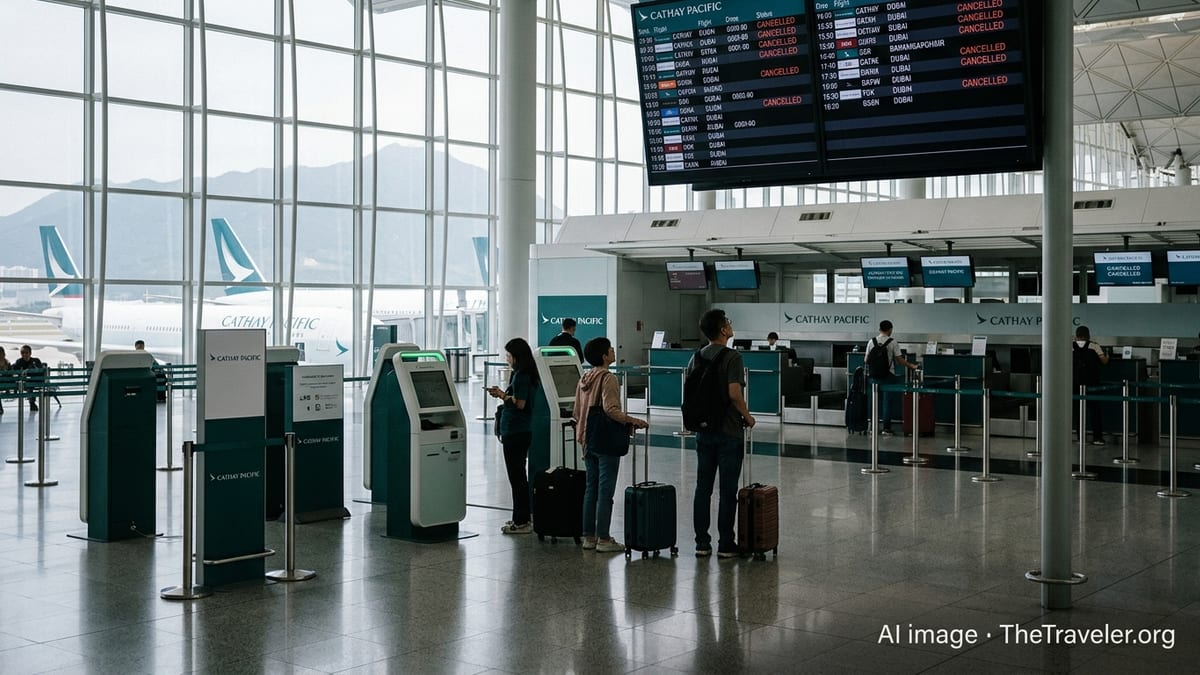
Cathay Pacific has extended the suspension of its Hong Kong–Dubai passenger services until at least April 2026, as the escalating conflict in the Middle East and repeated disruptions at major Gulf hubs continue to reshape long-haul travel between Asia, Europe and Africa.
Get the latest news straight to your inbox!
Middle East Conflict Ripples Across Gulf Aviation
Ongoing hostilities involving Iran and several regional states have triggered sweeping disruptions to air travel across the Middle East, with Dubai and Abu Dhabi among the hardest hit. Reports indicate that waves of missile and drone strikes targeting infrastructure in the United Arab Emirates have repeatedly forced airspace closures and substantial reductions in operations at Dubai International Airport, one of the world’s busiest hubs.
Publicly available aviation data and media coverage show that in late February 2026, authorities in the UAE temporarily shut airspace as a precaution following Iranian strikes, prompting large-scale diversions and cancellations. While some Gulf carriers have since resumed limited services, international airlines have taken a more conservative approach, citing heightened security risks, volatile airspace conditions and sharply increased insurance and war-risk premiums.
Industry analyses describe a pattern of intermittent reopening and reclosing of Middle Eastern airspace, complicating flight planning for carriers across Europe and Asia. These disruptions have affected not only point-to-point routes into Gulf cities but also the wider network of connecting flights that traditionally move millions of passengers between continents through Dubai each year.
According to recent coverage from business and travel outlets, thousands of daily flights across the region have been cancelled or rerouted since the latest escalation, with Dubai and Abu Dhabi bearing a disproportionate share of the impact due to their role as regional super-hubs.
Cathay Pacific Pulls Back From Dubai Amid Heightened Risk
Cathay Pacific had already halted its services to Dubai and other select Middle Eastern destinations in early 2026 as tensions intensified. Travel and aviation reports from Hong Kong indicate that the carrier initially suspended flights throughout March before progressively extending the pause as the conflict widened and attacks reached closer to key Gulf airports.
The decision to prolong the suspension to at least April 2026 positions Cathay Pacific among a growing list of Asia-Pacific and European airlines that have withdrawn or sharply reduced schedules to the Gulf. Public information from aviation trackers suggests that carriers including British Airways, Lufthansa, Virgin Atlantic and several regional rivals have either cancelled Dubai flights outright or shifted capacity to alternative routings that avoid the most affected airspace.
Analysts note that for Cathay Pacific, the Dubai route, while strategically significant as a link to the Middle East and beyond, represents a relatively small portion of its overall network compared with its long-haul corridors to North America, Europe and the wider Asia-Pacific. By suspending flights to Dubai, the airline can redeploy aircraft to more stable markets and avoid operational and financial exposure in a volatile theater.
Publicly available corporate guidance from Cathay Pacific in recent weeks has emphasized a cautious approach to route planning in regions affected by military activity, with the carrier highlighting fuel-price volatility, insurance surcharges and possible knock-on effects on schedules as key variables shaping its network decisions in 2026.
Stranded Passengers and Limited Alternatives for Hong Kong–Gulf Travel
The continued suspension of Cathay Pacific’s Dubai flights is particularly disruptive for travelers who rely on Hong Kong as a gateway between North Asia and the Gulf. With direct services paused and other international airlines also cutting or curtailing their Middle East schedules, passengers are increasingly dependent on complex itineraries routed via Southeast Asia or Central Asia, often involving longer journey times and higher fares.
Travel forums and passenger reports describe a surge in demand for seats on airlines that continue to offer connections between East Asia and Europe or Africa without transiting the conflict zone. Carriers based in Singapore, Seoul and other relatively unaffected hubs are seeing increased traffic as flyers seek alternatives to Gulf-based connections that traditionally offered some of the most efficient routings.
With capacity through Dubai sharply reduced, competition for remaining long-haul seats has intensified, and some travelers report rebooking windows stretching into late spring. Publicly available fare data referenced in recent media coverage indicate that prices on several non-Gulf routes have climbed as displaced passengers vie for limited alternatives.
For corporate travelers and expatriate communities with ties to both Hong Kong and the Gulf, the disruption is particularly acute. Many are being forced to adjust travel plans at short notice, rely on virtual meetings or postpone nonessential trips until airlines restore predictable schedules into the region.
Network Realignment and Operational Pressures on Cathay Pacific
The suspension of flights to Dubai also feeds into Cathay Pacific’s broader network strategy for 2026, as the airline attempts to rebuild capacity after the pandemic while navigating an increasingly unstable geopolitical environment. Public filings and interviews referenced in business coverage suggest that Cathay Pacific has targeted moderate growth in passenger capacity for the year, but with clear caveats around potential disruptions linked to the Middle East and other flashpoints.
Industry commentators point out that each long-haul cancellation frees up widebody aircraft that can be reassigned to more resilient routes, such as transpacific and intra-Asia services, where demand has been recovering steadily. However, the volatility of the Middle East conflict complicates long-term planning, as carriers must balance short-term risk mitigation against the possibility that Gulf markets could reopen more fully later in the year.
Operationally, airlines are also contending with higher fuel costs associated with detours around restricted airspace. Flight paths that once used efficient corridors across the Middle East now often require extended routings, adding hours of flight time and significantly increasing fuel burn. Public analysis of global flight-tracking data shows that these detours have become routine for many Europe–Asia services since the latest escalation.
For Cathay Pacific, such pressures intensify the need to prioritise routes where yields remain robust enough to absorb higher operating costs. Suspending Dubai services until at least April 2026 reflects that calculus, signaling a willingness to sacrifice some connectivity in favor of financial and operational resilience.
What Travelers Should Expect in the Months Ahead
With the trajectory of the Middle East conflict still uncertain, travel experts anticipate continued volatility for flights touching the region, including services between Hong Kong and the Gulf. While some Gulf-based carriers are gradually rebuilding their schedules, international airlines such as Cathay Pacific are likely to move more cautiously, waiting for a sustained period of stability before committing aircraft and crew back into affected markets.
Publicly available guidance from aviation regulators and industry bodies encourages passengers to monitor airline notifications closely, avoid nonessential travel through active conflict zones and build extra flexibility into itineraries. Travelers with tickets on suspended routes are generally being offered rebooking onto alternative services or refunds, though options may be limited during peak travel periods.
For now, the extension of Cathay Pacific’s Dubai suspension until April 2026 underscores the fragility of long-haul connectivity through the Middle East and highlights how quickly geopolitical shocks can redraw global air routes. As airlines reassess risk and capacity in real time, Hong Kong–based and connecting travelers will need to adapt to a network that remains in flux well into the coming months.