

More news on this day
The rapid escalation of conflict across West Asia has triggered a cascading airspace crisis, forcing Cathay Pacific and a growing list of Gulf and Asian carriers to cancel flights, reroute long-haul services and hastily rewrite the global map of air travel.
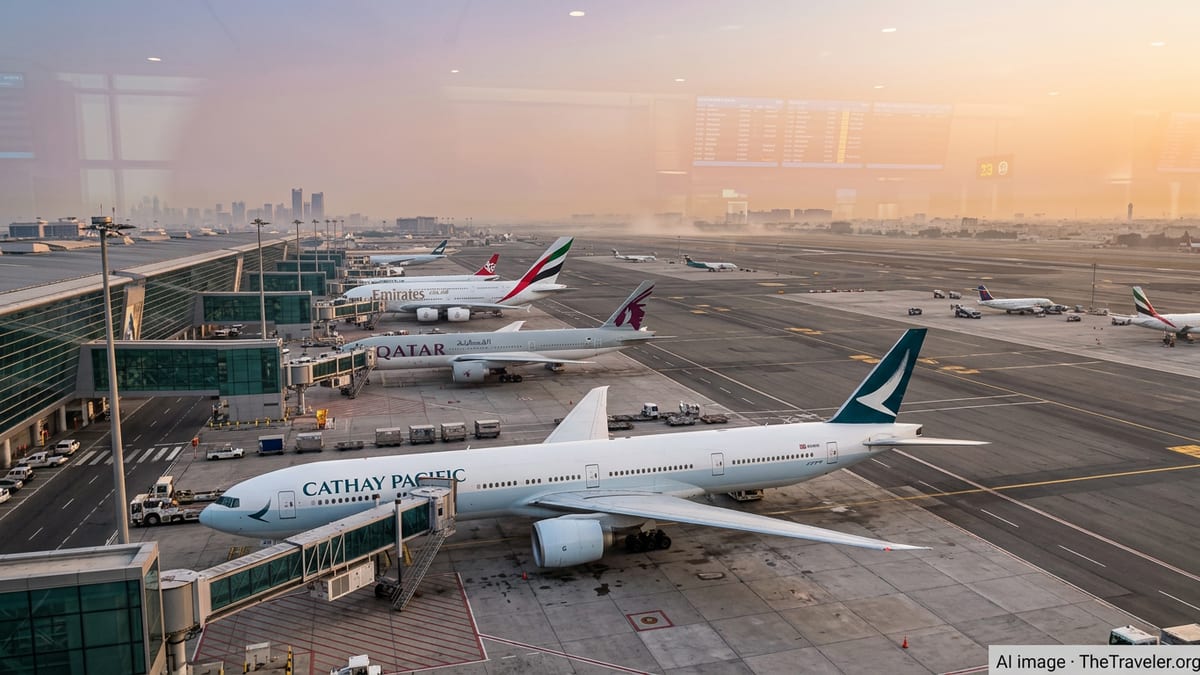
Cathay Pacific Halts Gulf Routes as Tensions Spike
Cathay Pacific has temporarily suspended passenger flights to and from Dubai and Riyadh, joining Middle Eastern giants Emirates, Etihad, Qatar Airways, Saudia and Gulf Air in sharply curtailing services across the region. The move comes after airspace closures and security warnings spread quickly following strikes on Iran and subsequent retaliatory attacks that have put large portions of West Asian skies off limits.
The Hong Kong carrier has blocked new bookings and introduced ticket waiver policies for affected passengers on its Hong Kong–Dubai and Hong Kong–Riyadh routes through mid-March, allowing rebooking, rerouting or refunds without penalty. It is also adjusting some long-haul flight paths to avoid conflicted airspace, adding extra fuel and, in some cases, intermediate technical stops.
While Cathay Pacific’s core transpacific network remains intact, its withdrawal from Gulf gateways underscores how the crisis has spilled beyond the immediate conflict zone. Analysts say the airline’s strong Asia–Europe and Asia–Australia traffic flows, already under pressure from past regional disruptions, now face an additional squeeze as passengers scramble for itineraries that bypass West Asia entirely.
Investor reaction has been mixed. Shares in several Asia-Pacific carriers, including Cathay Pacific, have edged higher this week on expectations that airlines with non-Gulf hubs will capture displaced demand. Yet executives caution that prolonged uncertainty over airspace access, fuel costs and insurance premiums could quickly erode those gains.
Gulf Hub Shutdowns Ripple Across Global Networks
The closures and restrictions affecting airspace over Iran, Iraq, Israel, Jordan, Lebanon and parts of the Gulf have effectively throttled operations at key West Asia hubs. Emirates in Dubai, Etihad in Abu Dhabi and Qatar Airways in Doha have all suspended or severely curtailed flights for periods since February 28, with only limited services resuming via lengthy detours in recent days.
Industry data indicates that thousands of flights into and out of the broader Middle East have been grounded or delayed since the first airspace bans were announced. Gulf carriers, which normally move close to 100,000 passengers a day through their hubs, have been forced to cancel waves of departures, leaving terminals crowded with stranded travelers and aircraft parked on remote stands.
Saudia, Gulf Air and other regional airlines have also trimmed schedules or avoided specific countries entirely, citing governmental directives and evolving security assessments. Some carriers are steering clear of airspace over Israel, Lebanon, Jordan, Iraq, eastern Saudi Arabia and Iran, even where limited corridors remain technically open, in order to reduce risk to crews and passengers.
For the global aviation system, the impact is immediate and structural. With three of the world’s most important connecting hubs constrained at the same time, the normal flow of traffic between Europe, Africa, Asia and Australasia has been disrupted, forcing airlines to improvise and passengers to endure long waits, complex routings and unpredictable last-minute changes.
Thai Airways, Asian Carriers and the New Route Geography
As Gulf hubs falter, Asian and European airlines that can route around the region are emerging as critical lifelines. Thai Airways has reported exceptionally strong demand on its nonstop links between Bangkok and key European destinations, as travelers seek to avoid West Asia transit entirely in favor of more northerly or southerly paths.
Other Asian flag carriers, including Japan Airlines, Korean Air and Qantas, are seeing surging interest in itineraries that connect via East or Southeast Asia rather than the Gulf. Routes that once played a secondary role in Europe–Asia flows are now heavily booked, with some long-haul flights operating at or near full capacity for days in advance.
This rapid redrawing of preferred corridors has commercial as well as operational implications. Airlines with geographically advantageous hubs outside the conflict zone are seizing the opportunity to strengthen their market position, while those tightly tied to West Asia are being forced to pivot towards point-to-point flying, regional routes and strategic partnerships with alternative connectors.
Aviation strategists warn that if airspace restrictions persist, airlines may be compelled to permanently re-evaluate the balance between hub-and-spoke operations and more direct, long-thin routes. For Cathay Pacific and Thai Airways, that could accelerate investment in ultra-long-haul aircraft and schedules designed to bypass traditional stopover points altogether.
Longer Flights, Higher Fares and Complex Detours
For passengers, the most visible effect of the crisis is on journey time and price. With swathes of West Asian airspace closed or heavily restricted, many Europe–Asia flights are being pushed into narrow northern corridors over the Caucasus and Central Asia, or into southern routes looping over Egypt before turning east across Saudi Arabia and Oman where permitted.
These diversions can add two to five hours to typical flight times, depending on origin, destination and available routings. They also require additional fuel and careful planning around potential alternates in case of sudden changes in airspace status. Some airlines have introduced fuel stops at secondary airports, turning what were once nonstop journeys into multi-leg odysseys.
Higher operating costs and reduced capacity are feeding directly into airfares. Travel agents across Asia and Europe report steep price increases on remaining nonstop or one-stop options between major cities, particularly in the first half of March. On certain high-demand routes, economy-class seats that were typically available at moderate prices weeks in advance are now either sold out or commanding multiples of their usual fares.
The strain is felt most acutely by travelers with limited flexibility: migrant workers shuttling between the Gulf and South Asia, students returning to campuses, and tourists at the tail end of peak-season holidays. Many find themselves stranded in transit hubs or forced to accept circuitous reroutings via multiple continents simply to get home.
Uncertain Timelines and What Travelers Should Expect Next
Regulators and airlines have so far offered only short rolling time frames for suspensions and reroutings, often extending advisories and booking blackouts by a few days at a time as the security picture evolves. Some carriers have begun launching limited relief flights, with strict capacity controls and alternative routings, but a full restoration of normal schedules appears distant.
Aviation security experts note that beyond the immediate military risks, airlines are contending with concerns over missile trajectories, electronic interference with navigation systems and the possibility of sudden, unilateral airspace closures. These factors make it difficult for carriers to commit to firm timelines for reinstating their previous networks across West Asia.
For now, travelers are being urged to monitor airline communications closely, keep contact details updated in their bookings and consider greater routing flexibility, including options that avoid the region altogether. Travel insurers and regulators are also facing pressure to clarify what protections and compensation apply when flights are disrupted by rapid geopolitical escalations.
In Hong Kong, Bangkok, Singapore, London and other major hubs, departure boards this week again tell a story of a fragmented sky: canceled flights to Gulf cities, long-haul services flagged with extended durations and a scattering of new, improvised routes. For Cathay Pacific and its regional peers, the challenge will be to keep global connectivity intact while navigating a conflict that has abruptly reshaped the geography of air travel.