

More news on this day
Major Asian airlines and global hotel brands are sharpening their focus on mainland China as inbound tourism accelerates, with Cathay Pacific joining a growing roster of regional carriers and hospitality groups betting on stronger demand from South Korea, Japan and the United States.
Get the latest news straight to your inbox!
Airlines Align to Channel Regional Traffic Into Mainland China
Cathay Pacific has been steadily rebuilding and expanding its network into the Chinese mainland, adding routes such as Hong Kong–Urumqi and bringing its combined coverage in the market to about 20 destinations, according to publicly available network updates. These additions position the Hong Kong-based carrier to funnel more connecting traffic from long-haul markets including North America and Northeast Asia into Chinese cities that are attracting renewed visitor interest.
The push comes as China’s inbound tourism has rebounded sharply since 2024, supported by streamlined entry policies and a wider resumption of international flight capacity. Industry data cited by tourism analysts show that China received nearly 27 million international tourists in 2024, almost doubling year-on-year, with arrivals in early 2025 continuing to climb as visa procedures and payment systems become more user-friendly for foreign travelers.
Publicly available planning documents and investor updates indicate that Cathay Pacific’s strategy increasingly leans on connecting traffic from the United States, South Korea and Japan into its Hong Kong hub, then onward to emerging mainland gateways. That mirrors moves by state-owned mainland carriers and their regional peers to focus marketing spend, schedule planning and partnerships on inbound visitor flows rather than purely outbound Chinese demand.
For U.S. travelers, increased connectivity via Asian hubs is particularly important while direct transpacific capacity to secondary Chinese cities continues to lag pre-pandemic levels. Travel trade commentary suggests that itineraries combining a stop in Hong Kong, Seoul or Tokyo with a mainland destination are becoming a standard way for North American visitors to access China’s newer cultural, technology and infrastructure showcases.
China Eastern, Air China, China Southern and Korean Carriers Step Up Inbound Campaigns
China’s big three state-owned airlines are all participating in a coordinated effort to grow inbound tourism, reflected in recently announced partnerships, new products and joint campaigns with cultural and tourism organizations. Air China has launched inbound-focused programs under the "Hello, China" banner, developing packages and promotional activities that bundle flights with on-the-ground cultural and sightseeing options for overseas visitors.
China Eastern and China Southern are likewise reshaping parts of their international networks to prioritize markets that have shown the fastest rebound in interest in visiting China. Industry reports point to South Korea and Japan as especially strong source markets, followed by longer-haul demand from the United States, Canada and parts of Europe. Carriers are restoring frequencies on trunk routes, deploying widebody aircraft on high-demand city pairs, and working with online travel agencies to highlight visa-free entry possibilities and multi-city itineraries.
South Korean airlines are playing a pivotal supporting role in this trend. Korean Air and Asiana, now operating under a merger framework that consolidates most South Korean full-service international capacity, have been increasing flights to Chinese cities such as Beijing, Shanghai, Qingdao and various secondary markets. Published schedules for the 2025 and 2026 seasons show capacity on China routes reaching around 90 percent of pre-pandemic levels, with further increases planned as demand stabilizes.
Japanese carriers are also rebuilding connectivity with China, although at a slower pace than their South Korean counterparts. Nonetheless, Japanese outbound travel to China is benefitting from improved air links and growing awareness of visa facilitation, particularly among business travelers and younger tourists seeking short-haul cultural trips to cities in eastern China. Airlines in the region are coordinating timetables to enable shorter connections via hubs in Seoul, Tokyo and Hong Kong for visitors originating in the United States and Europe.
Visa-Free Policies and Payment Reforms Boost Appeal for South Korean, Japanese and U.S. Visitors
Policy shifts remain a key driver behind the renewed focus on inbound tourism. China’s introduction and expansion of visa-free entry for selected countries, including a unilateral visa-free trial for South Korean citizens starting in November 2024, have made short-stay trips significantly easier for regional travelers. Official tourism statistics for late 2024 and early 2025 highlight a pronounced rise in South Korean and Japanese arrivals, especially on weekend and holiday city-break itineraries.
South Korean travelers, in particular, have responded quickly. Reports from Chinese provincial tourism bureaus describe higher volumes of visitors from South Korea to destinations such as Shandong, Shanghai and coastal areas, often arriving by air on Friday evenings and returning after two or three nights focused on food, shopping and wellness experiences. Airlines and travel agencies are designing tailored packages timed to these shorter, more frequent stays.
Meanwhile, reforms to digital payments and mobile services inside China are gradually removing a long-standing barrier for independent travelers from the United States and other Western markets. Publicly available updates from major mobile payment platforms indicate that foreign visitors can more easily link international bank cards and access transport, ticketing and dining services through familiar smartphone interfaces. This is encouraging U.S. and European tourists to consider trips that combine major gateways such as Beijing and Shanghai with newer destinations that were previously harder to navigate.
Marketing campaigns by airlines, hotel groups and tourism boards are converging on a similar message: that entering, paying and moving around China is more straightforward than at any time since before the pandemic. Combined with a strong U.S. dollar and competitive airfares as carriers rebuild capacity, this is helping to reposition China as a value-oriented but high-impact long-haul destination for American travelers.
Xiong’an–Daxing Corridor Emerges as a New Gateway for International Travel
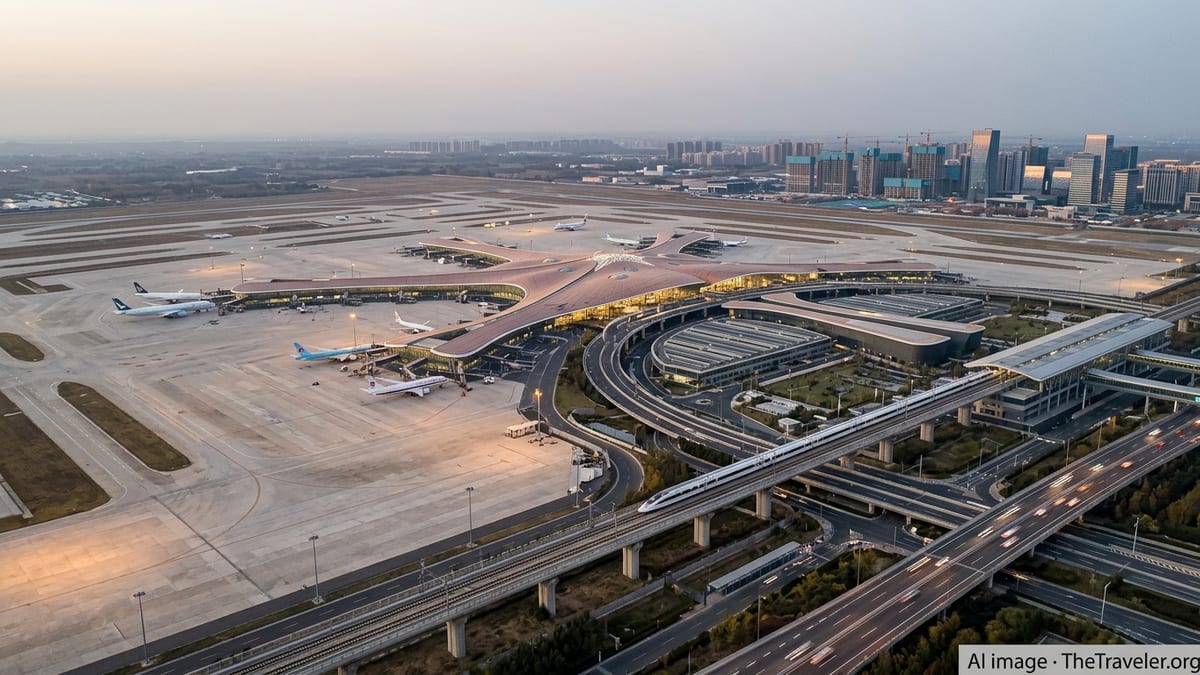
Alongside traditional hubs, the infrastructure corridor linking Beijing Daxing International Airport and the Xiong’an New Area is emerging as a strategic focus for inbound travel. Beijing Daxing, located roughly 50 kilometers northeast of Xiong’an, was designed as a major international gateway for the Beijing–Tianjin–Hebei region and is increasingly used as the primary entry point for visitors heading to China’s newest large-scale urban development zone.
Rail links such as the Jingxiong Express line are set to integrate Xiong’an more closely with Daxing Airport and central Beijing, creating a high-speed triangle that shortens journey times for both domestic and international travelers. Planning documents and official communications describe Xiong’an as a "city of the future" emphasizing sustainable design, advanced transport systems and smart-city infrastructure, which together are expected to draw a mix of business visitors, conference delegates and urban-planning enthusiasts from abroad.
Airlines are beginning to factor the Xiong’an–Daxing axis into their route planning and marketing language. Carriers serving Daxing are promoting connectivity not only to Beijing but also to surrounding development zones in Hebei province, signaling that inbound travelers can fly into Daxing and reach new business districts and cultural sites within a relatively short ground transfer. As long-haul frequencies to Daxing grow, this positioning is likely to gain traction among corporate travel planners and event organizers based in South Korea, Japan and the United States.
For aviation stakeholders, the success of the Xiong’an–Daxing corridor could help spread visitor flows more evenly beyond traditional urban cores. This aligns with broader national objectives to balance development across regions, support new economic clusters and diversify the tourism offer beyond legacy heritage sites and coastal resort cities.
Hilton and Marriott Lead Hospitality Expansion Around Xiong’an and Daxing
The hospitality sector is moving quickly to capture anticipated demand around the Xiong’an–Daxing gateway. International hotel chains, led by groups such as Hilton and Marriott, are opening and repositioning properties to serve both airport travelers and guests headed to Xiong’an’s business and government districts. A growing pipeline of midscale and upscale hotels near transport hubs is intended to provide reliable accommodation, meeting spaces and recognizable service standards for foreign visitors.
Marriott already operates a Fairfield-branded hotel in Xiong’an, located in Hebei’s Baoding area with road access to Beijing Daxing International Airport. Hotel information shows that this property targets business and government travelers working in the new area, but it is also positioned as an option for international guests seeking a base within reach of both Xiong’an and the wider Jing-Jin-Ji region. As the rail connection to Daxing strengthens, hotels in Xiong’an are expected to receive more transit passengers and conference attendees arriving via long-haul flights.
Hilton, for its part, has expanded its footprint around Beijing Daxing with properties such as the Hilton Garden Inn adjacent to the airport district. Public descriptions of the hotel emphasize proximity to the terminal complex and to local industrial and logistics zones, signaling that it is designed to serve both overnight transit passengers and visiting professionals linked to the broader development corridor toward Xiong’an. Similar projects by other international and domestic brands suggest that a full hospitality ecosystem is taking shape around the new gateway.
Industry observers view the parallel growth of airline capacity, airport infrastructure and branded accommodation as a sign that the Xiong’an–Daxing region is being positioned as more than a spillover zone from Beijing. Instead, it is evolving into a distinct node in China’s inbound tourism and business travel network, one that airlines such as Cathay Pacific, China Eastern, Air China, Korean Air, China Southern and Asiana can help populate with visitors from South Korea, Japan, the United States and beyond.