

More news on this day
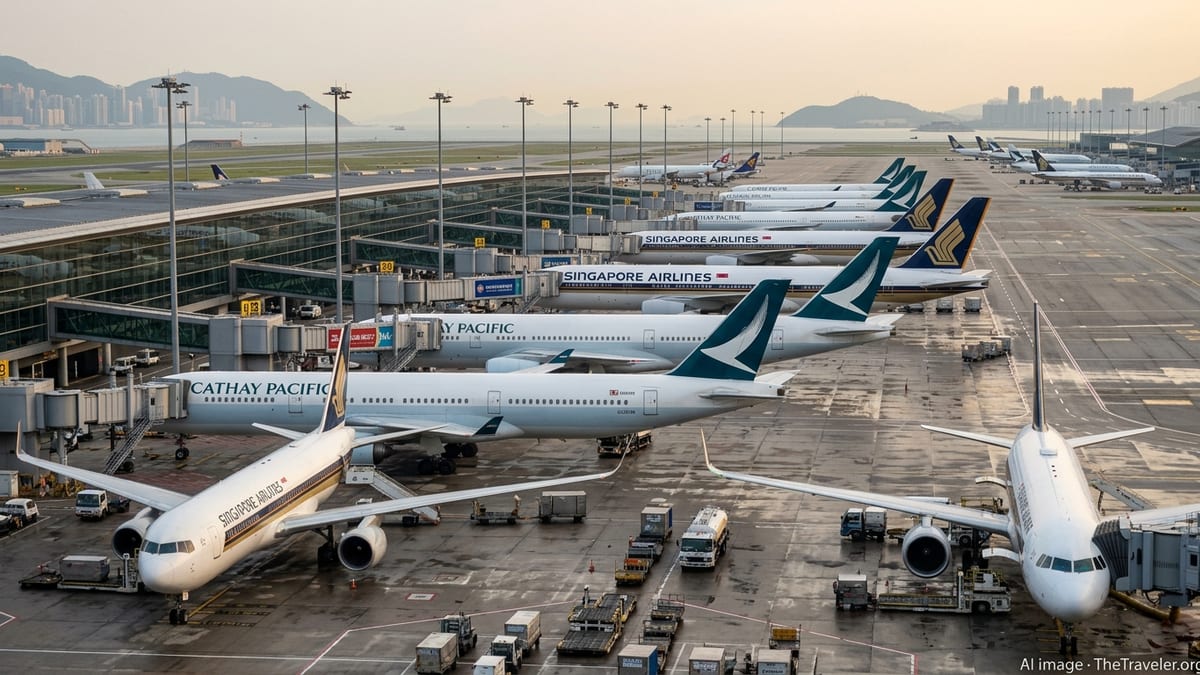
Cathay Pacific and Singapore Airlines are accelerating their European expansion plans, adding capacity and larger aircraft as renewed conflict involving Iran disrupts Gulf air hubs and reshapes long-haul travel between Europe and Asia.
Get the latest news straight to your inbox!
Shifting Long-Haul Traffic Away From Gulf Hubs
Weeks of airspace closures and conflict-related disruptions across Iran and the wider Gulf have sharply reduced the reliability of traditional Middle Eastern hubs that long dominated traffic between Europe and Asia. Publicly available aviation data shows that large portions of regional airspace have been intermittently closed or heavily restricted since late February 2026, forcing carriers based in Dubai, Doha, Abu Dhabi and Bahrain to cancel services, reroute aircraft and cut frequencies on core trunk routes linking Europe with India, Southeast Asia and Australasia.
Reports indicate that long-haul passengers have faced detours of two to five hours on itineraries that once relied on fast, one-stop connections via the Gulf. Analysts tracking the fallout from the Iran conflict describe bottlenecks similar to those seen when airlines first avoided Russian and Ukrainian airspace, but note that this time the congestion is even more acute as several major hubs in the Middle East operate at reduced capacity or remain closed to regular transit traffic.
With travelers and corporate travel managers seeking more predictable itineraries, attention is turning back to Asian gateways that offer nonstop or one-stop connections to Europe without depending on contested corridors. In this environment, Cathay Pacific and Singapore Airlines are positioning their home hubs as stable alternatives, moving quickly to claim market share left on the table by Gulf competitors and some European carriers cutting back exposure to the region.
Industry observers say the shift could mark a structural rebalancing of premium long-haul flows, with Hong Kong and Singapore benefiting from their location on southern or northeastern routings that skirt the most sensitive Middle Eastern skies while still providing competitive timings into major European capitals.
Cathay Pacific Upgauges Europe Network and Restores Frequencies
Cathay Pacific has been steadily rebuilding its long-haul network over the past two years, and the latest Middle East turmoil is accelerating that timeline for Europe. According to published schedules, the airline is deploying larger widebody aircraft, including additional Airbus A350-1000 and Boeing 777-300ER services, on key routes from Hong Kong to London, Paris, Frankfurt and Milan, as it anticipates stronger point-to-point demand and spillover traffic from disrupted itineraries via the Gulf.
Capacity data from aviation analytics providers indicates that Cathay has restored or exceeded pre-pandemic weekly frequencies on several European routes and is planning incremental increases for the upcoming summer season. Some secondary European gateways that previously saw seasonal or limited service from Hong Kong are also returning to the map, reflecting both the rebound in Chinese outbound travel and the sudden need for more non-Gulf connecting options for passengers originating in North Asia and Australasia.
Route-mapping tools show that Cathay’s Europe flights are primarily utilizing northern and Central Asian corridors that avoid Iranian, Iraqi and Israeli airspace. While these paths lengthen flying time compared with historical great-circle routes through the Middle East, the detours are generally shorter than those now faced by airlines whose hubs sit inside or adjacent to conflict-affected zones.
Travel trade reports suggest that corporate clients in Hong Kong, southern China and Australia are increasingly favoring Cathay itineraries to Europe when reliability and schedule certainty outweigh absolute minimum travel time. That trend is encouraging the carrier to maintain high-capacity aircraft on routes such as Hong Kong to London Heathrow and open additional frequencies to continental hubs where alliance and codeshare partners can provide onward connectivity into regional European markets.
Singapore Airlines Taps Premium Demand With Larger Jets
Singapore Airlines, already one of the most active Asian carriers in the Europe market, is also adjusting its strategy in response to the disruption across the Gulf. Publicly available information from the airline’s booking systems and fleet deployment charts shows more Airbus A350-900 and Boeing 777-300ER aircraft assigned to high-demand routes such as Singapore to London, Paris, Zurich and Frankfurt, with selected services upgauged from smaller regional widebodies.
Network planners appear to be concentrating on thickening capacity on existing European trunk routes rather than adding large numbers of new cities in the immediate term. However, schedule filings and aviation industry commentary indicate plans for increased frequencies to key Northern and Western European hubs, aimed at capturing passengers who previously connected via Doha, Dubai or Abu Dhabi but are now looking for routings that circumvent the conflict area entirely.
Singapore’s geographical position allows Europe-bound flights to follow southern paths over the Indian Ocean and Africa or curve north via Central Asia, depending on daily airspace advisories. According to published flight tracking data, many services have adopted slightly longer but stable routings that steer clear of Iranian and Iraqi skies while preserving overnight timings that are popular with business travelers.
Travel agencies in the Asia-Pacific region report stronger inquiries for Singapore Airlines itineraries that link secondary Asian cities to Europe through Changi Airport, especially from markets such as Indonesia, Vietnam and Australia, where travelers would otherwise have connected through Gulf hubs. The carrier’s ability to offer premium cabins with consistent service standards on these rerouted long-haul sectors is viewed as a competitive advantage as fares rise across the industry.
Competition Intensifies as Capacity Shifts to Europe
The redirection of long-haul demand away from the Middle East is prompting a broader recalibration of capacity among airlines that can bypass the conflict zone. European network carriers such as Lufthansa, Air France-KLM and British Airways are fine-tuning their own schedules to Asia, but many have limited bandwidth to add large amounts of new capacity while dealing with higher fuel costs, crew rostering challenges and persistent aircraft delivery delays.
In this context, Cathay Pacific and Singapore Airlines, with relatively young and efficient widebody fleets, are emerging as some of the most agile operators able to respond quickly to sudden swings in demand. Aviation consultancy analysis notes that both carriers are redeploying aircraft from weaker regional markets and delayed mainland Chinese segments into more resilient Europe sectors, where yields have remained firm throughout the recent volatility.
For Gulf carriers, the situation is more constrained. Public reports describe episodes of mass cancellations, operational pauses and ongoing uncertainty about when full hub connectivity will resume. Even when flights operate, extended routings around closed airspace dilute the time-saving advantages that once underpinned the model of using Middle Eastern hubs as global super-connectors.
As a result, booking patterns are starting to favor itineraries that link Asia and Europe via non-Middle Eastern gateways. According to industry booking data referenced in recent travel trade coverage, the share of Asia-Europe traffic connecting through Singapore and Hong Kong has risen since the latest round of Iran-related disruptions, while flows via Gulf hubs have declined. This dynamic is reinforcing the decision by Cathay and Singapore Airlines to prioritize Europe for their scarce long-haul aircraft.
What the Shake-Up Means for Travelers and Fares
For travelers, the rapid reshaping of Europe-Asia connectivity is delivering a mixed experience. On one hand, the expansion of services by Cathay Pacific and Singapore Airlines is helping to offset some of the lost capacity from reduced Gulf operations, preserving a broad range of one-stop options between major cities. On the other hand, rerouting around conflict zones increases flight times and fuel burn, costs that are likely to feed through into higher fares and tighter availability, especially in premium cabins.
Analysts tracking ticket prices across the affected corridors report upward pressure on business and premium economy fares into Europe for departures from East and Southeast Asia, as demand outpaces the additional capacity being introduced by non-Gulf carriers. Economy-class travelers are also encountering fewer deeply discounted seats, with many airlines prioritizing yield management over pure volume while jet fuel remains expensive and flight times remain extended.
Travel management firms advise that passengers seeking to use Cathay Pacific or Singapore Airlines for Europe trips should book earlier than usual and remain flexible on dates and routings. With schedules still subject to short-notice adjustments in response to changing airspace restrictions, itineraries can shift from one day to the next, even on routes far from the immediate conflict area.
Despite the uncertainty, industry observers suggest that Hong Kong and Singapore are well placed to consolidate their roles as leading intercontinental hubs if the Iran conflict and related Middle East instability drag on. The current moves by Cathay Pacific and Singapore Airlines to strengthen their European flight schedules, deploy larger aircraft and lock in new traffic flows could have lasting effects on how global travelers move between Europe and Asia long after the immediate crisis passes.