

More news on this day
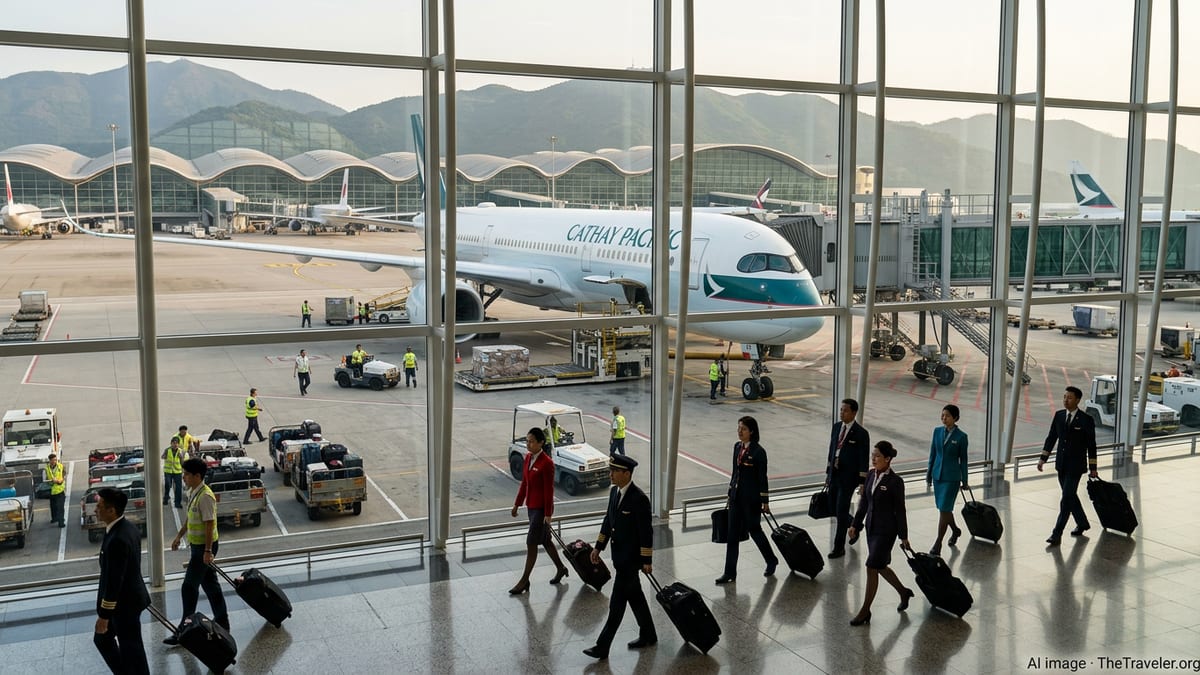
Cathay Pacific’s latest workforce strategy, centered on recruiting about 3,000 new employees, is emerging as a pivotal development for Hong Kong’s aviation recovery and global travel flows, with implications for tourism markets from Europe to Southeast Asia and for hospitality leaders such as Hilton and Marriott.
Get the latest news straight to your inbox!
A Strategic Hiring Wave After Years of Retrenchment
Publicly available information indicates that Cathay Pacific is moving ahead with plans to hire around 3,000 additional staff as part of a broader multi‑year rebuilding effort following deep cuts during the pandemic. Recent coverage of the airline’s efficiency measures notes that this recruitment drive is intended to lift total headcount above 34,000, a level more consistent with its expanding network and restored long‑haul capacity.
The hiring plans come alongside a drive to trim non‑operational and back‑office expenses, with the group targeting cost savings in functions such as marketing and administration to free up investment for technology and operational growth. Reports indicate that this dual approach allows Cathay Pacific to reallocate resources toward front‑line roles, aircraft operations, and customer‑facing services, all of which are essential to meet rising travel demand.
Industry data over the past two years shows a steady return of long‑haul and regional routes from Hong Kong, including restored links to Europe and North America and increased frequencies into key Asian markets. The planned 3,000‑person recruitment is designed to underpin that capacity, providing pilots, cabin crew, ground staff, and commercial specialists needed to stabilise schedules and reduce the operational strain that emerged during the early stages of the recovery.
For Hong Kong, the move signals renewed confidence in the city’s role as a global hub. With the three‑runway system at Hong Kong International Airport ramping up and competition from regional rivals intensifying, Cathay Pacific’s hiring surge underscores a belief that traffic through the city will continue to rise through 2026 and beyond.
Hong Kong’s Labor Market and Training Pipeline Under Pressure
The decision to bring on thousands of new employees in a short period presents both opportunities and challenges for Hong Kong’s labor market. Aviation, tourism, and services sectors are already competing for talent as visitor numbers recover, while housing and cost‑of‑living pressures complicate recruitment and retention for many employers.
Recent reports on Cathay Pacific’s strategy highlight an increasing reliance on diversified recruitment sources, including greater outreach to the Chinese mainland and overseas talent pools for pilots and cabin crew. This approach helps the airline manage local shortages while still anchoring much of its training and management activity in Hong Kong, sustaining the city’s position as a regional center for aviation skills.
Training capacity will be critical. Bringing in 3,000 staff in roles ranging from cockpit to call centers requires expanded simulator time, safety and service training, and onboarding programmes that can maintain operational standards while scaling quickly. Publicly available information on the group’s previous hiring rounds suggests that Cathay Pacific has already been investing in training facilities and digital learning tools to accelerate this process.
For local workers, particularly younger jobseekers and mid‑career switchers, the recruitment wave represents a renewed pathway into an industry that had, until recently, been associated with layoffs and uncertainty. The shift from contraction to cautious expansion is likely to improve sentiment around aviation careers and to support related industries such as airport services, catering, and travel retail.
Spain and Vietnam Benefit from Network Rebalancing
While the hiring drive is centered on Hong Kong, the effects are expected to ripple across Cathay Pacific’s international network, including key leisure and business destinations such as Spain and Vietnam. Industry schedules and airline announcements in recent seasons show more capacity being restored to major European gateways and popular Southeast Asian cities, reflecting robust demand from Asian travelers and a growing flow of inbound visitors.
As Cathay Pacific rebuilds its long‑haul presence, Spain stands to gain from improved connectivity, particularly through destinations that link Asian markets with Mediterranean cruise ports, cultural centers, and sun‑and‑beach resorts. Additional cabin crew, pilots, and operations staff in Hong Kong enable more stable schedules into European hubs, which in turn support tour operators, regional airlines, and local hospitality providers.
Vietnam, one of the region’s fastest‑growing tourism and investment destinations, is similarly positioned to benefit from the airline’s expanded workforce. Higher staffing levels make it easier for Cathay Pacific to add frequencies to cities such as Hanoi and Ho Chi Minh City or to support connecting itineraries that funnel traffic between Vietnam, North Asia, and long‑haul routes to Europe and North America.
These adjustments also align with broader patterns in Asia‑Europe travel, where travelers increasingly prefer one‑stop itineraries through major hubs rather than multi‑stop routings. A better‑resourced Cathay Pacific, backed by 3,000 new recruits, is more likely to deliver the punctuality and service reliability required to stay competitive in this segment.
Hospitality Giants Poised to Capture Travel Spillover
The recruitment surge is expected to deliver knock‑on benefits for global hotel brands, particularly groups like Hilton and Marriott that already have significant footprints in Hong Kong, Spain, and Vietnam. Increased airline capacity and more reliable schedules typically translate into higher room demand from both leisure and corporate travelers, as well as from airline crew rotations.
Market observers note that as Cathay Pacific rebuilds route density on long‑haul flights and reinforces regional connectivity, hotels near key airports and city centers are likely to see stronger occupancy. In Hong Kong, additional overnight stays from transit passengers, business travelers, and returning events can provide crucial midweek demand. In Spain and Vietnam, where seasonal tourism remains a dominant driver, added air capacity can help extend travel seasons and smooth out occupancy across the year.
Hilton, Marriott, and other major operators also tend to benefit from sustained crew contracts and negotiated corporate rates that are closely linked to stable airline schedules. A larger Cathay Pacific workforce, including more cabin crew and pilots, typically requires long‑term accommodation arrangements in key destinations for training, layovers, and rotation management. That creates relatively predictable business for hotels positioned in gateway cities and near major airports.
At the same time, hospitality brands face their own staffing constraints, and higher passenger flows can strain service levels if hotel hiring does not keep pace. The interaction between Cathay Pacific’s 3,000‑person hiring effort and parallel recruitment drives within global hotel chains may therefore shape service quality and wage dynamics across multiple markets.
Technology, Service Quality, and the Future of Regional Competition
Cathay Pacific’s decision to combine targeted job cuts in some back‑office roles with substantial front‑line hiring reflects a broader realignment around technology and customer experience. Publicly available coverage indicates that the airline is seeking savings in administrative areas to fund investments in artificial intelligence, digital tools, and operational systems, all while adding thousands of new staff to support the physical delivery of its services.
This model suggests that new recruits will increasingly work in an environment where digital platforms handle routine tasks and data analysis, while human staff focus on complex problem‑solving, safety, and high‑touch customer interaction. For travelers moving through Hong Kong, Spain, and Vietnam, that could translate into smoother disruption handling, more personalized offers, and faster airport processing, provided that training keeps pace with the technology.
Regionally, the move raises the stakes for rival hubs and carriers that are also racing to rebuild capacity and capture demand. Gulf and Southeast Asian airlines have been expanding aggressively, while airports across Asia and Europe vie for transfer traffic. By committing to hire 3,000 more people and deepen its talent base, Cathay Pacific is signaling that it intends to protect and grow Hong Kong’s status as a preferred transfer point between Asia, Europe, and North America.
The success of this strategy will depend on how effectively the airline integrates new employees, coordinates with tourism stakeholders, and aligns its network with evolving travel patterns. For destinations such as Spain and Vietnam, and for hotel brands from Hilton to Marriott, the trajectory of Cathay Pacific’s 2026‑era hiring push will be closely watched as a barometer of future demand and connectivity.