

More news on this day
Travelers at Paris Charles de Gaulle Airport faced mounting frustration on March 5 as at least 31 flights were canceled and more than 100 delayed, with major carriers including Air France, El Al, Emirates, Etihad Airways and Qatar Airways suspending or rerouting services amid a widening airspace crisis linked to Middle East tensions.
Major Paris Hub Hit Hard by Ripple Effects of Regional Crisis
The disruption at Charles de Gaulle, France’s busiest international gateway, is part of a broader wave of flight chaos sweeping across Europe and the Middle East after multiple countries in the region closed or restricted their airspace in response to escalating conflict. Aviation analytics and passenger-rights monitors reported on March 5 that Paris Charles de Gaulle alone logged 27 to 31 cancellations and around 120 to 130 delays, placing the airport among the hardest hit in Europe.
Flight tracking data and operational summaries show that traffic patterns into and out of Paris have been heavily distorted, with long-haul routes that typically transit Middle Eastern corridors now forced to detour around closed skies. Those extended routings are adding hours to flight times, tightening crew-duty limits and forcing last-minute schedule adjustments that are cascading across airline networks and into major hubs like Charles de Gaulle.
European airports including London Heathrow, Amsterdam Schiphol, Frankfurt and Zurich also reported significant operational strain on March 5, but passengers at Charles de Gaulle are bearing a disproportionate share of knock-on delays as French flag carrier Air France adjusts its long-haul program and partner airlines juggle scarce fleet and crew resources.
Air France, El Al, Gulf Carriers Among the Worst Affected
Air France has been forced to extend and widen a series of suspensions on routes touching the Middle East, in particular services to Dubai, Riyadh, Tel Aviv and Beirut. The airline has confirmed that these flights will remain canceled at least through the end of the week, while it continues to avoid large portions of airspace over Israel, Lebanon, Jordan, Iraq, Qatar, Kuwait, Bahrain, eastern Saudi Arabia and Iran for safety reasons. That strategy, while precautionary, is directly impacting aircraft and crew availability for services operating into and out of Paris.
Israeli carrier El Al, which relies on Charles de Gaulle for European connectivity, is also dealing with a heavily curtailed schedule amid ongoing restrictions closer to home. Passengers booked on El Al services connecting through Paris have reported short-notice cancellations and lengthy rebookings as the airline prioritizes core routes and repatriation traffic.
Gulf carriers are compounding the strain. Emirates, Etihad Airways and Qatar Airways have each suspended or sharply reduced normal operations after the closure of key Middle Eastern airspace and hub airports. With Dubai, Abu Dhabi and Doha operating only limited or special flights, many of their usual Paris-bound passengers are now stranded mid-journey or struggling to secure new itineraries that bypass the Gulf entirely. British Airways and other European carriers serving Charles de Gaulle have also reported delays as they reroute flights to avoid restricted regions.
Scenes of Confusion as Passengers Queue for Answers
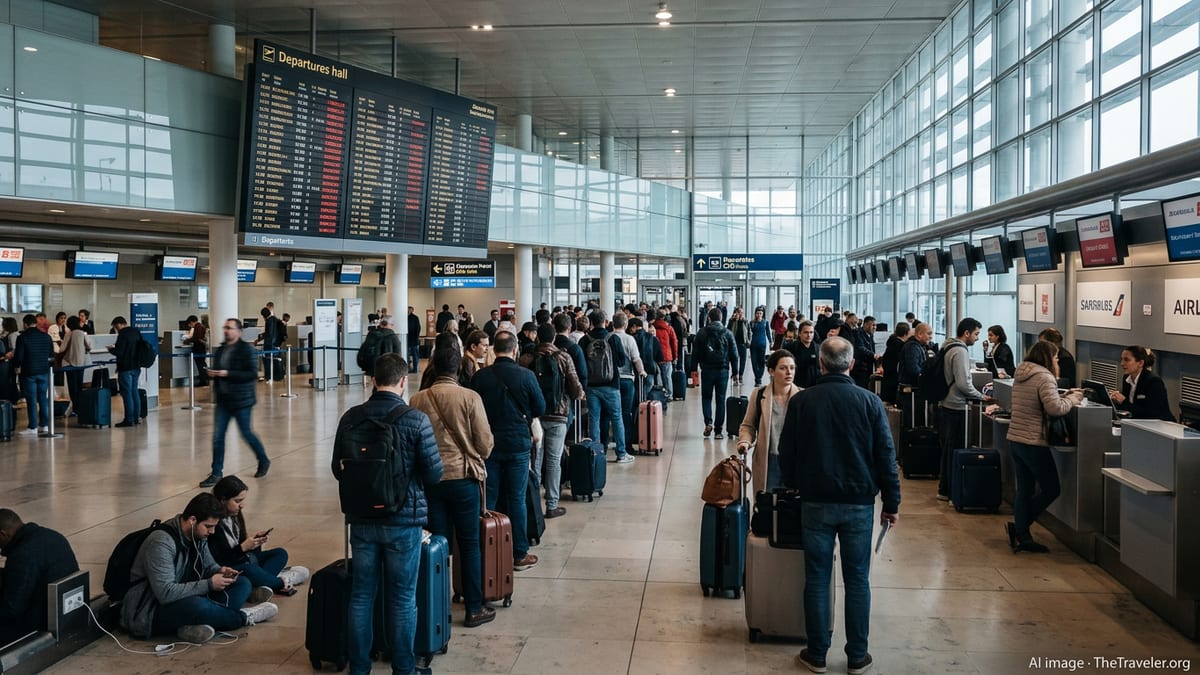
Inside Charles de Gaulle’s terminals, the operational turmoil has translated into long queues at airline counters, crowded departure halls and departure boards dominated by red "canceled" and "delayed" notices. Travelers arriving at the airport early on March 5 described overnight lines at ticket desks and security lanes, with many unsure whether their flights would operate even after clearing check-in.
Families heading to Asia and Africa via Gulf hubs said they were turned away at the check-in desk once staff confirmed that their onward connections had been canceled. Others reported being checked through to Paris with no guaranteed onward routing, leaving them to fend for themselves upon arrival at Charles de Gaulle as they sought alternative connections on remaining European or North American services.
Airlines and airport staff have urged passengers not to travel to the airport without a confirmed, operating booking, noting that walk-up assistance is limited and hotel inventory around the airport is increasingly scarce. Even so, many travelers have continued to show up at terminals hoping to secure standby seats on the few long-haul departures still running close to schedule.
What Stranded Travelers at Charles de Gaulle Can Expect
Experts in European passenger rights note that travelers departing from or arriving into Charles de Gaulle are covered by EU protections that require airlines to provide care and assistance in the event of long delays or cancellations. This typically includes meals, refreshments and hotel accommodation where necessary, along with a choice between a refund or re-routing at the earliest opportunity. However, when cancellations stem from extraordinary circumstances such as sudden airspace closures or armed conflict, airlines may not owe additional cash compensation even though they must still look after passengers.
In practice, the extraordinary scale of the current disruption means that rebooking options are limited. With airspace closures expected to last several days in parts of the Middle East and key long-haul aircraft tied up on extended detour routings, many travelers at Charles de Gaulle are being rebooked days rather than hours ahead. Travel advisors recommend accepting the first viable re-routing offered, even if it involves an unexpected stopover or a different airline, rather than holding out for a direct replacement flight that may not materialize soon.
Travelers are also being encouraged to keep boarding passes, booking confirmations and receipts for meals, ground transport and accommodation. These documents will be essential when seeking reimbursement or asserting rights once airlines stabilize their operations and open formal claims channels for the disruption period.
Outlook for Paris Flights in the Coming Days
While some carriers have started to operate limited repatriation and cargo flights through the Gulf region, there is little immediate relief in sight for normal passenger schedules. Airlines are warning that disruption will likely persist well beyond the formal reopening of individual airspaces as they work through a massive backlog of stranded passengers and reposition aircraft and crews around the world.
For Charles de Gaulle, that means continued pressure on departure and arrival banks, with rolling delays likely even on routes that do not normally overfly the Middle East. Operational planners say it could take a week or more for schedules to normalize, assuming there are no further escalations or new restrictions.
For now, the advice to anyone booked to travel through Paris is simple: monitor flight status constantly, stay in close contact with the operating airline or booking agency, and be prepared for last-minute changes. With major carriers from Air France and El Al to Emirates, Etihad and Qatar Airways still working to reshape their networks around a rapidly changing situation, certainty remains in short supply at one of Europe’s most important air gateways.