

More news on this day
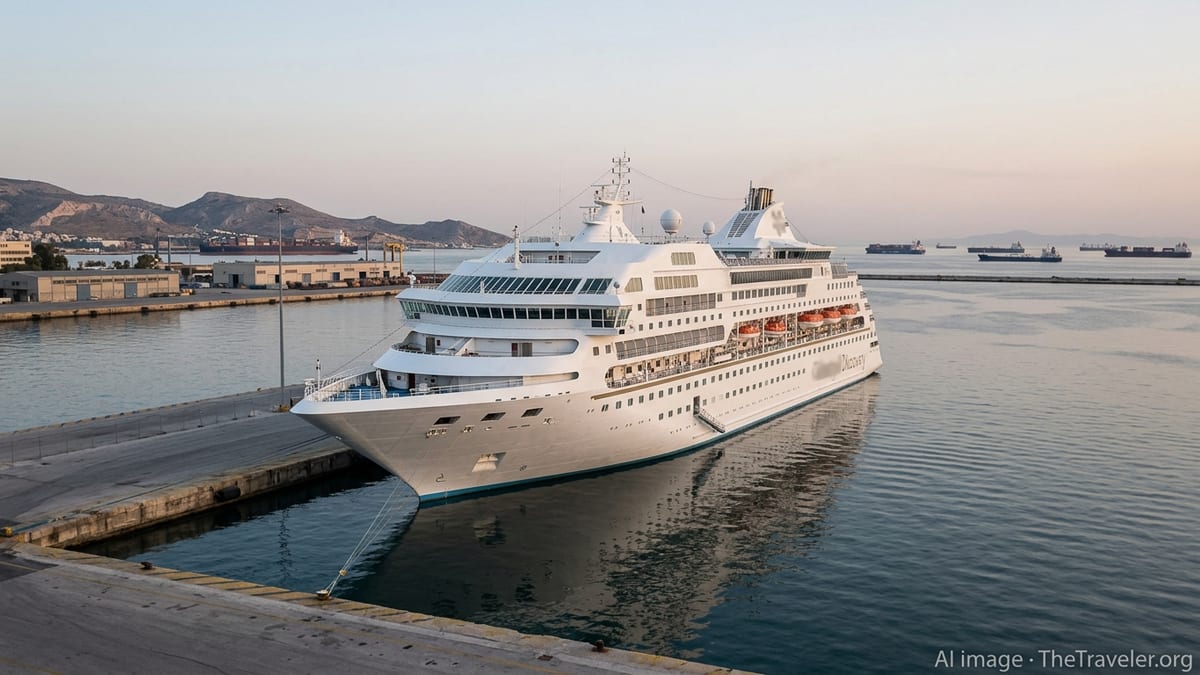
Celestyal Cruises has canceled an April 2026 Aegean Sea sailing on the Celestyal Discovery, as ongoing tensions and operational disruption in the Arabian Gulf continue to ripple into Mediterranean cruise schedules.
Get the latest news straight to your inbox!
Fallout From Arabian Gulf Crisis Reaches the Aegean
The April 2026 Aegean Sea cruise on Celestyal Discovery was scheduled as part of the ship’s early-season deployment from Piraeus, marking its return to short Greek Isles itineraries after the winter in the Arabian Gulf. Publicly available scheduling information and industry coverage indicate that Celestyal has now removed the voyage from sale and notified booked guests that the sailing will not operate.
The decision follows a cascade of cancellations across the region after military escalation around the Strait of Hormuz in late February 2026 led to port closures, blocked sea lanes and widespread security advisories for commercial vessels. Cruise industry reports show that Celestyal had already ended its Arabian Gulf season early and repositioning plans for both Celestyal Discovery and Celestyal Journey have been significantly disrupted.
With the Celestyal Discovery affected by the same web of restrictions and uncertainties hampering other ships in the Gulf, the line has had to adjust its European start-up plans. The canceled April Aegean departure illustrates how far the shockwaves from the Gulf crisis are reaching, even into itineraries that never enter Middle Eastern waters.
Ships Immobilized and Itineraries Redrawn
Throughout March 2026, cruise sector publications have detailed how Celestyal Discovery and its sister ship Celestyal Journey became entangled in the fast-changing security situation, as naval activity and drone and missile strikes reshaped risk assessments for civilian traffic. Some reports indicate that both vessels were held in or near key Gulf ports while authorities reassessed safe corridors and commercial operators evaluated insurance and war-risk exposure.
Earlier, Celestyal had already canceled multiple short Greece departures on Celestyal Discovery in March, including three and four night sailings roundtrip from Athens, citing the knock-on effects of the Arabian Gulf disruption on ship positioning. The additional loss of an April Aegean Sea cruise suggests that the company continues to face challenges bringing the vessel back into its planned Eastern Mediterranean program on time.
Across the wider market, several lines with winter deployments in the United Arab Emirates, Qatar and neighboring states have cut short their seasons, rerouted ships or paused operations in the region entirely. This broader reset of Arabian Gulf cruising has reduced deployment certainty for spring and summer schedules that depend on smooth repositioning via the Suez Canal and eastern Mediterranean.
Security Advisories Tighten Around the Strait of Hormuz
The cancellation of Celestyal Discovery’s Aegean sailing is rooted in a security landscape that has rapidly deteriorated since late February. Maritime bulletins and risk assessments published in early March describe an immediate elevation of ship security levels across the Arabian Gulf, Gulf of Oman, Strait of Hormuz and adjoining waters, following intensified military operations and attacks on commercial shipping.
International coverage of the crisis notes that the Strait of Hormuz, a narrow chokepoint linking the Persian Gulf to global sea lanes, has seen traffic freeze or divert as governments and shipping companies respond to the threat of missile and drone strikes. Container carriers, tanker operators and cruise lines have all reported delays, diversions or suspensions of service as they seek to keep vessels clear of high-risk zones.
For cruise operators, the combination of restricted transit options, emergency surcharges, insurance issues and constrained air connectivity into key embarkation ports has made it difficult to maintain predictable itineraries. The domino effect has reached beyond the Gulf itself, affecting voyages that depend on timely transits through the eastern Mediterranean and on reliable access to shipyards, provisioning hubs and turnaround ports.
Impact on Travelers Booked on the Canceled Sailing
Guests who had reserved the April 2026 Aegean Sea itinerary on Celestyal Discovery are now confronted with changes to their travel plans. Based on patterns seen in earlier Celestyal cancellations this season, impacted passengers can typically expect options such as full refunds or the opportunity to transfer to alternative departures later in the spring or summer, although exact arrangements vary by booking channel and fare type.
Travel advisors are encouraging affected travelers to review their documentation closely and to pay attention to any deadlines associated with rebooking or refund choices. Those with independently arranged flights or pre- and post-cruise stays in Athens may need to coordinate separately with airlines and hotels, as schedule changes driven by geopolitical risk often fall outside standard travel protection coverage unless specific policies were purchased.
For many guests, the lost sailing may also mean missing out on highly anticipated calls at marquee Aegean ports at the start of the season. However, observers note that the decision to cancel, rather than risk a late repositioning or last-minute itinerary substitutions, provides more clarity for travelers than a prolonged period of uncertainty.
Broader Implications for the Eastern Mediterranean Season
The removal of an April Aegean voyage from Celestyal’s program highlights how fragile the early Eastern Mediterranean season can be when it depends on ships arriving from politically sensitive regions. Cruise deployment plans for the Greek islands, Turkey and the wider Eastern Med are often tightly sequenced, leaving limited margins when a vessel is delayed by security disruptions thousands of miles away.
Industry analysts suggest that if instability around the Strait of Hormuz persists, operators may further decouple their Mediterranean programs from winter Gulf deployments, favoring repositioning routes that avoid contested chokepoints. Some lines had already demonstrated this trend by transiting sensitive bottlenecks such as the Red Sea without passengers, and by building more slack into schedules to absorb unforeseen delays.
For now, published information indicates that Celestyal continues to prepare Celestyal Discovery for a broader 2026 Greek Isles season once the vessel is safely repositioned. The canceled April Aegean cruise stands as one visible instance of how the Arabian Gulf crisis is reshaping itineraries, as cruise lines weigh guest safety, operational reliability and commercial viability in an unusually volatile maritime environment.