

I went to the Central Kalahari Game Reserve because I wanted to know what real isolation felt like, not the curated seclusion of a luxury lodge with Wi‑Fi and plunge pools, but the kind of space where your nearest neighbor might be a lion you never see.
I got exactly that, and a few things I was not quite prepared for. It was one of the rawest travel experiences I have had, equal parts awe, anxiety, boredom, and quiet satisfaction. If you have ever romanticized the word “remote,” the Central Kalahari will test whether you really mean it.
Planning A Trip That Refuses To Be Simple
Before I even reached the reserve, I realized Central Kalahari is determined to filter out casual visitors. Nothing about planning this trip was plug‑and‑play. I had to prebook campsites through different operators and the Department of Wildlife and National Parks, then pay park fees separately, then make sure I had the right vouchers on paper because I could not rely on a mobile signal at the gate. Campsites inside CKGR are limited and often booked months in advance, especially the better‑known ones like Deception, Sunday Pan, and Piper Pan. I left my planning a bit late and paid the price in a slightly fragmented itinerary built around whatever sites were still available.
Gate hours were another rigid constraint. CKGR officially opens around 6:30 a.m. and closes at 6:30 p.m. from April to September, and roughly 5:30 a.m. to 7 p.m. from October to March, with minor variations from one information source to another. The key reality on the ground is simple: you must be out on time or risk fines and tense conversations with the rangers. That sounds theoretical until you are 70 kilometers of sandy track away from the gate in failing light, calculating whether you need to speed up on roads where 40 km/h is already optimistic.
What surprised me most was how much bureaucracy and logistics stood between me and the wilderness. Park entry fees are charged per person per day and per vehicle, and they are separate from camping fees. Some gates have working card machines, some do not, and everyone advises carrying enough pula in cash for all your days inside. Road conditions change with heavy rains and can trigger sudden gate or route closures, as happened recently when parts of the reserve were temporarily shut due to flooding. That means you cannot treat your route and dates as fixed. You have to accept that CKGR plays by its own rules, and your trip might bend to them at the last minute.
Getting In: The Long, Empty Road To Somewhere
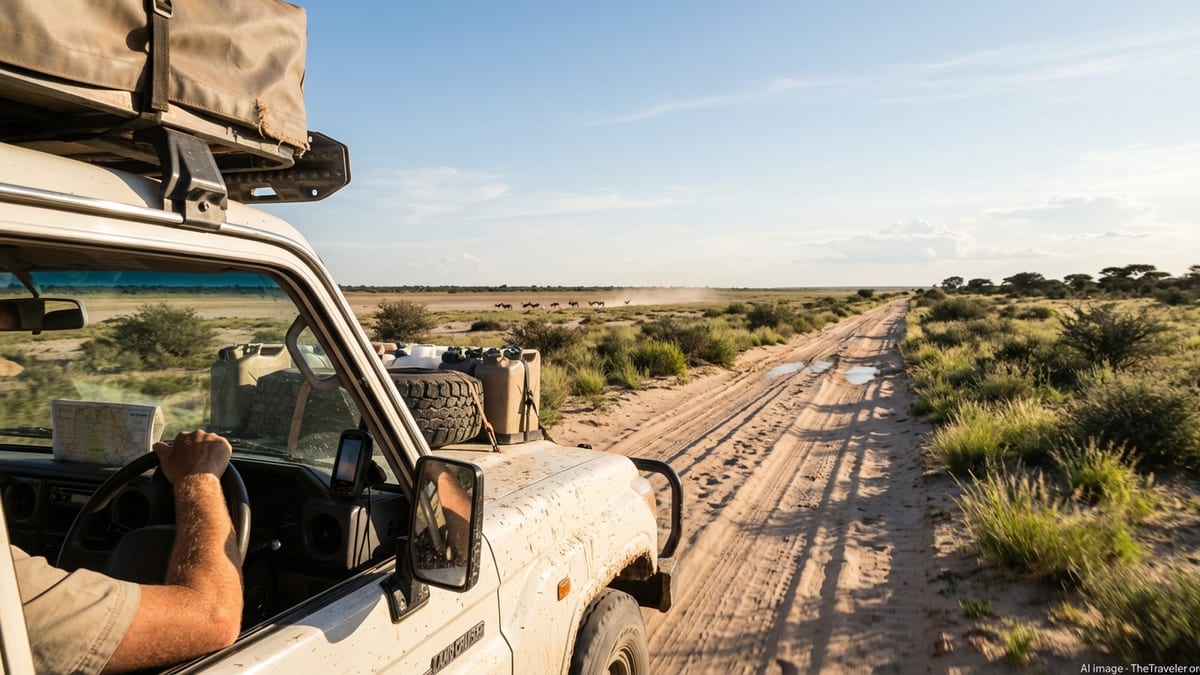
The drive to Central Kalahari felt like a slow peeling away of the modern world. I entered via Matswere Gate, using Rakops as the last realistic place for fuel and basic supplies. Everyone warns you there is no fuel inside CKGR, and they are not exaggerating. You need to carry jerry cans, plan for slow driving on thick sand, and factor in detours. Water is only reliably available at Xade on the western side, and even there it is not drinking quality, so you carry all your drinking water in from outside. I arrived with the car heavier and more cluttered than felt comfortable, stacked with fuel, water, food, and more gear than I would normally take on a two‑week trip.
That level of self‑reliance is exhilarating on paper and a bit sobering in reality. I found myself obsessively checking fuel consumption and water levels, doing mental math after each long game drive. The thought of a breakdown in the middle of a blazing afternoon with no other vehicles in sight for hours was always sitting somewhere in the back of my mind. This is not the sort of park where you hail down a safari vehicle every ten minutes and ask for help. Many visitors travel in a minimum convoy of two vehicles, which in hindsight I wish I had done. I went with one, and while I never had a crisis, I never felt fully relaxed about it either.
The moment I passed through the gate, the park asserted its scale. The Central Kalahari covers around 52,000 square kilometers. I did not see that number; I felt it in the silence, in the long, featureless stretches that passed without a single animal, in how quickly I lost track of landmarks beyond the GPS line on my dashboard. It was both soothing and unnerving. The tar roads were long behind me, and the reserve showed no interest in offering gentle warm‑up sections. It is thick sand, corrugations, and the occasional deceptive patch that can bog you down, from the first kilometers onward.
Campsites, Comfort, And The Reality Of Being Unfenced
I split my nights between a couple of the more talked‑about areas: near Deception Pan and around Sunday Pan. The campsites are as wild as advertised. Many are just a cleared patch, a fire ring, a basic long‑drop toilet, and in some cases a bucket shower or simple standpipe, though you cannot assume running water. There are no fences anywhere. You are camping in the middle of the bush, and the only boundary between you and whatever walks by is the thin fabric of your tent or rooftop camper.
That level of exposure was one of the reasons I came, but I will admit the romance wore thin at about two in the morning on the first night. I woke to the rasping contact calls of lions somewhere nearby, followed by the crunch of hooves and the strange, amplified echo of small sounds in the dry night air. It was thrilling, but it was also hard to go back to sleep with that much awareness of my own vulnerability. Hyena laughed in the distance later that night, and when I shone my torch towards the edge of camp I caught the brief reflection of eyes and a dark shape slipping away. Part of me was exhilarated, part of me counted the hours until dawn.
Facilities are deliberately minimal, and they felt more primitive than I had fully internalized beforehand. If you are used to national park campsites with hot showers and proper ablutions, CKGR is a different universe. You burn your own purchased firewood, carry out your trash, and treat every liter of water as precious. There is no shop, no bar, no small kiosk where someone sells cold drinks. If you forget something, you learn to do without it. I appreciated the purity of that, but I also caught myself longing for a basic communal camp office where I could get reliable updates on road conditions instead of relying on word of mouth and outdated notes in guidebooks.
Wildlife: Fewer Sightings, Deeper Moments
If you come to Central Kalahari expecting the dense, constant wildlife of places like Chobe or the Maasai Mara, you will be disappointed. Game viewing here is about long quiet stretches punctuated by occasional, often intense encounters. I had entire mornings where I saw almost nothing but springbok and gemsbok in the shimmering distance, and then suddenly, on a random bend, I would come across a cheetah lying in the shade of a scrub, or a pair of bat‑eared foxes trotting across the track.
The famous black‑maned Kalahari lions do exist, and I did see them eventually. Ironically, my first sighting was not cinematic. Two males were slumped in the grass well off the track, barely lifting their heads. The heat made them lethargic, and after half an hour of watching them do nothing, I drove off slightly underwhelmed. Later, around dawn at another pan, I glimpsed a female moving along the edge of the open area, her coat catching the early light. That moment felt more in tune with the place: quiet, earned, not arranged for my benefit.
One of my favorite sightings was actually a group of oryx moving across a flat, almost colorless pan at sunset, their silhouettes black against an orange sky. It was not dramatic in the usual safari way, but it was deeply atmospheric. I noticed that in Central Kalahari my standards shifted. I stopped chasing “ticks” and started appreciating the way the light fell on an empty landscape, the way dust hung in the air behind a distant herd, the shock of green after localized rain. It is a park that teaches patience, and if you cannot find some joy in a long drive with very little happening, you will likely be frustrated.
Silence, Scale, And The Mental Side Of Isolation
The Central Kalahari is not just physically isolating; it also strips away distractions. There is often no phone signal, no internet, and very little to do in camp once the sun goes down other than read, listen, and think. I had gone in looking for that digital break, yet on the second night I caught myself reaching for my phone out of habit, then feeling oddly adrift when there was nothing to connect to. It was a small but telling discomfort.
During the day, the sense of scale becomes almost abstract. The pans and ancient riverbeds stretch beyond what your eye can comfortably process. After a few days, the sameness of the bush and the color palette can blur together. I had to work at staying attentive. On one especially quiet afternoon, I drove for three hours without seeing another vehicle. At first that felt like a victory: I was alone in one of Africa’s largest protected areas. By the end of the third hour, it felt more like a weight, a subtle awareness that if something went wrong I would have to manage it myself.
Night in CKGR has its own personality. The sky is astonishingly bright with stars, the Milky Way clearly visible, and there is a steady low hum of insects that turns the darkness into a textured kind of silence. I loved those hours, but again, there were moments of unease. Every rustle outside the tent had a story in my head. I realized how dependent I usually am on artificial light, sound, and other people to dilute my imagination. In Central Kalahari, there is nowhere for your thoughts to hide. You meet your own limits as much as you meet lions and antelope.
Weather, Seasons, And When It Just Does Not Work
Weather in the Central Kalahari is more than background; it can make or break the entire trip. I visited toward the tail end of the wet season, when animals are generally more concentrated around the pans but road conditions are at their trickiest. Recent heavy rains had already led to temporary closures of some routes and partial closures in parts of the reserve. Even once everything officially reopened, rangers were clear that some tracks were still muddy, rutted, and not advisable unless you were experienced at recovering a stuck vehicle.
I hit one section near a pan that looked passable from a distance but turned into a greasy, slippery strip once I was committed. I made it through with spinning wheels and a sharply elevated heart rate, but it was the kind of moment that forced me to reassess my threshold. If I had been traveling alone without recovery equipment, it would have been unwise. The lesson was blunt: in CKGR, you have to respect weather advice, even if it forces you to abandon a hoped‑for route or a specific campsite you were excited about.
On the flip side, the wet, or “green,” season does bring some real rewards. The Kalahari’s normally parched landscape softens, grasses shoot up, and herds move in to take advantage of the brief plenty. I saw more grazing game near Deception Pan than I likely would have in mid‑dry season. The tradeoff is that some days are oppressively humid and hot, and afternoon storms can build out of nowhere. For many travelers, the safer bet is the drier window from about April to November, when mud is less of an issue and driving is more predictable, though waterholes and pans might be less dramatic and the days can be very dusty.
Things That Frustrated Me (And Why I Would Do It Differently)
As powerful as my time in the Central Kalahari was, several aspects did frustrate me. The first was the booking complexity. Different entities manage different campsites, and communication with offices in Maun and Gaborone can be slow or inconsistent. I spent a surprising amount of time before the trip sending emails, following up, and double‑checking that payments had actually been received and processed. A couple of times I was given conflicting information about availability. If you are someone who gets easily stressed by administrative uncertainty, this process will test your patience.
On the ground, signage is minimal. I relied heavily on GPS and offline maps, but there were still junctions where the track on the ground bore only a vague resemblance to the line on my screen. After recent rains, some detours around flooded sections had appeared, and not all of them were obvious. It was not disastrous, but it added cognitive load to already long driving days. I spent more time than I wanted to thinking about navigation instead of simply absorbing the landscape.
Another disappointment, though a predictable one in hindsight, was the limited human contact. I enjoy remote places, but I also like occasional conversations with other travelers or rangers to trade information and impressions. CKGR offers very little of that. Camps are far apart, and often you are the only vehicle at a given site. When I did bump into another party at a pan, there was usually a quick, practical exchange about road conditions and recent sightings, then everyone moved on. It is not an inherently social destination, which is a feature for some people, a bug for others. For me, it was a mixed bag.
If I did this trip again, I would change a few things. I would go with at least one other vehicle, both for psychological comfort and for practical backup. I would plan fewer campsite changes and spend at least three nights in one area to reduce long relocation drives that eat into the day. I would commit more firmly to one season instead of trying to straddle a shoulder period and accept its compromises. In short, I would design the trip around slowness, not around trying to “see” as much of the huge reserve as possible.
The Takeaway: Who Central Kalahari Is Really For
After several days in the Central Kalahari Game Reserve, I left with a strange mixture of relief and nostalgia. Relief because the constant low‑level vigilance of self‑driving, water and fuel management, and weather watching is tiring. Nostalgia because very few places make you feel as small and as quietly privileged as the CKGR does when you are alone on a track with no other humans in sight, watching a line of wildebeest dissolve into heat haze.
This is not a park for first‑time safari travelers who want guaranteed big cat action and comfortable lodges with pools and sundowners. It is not suited to people who dislike logistics or who feel unsettled when offline for days at a time. The Central Kalahari demands more of you: more preparation, more risk tolerance, more self‑reliance, and more patience with long stretches of “nothing happening.” When expectations are misaligned, that can turn into disappointment or even resentment.
But if you are an experienced traveler who craves wilderness in a literal sense, who is comfortable with 4x4 driving, who does not crumble when plans change because of weather or road closures, then CKGR can be quietly extraordinary. The wildlife sightings, when they come, feel earned. The silence is deep enough to reset something in your mind. The lack of infrastructure, while inconvenient, keeps the reserve far from mass tourism. I would go back, but I would go back slower, with better company, and with an even clearer understanding that Central Kalahari is not a conventional safari destination. It is an immersion into space, silence, and the complicated beauty of being alone.
FAQ
Q1: Do I really need a 4x4 to visit the Central Kalahari Game Reserve?
Yes. The tracks inside CKGR are sandy, often deeply rutted, and can become muddy or flooded after rain. A high‑clearance 4x4 is not optional; it is essential for both safety and access. Standard vehicles will get stuck or damaged on many of the internal routes.
Q2: How far in advance should I book campsites?
If you are traveling in popular months, especially around the green season and main holiday periods, aim to book several months in advance. Some of the prime campsites at Deception, Sunday Pan, and Piper Pan are often reserved close to a year ahead by organized tours and repeat visitors.
Q3: Is it safe to camp in unfenced sites with predators around?
It can be safe if you follow the rules strictly. Stay inside your tent or rooftop camper at night, keep food locked away, do not walk around after dark, and avoid leaving any scraps that might attract animals. Lions, hyena, and other predators do move through camps, so respect the fact that you are on their land.
Q4: What are the gate opening and closing times?
Gate hours generally run from around 6:30 a.m. to 6:30 p.m. between April and September, and from about 5:30 a.m. to 7 p.m. between October and March. Exact times can change slightly, so confirm before your trip and plan all driving so you are inside or outside the reserve within those hours.
Q5: Are there any shops, fuel stations, or restaurants inside CKGR?
No. There are no shops, fuel stations, or restaurants inside the reserve. You must arrive fully self‑sufficient with all your food, drinking water, fuel, and basic spares. The closest fuel is usually in Rakops to the east or Ghanzi to the west, and water inside the park is limited and generally not potable.
Q6: When is the best time of year to visit?
CKGR can be visited year‑round, but conditions and experiences differ. The green season from about November to April brings more grazing animals to the pans but can mean muddy, sometimes impassable roads. The drier months from roughly April to November offer easier driving and clearer skies but may feel harsher and more barren in places.
Q7: Can I visit without joining an organized tour?
Yes, self‑drive trips are common, but they require experience. You should be confident with 4x4 driving, basic vehicle recovery, navigation using GPS and maps, and planning for full self‑sufficiency. If any of that feels beyond your comfort zone, joining a guided trip is the safer and less stressful option.
Q8: What kind of wildlife can I realistically expect to see?
You can see oryx, springbok, wildebeest, giraffe, various smaller predators like jackal and bat‑eared foxes, and, with some luck and patience, cheetah and the famous black‑maned Kalahari lions. Sightings are usually less frequent than in more visited parks, so expect quieter days rather than constant animal activity.
Q9: How do park and camping fees work?
Park fees are charged per person per day and per vehicle, separate from camping fees. You usually pay park fees to the Department of Wildlife and National Parks, either in advance in towns like Maun or at the gate, where having cash in pula is strongly advised. Campsites are booked and paid for through a mix of DWNP and private operators, and you must show proof of your campsite booking at the gate.
Q10: Who is the Central Kalahari Game Reserve best suited for?
It is best for experienced, self‑reliant travelers who value solitude, wide open landscapes, and a more demanding style of safari. If you enjoy logistics, do not mind discomfort, and find satisfaction in earned experiences rather than instant rewards, CKGR can be deeply rewarding. If you prefer easy access, frequent wildlife sightings, and more comfort, other parks in Botswana will likely suit you better.